Northern Lights dazzle with colourful light show
The Northern Lights have illuminated the sky across Wales in hues of green and pink.
The spectacular display, known as the Aurora Borealis, can be seen when solar eruptions send particles towards Earth which interact with particles in the atmosphere.
On Monday evening, the natural phenomenon could be seen across Wales, Scotland and Northern Ireland, as well as large swathes of England.
The Northern Lights are typically most visible near the Arctic Circle, but can be seen in other areas at times of high solar activity.
Photos sent to the BBC show dazzling, colourful displays across Wales, including Penmachno in Conwy, Llandegla in Denbighshire, and Narberth in Pembrokeshire.

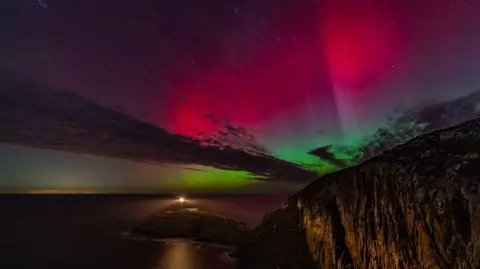 Gail/BBC Weather Watchers
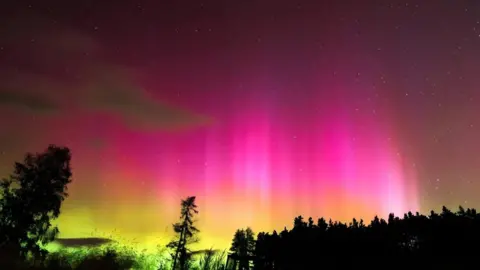 Meinir Lloyd Hughes
What are the Northern Lights?
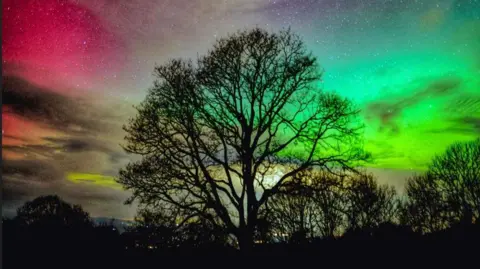 Ruth Davies / BBC Weather Watchers
Monday's spectacular display was the result of a Coronal Mass Ejection (CME) - when the Sun emits really large clouds of particles.
The dramatic colours are produced when those particles hit oxygen and nitrogen gases in the Earth's atmosphere.
Oxygen atoms glow green - the colour most often seen in the Northern Lights - while nitrogen atoms emit purple, blue and pink.
The Met Office said "severe geomagnetic storms" were observed on Monday evening, producing "widespread auroras visible across the UK, with reports extending as far south as northern Italy".
The activity is expected to decline but might remain visible in parts of Scotland and Northern Ireland on Tuesday, forecasters added.
