How to get the best view of the Northern Lights in 2026

 Gary Macleod
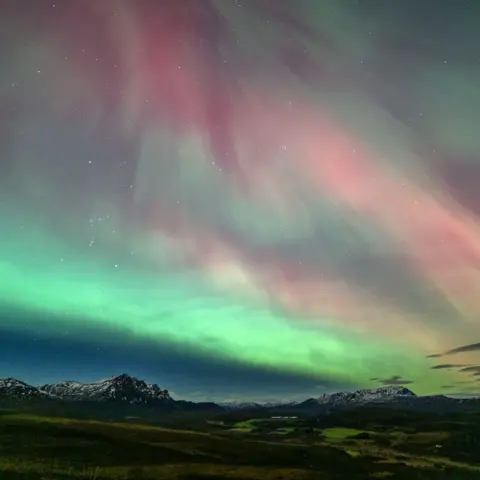
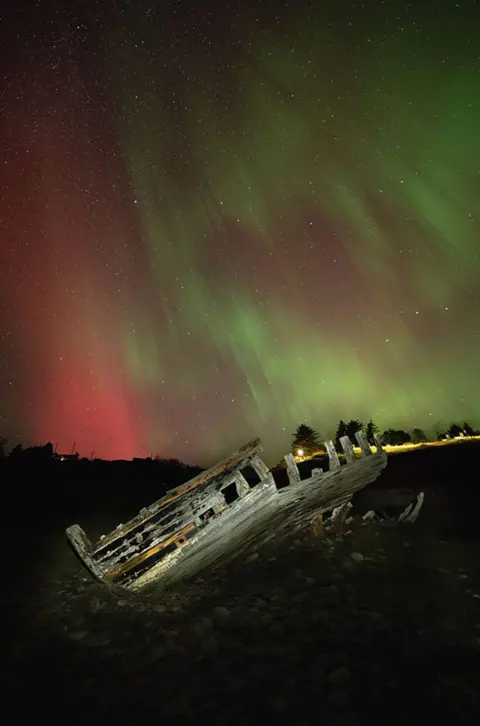
Watching and capturing the vivid purples, reds and greens of the Northern Lights in skies across the UK has become a bucket-list experience for many people in recent years.
"Once you get your first decent sighting it becomes an addiction," says amateur photographer Gary Macleod, who remembers watching the light show for the first time aged eight.
What used to be a once-in-a-lifetime event for people in the UK has become more common in recent years.
And experts say 2026 will be a peak year for aurora-spotting as the Sun has been in a heightened state of activity as part of its 11-year natural cycle.
 Gary Macleod
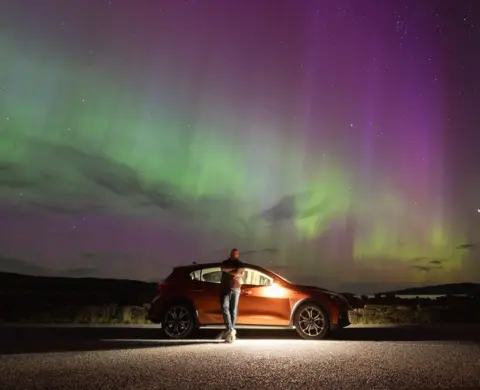
Macleod, who lives in Tongue in the Scottish Highlands, has been photographing the aurora for more than 30 years, but says it is something he'll never tire of.
"Sometimes I switch off the camera and just watch, because there is no better memory card than your own memory.
"People call them the merry dancers and when they are in full flow, they just go bananas – it's amazing to watch."
 Gary Macleod
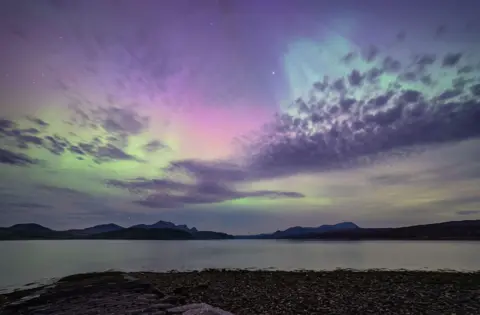
In January Macleod's eldest daughter captured her first images of the phenomenon.
"She has already realised how quickly it can hook you," he says. "It's brilliant to share that interest with my daughter, it ignites more in me and I want to pass on my knowledge."
When can I see the Northern Lights?
The Northern Lights are best seen at night with a clear sky.
"It's serendipitous timing," says Prof Jim Wild, a space physicist at Lancaster University and a member of the AuroraWatch UK team, which lets people know when the Northern Lights might be seen in the UK.
"The autumn and winter months tend to be the best times to see them as there are longer periods of darkness, but the weather also has to be good."
A calm night with no moon and very few clouds are believed to be the optimal conditions for seeing the aurora.
 Gary Macleod
Astronomer Royal for Scotland Prof Catherine Heymans says it is very hard to plan for the Northern Lights as it cannot always be predicted or forecast.
Sometimes you just need to cross your fingers and hope you are lucky, she says.
"When it happens, it is so magical because you see the colours change and sweep across the sky," Heymans adds. "It is very special because it can be quite rare."
Free mobile apps, such as AuroraWatch UK and Glendale, can provide alerts of when the Northern Lights might be visible from the UK.
 Gary Macleod
"Statistically now is the best time to see the Northern Lights," Wild says.
He says the chances of seeing them will drop off in the next year or two and continue to fall until the Sun hits its minimum level of activity.
Where can I see the Northern Lights?
The greatest probability of seeing the Northern Lights in the UK is in Scotland.
"People in Scotland are always on the front line and going to see them before the rest of the UK," Wild says. "For it to be visible in England, it needs to be something quite spectacular."
But there has to be no light pollution, which can be challenging in towns and cities across the UK.
When it's cloudy, light pollution reflecting off the ground can make the clouds glow and look a lot like an aurora.
 Catherine Heymans
Scotland has internationally recognised dark sky sites, which are largely protected from light pollution and recommended for stargazing.
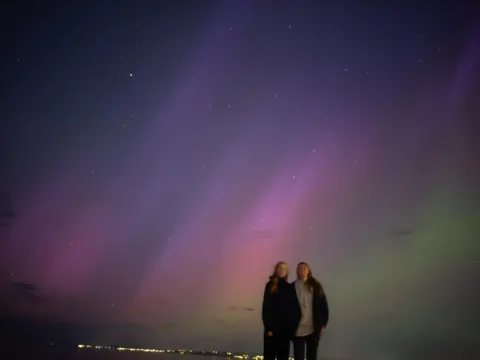
Heymans, who lives in Edinburgh, suggests these are some of the best places to see the Northern Lights.
Galloway Forest Park, the Isle of Rum, Moffat, Tomintoul and Glenlivet in the Cairngorms, North Ronaldsay, Coll and Shetland are all designated dark sky parks.
But Heymans says Portobello Beach near Edinburgh is also a good place for urban aurora spotting as there are few streetlights and it faces north.
How do I know I have seen the Northern Lights?
"What you're looking for with an aurora is a shimmery, silvery cloud," says Heymans.
She recommends using night mode on a mobile phone to take a photo of the shimmer as it will automatically adjust to the low light and amplify what is there.
"If it comes out green, it's more than likely the Northern Lights," she says.
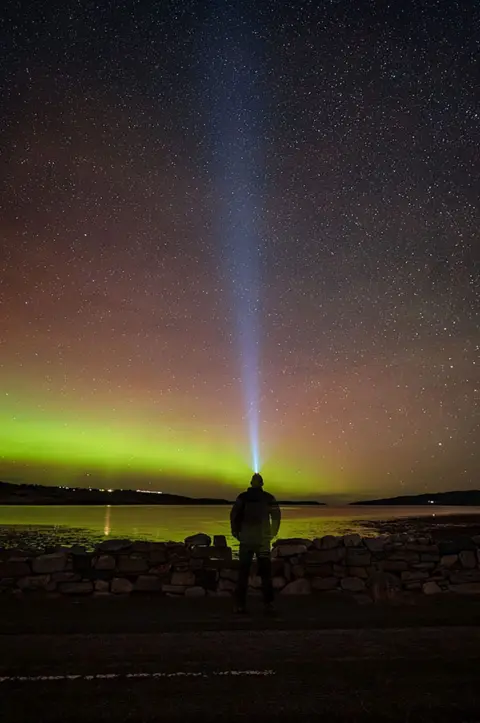
Heymans says the photographs people often post on Instagram can be "false advertising" because the colours of the Northern Lights are not always visible to the naked eye.
 Gary Macleod
In the dark your eyes cannot always distinguish colour, and it can look grey because there are not enough colour-sensitive parts to register it.
Sensors on the phone are sensitive to the red and green colours of the Northern Lights.
"You have an aurora detector in your pocket," Wild says.
But he says the bright light from a mobile phone screen can reduce your dark-adapted vision.
Macleod agrees: "Turn off torches and car headlights, and stop looking at your phone because the light from the screen can affect your eyes acclimatising and adjusting to the total darkness."
What do the Northern Lights look like?
Different gases produce different colours when energised.
The two most common gases in the Earth's atmosphere are nitrogen and oxygen. Oxygen atoms glow green - the colour most often seen in the Northern Lights.
"You mainly inhale oxygen and nitrogen so most of the time the amazing colours come from the same gas you're breathing in," Wild says.
 Gary Macleod
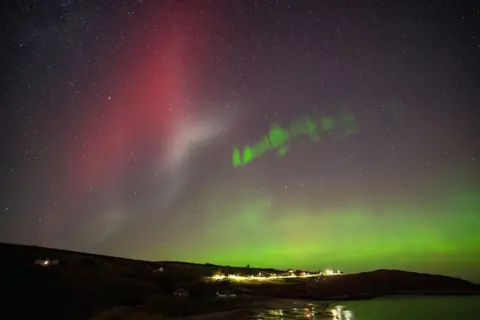
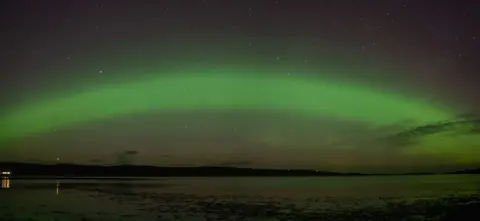
He says a good display of auroras will be shimmering red and green colours mainly, with stripes and patterns that silently move across the sky.
"It can go from nothing to a huge arc or a curtain of light that stretches from horizon to horizon in a few seconds - it really can be quite spectacular and breathtaking."
