'Hotspot' police scheme results in 410 arrests

 BBC
BBCA police scheme to tackle anti-social behaviour (ASB) "hotspots" has resulted in 410 arrests, officers say.
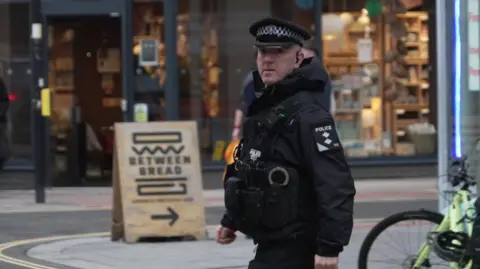
Devon and Cornwall Police said officers had conducted more than 45,000 hours of extra patrols across both counties, mainly targeting 15 areas, as part of the "hotspot policing initiative" which launched in March 2024.
The initiative put more highly-visible police patrols in known problem areas, officers said.
Insp Nathan Johnson, Devon and Cornwall Police, said: "The data tells us where the problem areas are ,and the science shows that, if we put highly visible police patrols there for about 15 minutes, it has a real impact on those."
The scheme was introduced through a £2m investment by the government, with additional funding from the Office of the Police and Crime Commissioner.
Hotspot policing is concentrated in: Barnstaple, Bideford, Bodmin, Camborne, Exeter, Exmouth, Newton Abbot, Newquay, Paignton, Penzance, Plymouth, St Austell, Tiverton, Torquay and Truro.
Figures showed officers responded to 647 incidents across the 15 locations since the additional patrols began in March 2024.
In Exeter city centre, three hotspot areas had seen a 24% decline in anti-social behaviour, according to Inspector Nathan Johnson.
He and his team spend hours patrolling the streets every day.
He said: "You can't police a city centre effectively from behind a car window.
"That is brilliant for other types of criminality, but, to police the city centre, you need to be speaking to people and showing a presence."
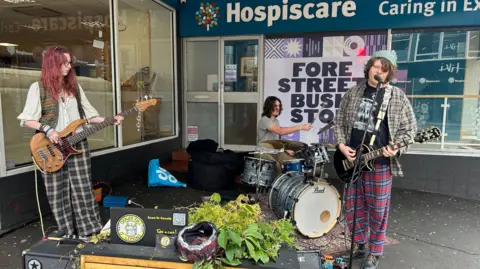
As part of the scheme, Nick Hall, director of the Music In Devon Initiative, said he worked with police and the InExeter business improvement district to help set up a busking spot in Fore Street, one area previously known for drugs and ASB in the city centre.
Signs have been put up, planters built and twice a week artists perform there.
Mr Hall said: "Whilst the music is here, it tends to encourage people to walk past and gather in the area, and we hope it will encourage musicians to use the space on the other days of the week when we are not there."
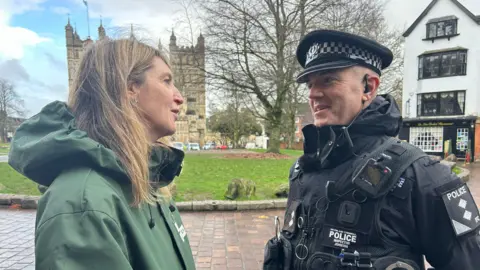
Nicola Wheeler, from InExeter, who works with 670 city centre businesses, said a lot of traders were concerned 18 months ago about the risk of ASB putting people off coming into town.
She said: "In South Street and Sidwell Street, which have notoriously been quite tricky areas, we have seen huge improvements and a lot of our traders are reporting a much more relaxed atmosphere, and a much nicer experience for their customers."
Devon and Cornwall Police said that, while there would be no funds provided by the Home Office for additional foot patrols from May 2026, hotspot policing would remain as part of the force's "business as usual" practice.
Police and Crime Commissioner Alison Hernandez said she recognised the positive impact that street marshals had made on communities' sense of safety, and that she would do all she could to secure extra investment for them to continue.
