Old book reveals daring bid to rescue Charles I

 Leeds Museums and Galleries
The earliest known written account of a daring bid to rescue King Charles I from imprisonment in Leeds has gone on display in the city.
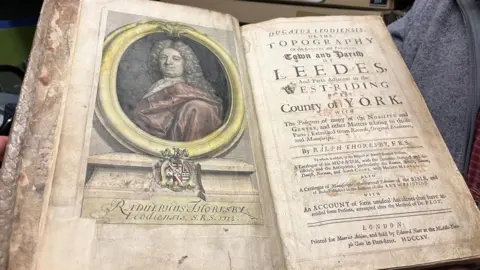
The plot, revealed in Ralph Thoresby's Ducatus Leodiensis - the first major history of Leeds - saw the 17th century monarch offered the chance to escape from Red Hall in the city centre in 1647 by disguising himself in women's clothing.
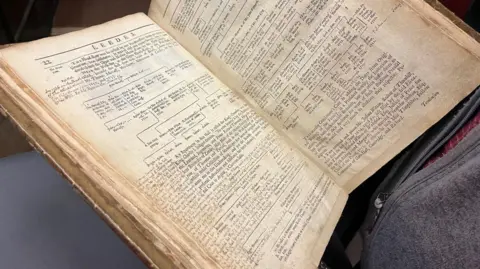
The story from the days of the English Civil War survives in a series of handwritten notes found in a unique edition of the book held at Leeds Central Library.
Printed in the mid‑1740s, the volume is now on public display at the library until the new year.
Charles I was brought to Leeds as a prisoner during the civil war on 9 February 1646 and was held in a room, afterwards known as the King's Chamber, in Red Hall.
According to the notes in the text, it was a servant of wool merchant Thomas Metcalf, called Mrs Crosby, who offered to provide the disguise to the ill-fated King.
The ruse would then have seen Mrs Crosby lead the King out of a garden door on Lands Lane under the cover of darkness before leaving Leeds and his captors behind.
Although the King refused, he handed Mrs Crosby his garter as a gesture of thanks, telling her that if his son ever came to the throne, she was to give it to him and recount the story of how she came by it.
 Getty Images
When King Charles II later came to power years after his father's execution in 1649, Mrs Crosby presented him with the garter and as a reward, her husband was appointed to the prestigious position of High Bailiff of Yorkshire.
Widely regarded as the city's first historian and the son of a merchant, Thoresby dedicated much of his life to the study and collection of the history of Leeds.
First published in 1715, the Ducatus Leodiensis is an antiquarian survey of Leeds and its surrounding region and is widely regarded as the earliest substantial history of the area.
 Leeds Museums and Galleries
Antony Ramm, Leeds Central Library's special collections librarian, said: "Before Thoresby set to work on the Ducatus, Leeds was, of course, already a city steeped in history.
"But his exhaustive research and irrepressible dedication to compiling such a comprehensive record of the city's heritage may well have prevented many of these fascinating events and stories being lost in time."
Listen to highlights from West Yorkshire on BBC Sounds, catch up with the latest episode of Look North.
