Pavarotti given new voice in release of 1995 concert

 Getty Images
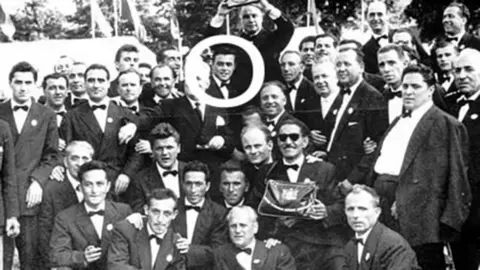
In 1955, a 19-year-old trainee teacher from Italy arrived in Wales with his dad and a small choir to compete in the annual Llangollen International Music Eisteddfod.
The choir consists of amateurs and has little expectation of success but the group from Modena take first place and change the course of singing history.
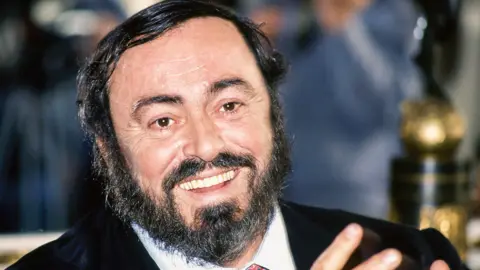
For that 19-year-old was Luciano Pavarotti, who would go on to become the most famous tenor in the world and, arguably, of all time.
For him, that win against the odds showed him that a future in singing might just be possible.
Fast forward 40 years and the world-renowned Pavarotti returned to the Denbighshire town where it all began for him, hosting a concert to commemorate that momentous festival.
Now, recordings of the 1995 concert have been released by the Decca record label to mark what would have been Pavarotti's 90th year and the 70th anniversary of the original event.
Allow Google YouTube content?
The trip to the eisteddfod saw Pavarotti travel with his father Fernando, also a tenor, whose love of music and opera meant the young Luciano was bathed in music from birth.
He was inspired to join Fernando in the Corale Rossini, the choir made up of amateurs in his home town of Modena.
Nicoletta Mantovani, Pavarotti's widow, said the close relationship between the two Pavarottis was an additional reason for Llangollen's importance to him.
"Since he was a kid he was singing La Donna e Mobile [from Verdi's opera Rigoletto] because he said 'my father is a tenor and I am a little tenor'.
"It was in his mind this love for opera. Opera was always played at home and even in the street, so like our pop music now in a way."
 Anna Nguyen/Gulfshore Life
The "famous win" from 1955 stayed with Pavarotti and after he met Nicoletta - his second wife - Llangollen was a name she would come to know well.
"He was speaking about it a lot because for him it was really meaningful," she said.
"He was a very young boy, he was turning 20. It was his first trip abroad, so something very exciting.
"He received such a welcome because they were hosted by local families with the flavour of family, not just professional. It was really a great experience from a human point of view."
Pavarotti really enjoyed getting to know another culture through the visit, but the highlight was, naturally, his first triumph in singing.
"The win – he always described to me that moment I think 1,000 times because he said 'we were there waiting and they didn't call us as fifth, and then not as fourth, and then not as third. Then we start to say, impossible, impossible'. And then they won," Nicoletta said.
"So for him that win stays in his heart for a long time because he was not in his career at that time so everything lasted longer.
"But more than everything he thought if we were able to win as a small choir from a small town in Italy, maybe I can have a chance to have my own career. So that was really a turning point for him."
And so it was to prove.
 Llangollen International Eisteddfod
After Llangollen, Pavarotti focused on his musical training with a new belief.
He made his professional debut in 1961 at the Teatro Municipale in Reggio Emilia near Modena and within a few years had appeared at Glyndebourne and Covent Garden opera houses.
By 1968, he had performed in New York's Metropolitan Opera House and went on to establish himself as one of the giants of the operatic world.
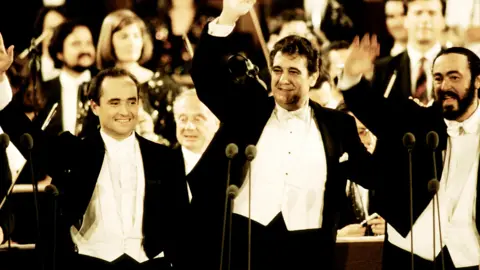
For non-aficionados it was his rousing performance of Nessun Dorma from Puccini's Turandot, alongside fellow tenors Placido Domingo and Jose Carreras at the Italia '90 football World Cup, that cemented him in popular culture.
The BBC used a recording of him singing the aria for their coverage of the tournament, making the song and his voice forever associated with the sport.
The return to Llangollen in 1995 was at Pavarotti's own request, although it took several years of negotiations between the eisteddfod and his representatives to achieve it.
 Getty Images
Nicoletta said: "I knew why he wanted to go back. It was really a very important anniversary. It was so meaningful for him."
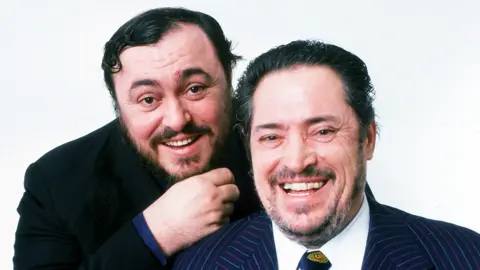
Pavarotti was asked to be president of the eisteddfod for one day of the festival and he said he would do it, but only if he could be joint president alongside his dad.
Speaking at the time, he told the vast crowds: "When they ask me what is a day more memorable in my life and I always say that it is when I won this competition because it was with all my friends.
"With me at that time there was a person that I would like to have the privilege to introduce - my father."
 Getty Images
The concert that followed saw Pavarotti perform alongside the Corale Rossini once again.
As well as the 4,500 audience members, a further 3,000 watched via a screen in Llangollen, and tens of thousands attended an outdoor broadcast of the concert in Swansea.
In addition to the 1995 concert, the new release, entitled The Lost Concert (Live at Llangollen, 1995) includes two recordings from the original 1955 performance by Corale Rossini.
Nicoletta said: "I'm glad Decca decided to include the first participation in 1955 in this wonderful new recording because that was performed by a very young Luciano.
"So if we have to imagine the first time we hear Luciano it is there, even if he's among the choir, but his first performance was this one."
Pavarotti never learned any songs in Welsh but did attempt to show Nicoletta how to pronounce Llangollen correctly - something he had mastered.
She said with a laugh: "He did it right but we had so much fun together trying to teach me. Put the tongue in this way, try to do like 'thl' - I couldn't."
The pronunciation may have eluded her but she renewed the connection between the Pavarotti family and Llangollen this summer when she visited the eisteddfod for the first time.
She presented the Pavarotti Trophy to the winners of the Choir of the World competition, as well as the Pendine Trophy in the International Voice of the Future contest for soloists.
"It was really special for me because through the memories of Luciano, I found exactly what he told me about the people, about the places. It was like a discovery of the memory.
"I could see the people there were so full of spirit and joy like he described."
