How landslides affect rail travel

 Getty Images
If you're a regular train user, you may have experienced delays caused by landslides.
But what are they and why do they cause so many issues?
After a landslide in the New Forest led to a line closure and significant disruption, we've taken a closer look at the impact they have on Britain's rail network.
What is a landslide?
A landslide – also known as a landslip – is when rocks, earth and debris fall from a natural slope like a cliff, hill or mountain.
Why do landslides happen?
In scientific terms, landslides occur when the force of gravity acting on a slope exceeds its resisting forces.
They can happen suddenly or over long periods of time and take place most frequently after periods of heavy rain when the ground is saturated with water.
Other factors that increase the chances of a landslip include:
- Prolonged hot or dry weather
- Cold weather
- Wind and storms
- Erosion
- Vibrations caused by traffic or construction work
It's believed that climate change could lead to an increase in landslides due to an increase in extreme weather conditions.
How do landslides affect rail travel?
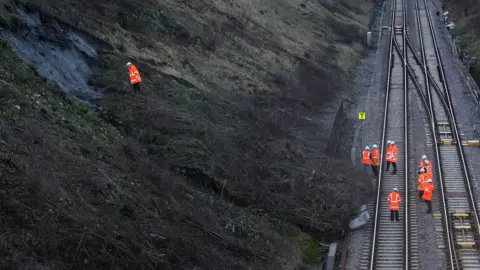
Unlike vehicles on the road, trains are unable to swerve to avoid debris if it falls onto a railway line. This means services often have to be re-routed, leading to delays while Network Rail engineers remove the blockage.
Any debris has to be removed from the line and infrastructure needs to be checked to ensure it is safe.
When a landslide takes place, the slope is often weakened, making further slips much more common.
Sometimes slopes on either side of a set of railway tracks need to be strengthened by improving drainage or adding stronger materials such as steel rods or soil nails.
This work to stabilise the earth can take time and lead to significant disruption.
 Getty Images
How common are landslides in the south?
According to a Freedom of Information request submitted to Network Rail by New Civil Engineer, the British rail network experienced 147 land movements between 1 May 2023 and 30 April 2024.
The Southern region, which includes Dorset and Hampshire, experienced the highest number at 45.
How dangerous can they be?
Though landslides most typically result in travel delays and structural damage, they can have more serious consequences.
In 1995, a train was derailed at Aisgill after hitting a landslide on the Settle to Carlisle line and was subsequently hit by another train.
A guard died and nearly 30 people were injured.
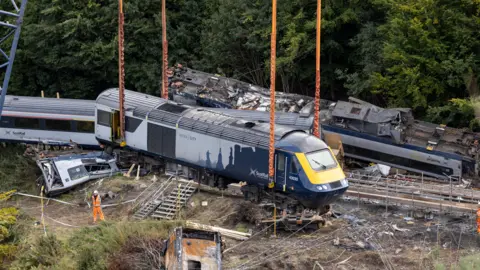
A train derailed at Carmont in Aberdeenshire on 12 August 2020 after hitting a landslide following heavy rain.
Three people died and six were injured in the incident.
Network Rail was fined £6.7m in 2023 after admitting a series of failings which led to the deaths.
Of the 87 people on board, four were left with minor injuries but no-one required hospital treatment.
What work is being done to mitigate the impact of landslides?
Network Rail uses helicopters equipped with laser imaging, detection and ranging to identify sites prone to landslides.
Where sites are at risk, motion sensors and CCTV are used to detect soil and rock movement. These sensors set off an alarm if a risk is detected and the area will be inspected by engineers.
Slopes can be stabilised by putting in drainage or using steel rods or soil nails.
If these options are not enough to fix the issue, Network Rail will re-profile the slope to reduce its angle, making it less prone to landslides.
Network Rail deploys people and resources to areas under flood warnings by the Environment Agency and Flood Forecasting Centre.
You can follow BBC Hampshire & Isle of Wight on Facebook, X (Twitter), or Instagram.
