From Sexhow to Crackpot: Quirky place names explained

 Google
From Blubberhouses to Crackpot and Fryup to Sexhow, North Yorkshire is a festival of funny place names, with many a hamlet observed through fits of giggles inside passing vehicles. But have you ever wondered where the strange names come from?
Archivist Alexandra Medcalf was curious - and found some of the county's more tittersome monikers were derived as far back as the 12th Century.
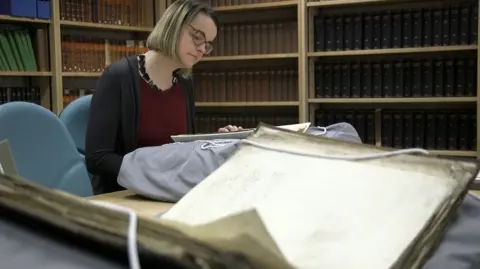
In 2019 she digitally preserved the Yorkshire Historical Dictionary, a book which began life through the work of noted historian Dr George Redmonds, who specialised in the origins of place names and spent 60 years collecting unusual words on postcards.
In doing so she helped fill in the details of the unusual place names for future generations.
So, if you're in the Yorkshire Dales or North York Moors and you spot a Boggle Hole or a Great Fryup, once the laughter and innuendos have calmed, Medcalf's research means the answer to the weird name puzzle is just a quick web search away.
Here's a few of her discoveries to get you going.
Sexhow
Sexhow, 18 miles (28km) north of Thirsk.
More platonic than it sounds.
Medcalf said: "It had quite a few different versions of its name going all the way back to the 12th Century and I think they've always been relatively unintentionally hilarious.
"We've had Sexhow, Saxhow, Saxho and Sexho. All hilarious, but none of it means what you think.
"It's two parts. Part one: Sex. It could be someone's name, Sec or Secca, which is a Scandinavian name, but it could also be a variation on six.
"Part two: How. That can mean either hill or an artificial mound.
"So possibly Sexhow means the ancient site of six hills or six burial mounds."
Blubberhouses
 Google
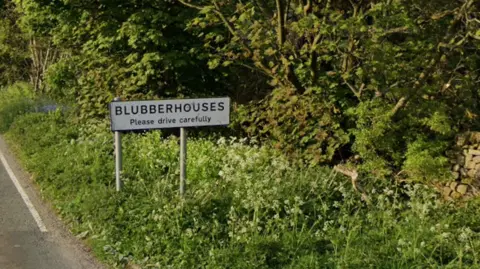
Blubberhouses is a village on the A59 between Harrogate and Skipton.
Was there blubber, were there houses? Had someone taken a whale up Yorkshire hills and built homes out of them?
Medcalf said: "One source states there were sheds on the moor used to store excess animal fat for agricultural or industrial use, up high above Harrogate, so that the people of Harrogate would not be offended by the smell.
"But the name goes back to the 13th Century at least, so I'm not sure just how elegant Harrogate was at the time, or how picky they were about the smells.
"Another theory suggests there was an orphanage up there and the children were crying, but that's absolute nonsense.
"Probably it comes from Middle English 'blueber', meaning a bubbling stream.
"So Blubberhouses translates to houses by the bubbling spring or houses at the bubbling stream."
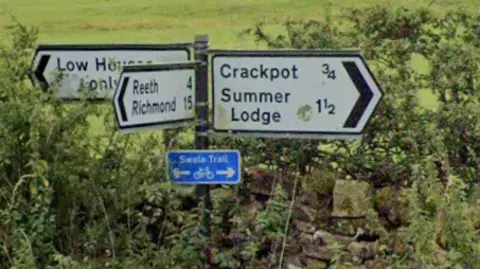
Crackpot
Crackpot is a small village in Swaledale known, among other things, for its dramatic limestone scenery. It is near the River Swale and close to the village of Reeth.
Medcalf said: "The pot part is used all over England for geographic features.
"In the North West it's used to mean a deep wet hole, but in North Yorkshire it specifically means a split in limestone rock.
"The 'crack' part is from Scandinavian 'Kraka' which means crows.
"So Crackpot is a rift in the limestone where crows abound.
"Why name it like that?
"Crows are an important omen in folklore - we still give respect to magpies for example.
"So maybe a Viking really upset a crow and that's why he needed to know about the Crackpot."
 Alexandra Medcalf
In a break from expounding on those unusual place names dotted about North Yorkshire, Medcalf, 39, explained where her drive to preserve their origins came from.
She said: "Since I was a kid I've been interested in the history of language. I realised you can look at words and places and it gives you a glimpse back into what was there before.
"And the language they used gives you a glimpse of how they saw their landscape."
Fryup
 Google
No eggs or bacon involved.
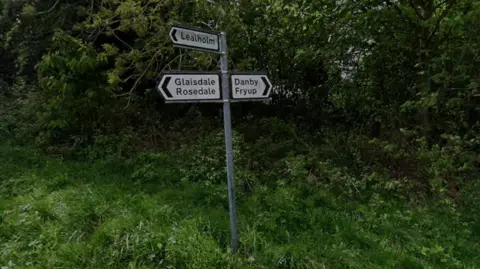
Fryup sits 19 miles (30km) west of Whitby in the North York Moors National Park, separated into two valleys: Great Fryup Dale and Little Fryup Dale.
Medcalf discovered it was a contortion of the name Friga and the word "hop" resulting in Friga's Valley.
She said: "A hop (sometimes 'hope'), was a small valley, sometimes specified as a valley through which a brook runs. You can find it in place names across northern England, not just in Yorkshire. Although it is in Yorkshire that it has often changed to, or is pronounced as, 'up'.
"We're unclear about who exactly Friga was. Some people claim Friga was an Anglo-Saxon princess, although there's no source for that, and she'd have been far more likely to have been Norse with a name like Friga.
"But Frigg/Friga/Freya, was a Norse goddess, the wife of Odin and the source of the word Friday (Frigg/Friga/Freya's day).
"So it's possible there was a religious connotation to the name that has been lost to time."
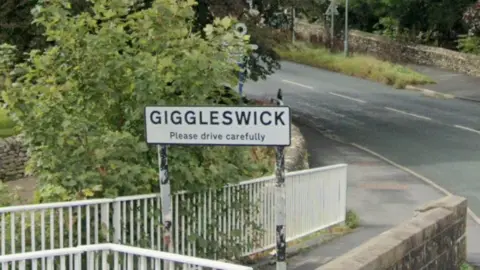
Giggleswick
 Google
Giggleswick is six miles (9.6km) west of Malham Cove and less than one mile from the town of Settle.
Medcalf said: "It breaks down into a personal name, 'Gikel/Gichel' and 'wick'
"It's impossible to know after all this time who Gikel/Gichel was, or if he was any fun.
"But thanks to the place name we know that he had a 'wick' – some sort of dwelling-house or farm building (or collection of buildings), in that place."
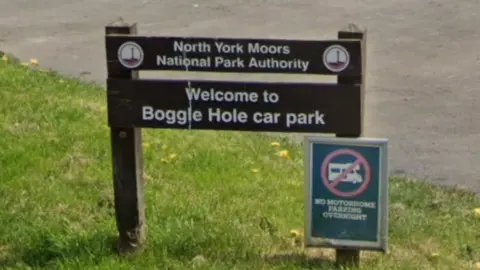
Boggle Hole
 Google
"This one I can't substantiate from any of my usual sources," Medcalf warned, "so it might need a pinch of salt."
She said: "But certainly boggle is an old dialect term for a goblin, spirit or ghost and hole, topographically, can mean different things, including ditches and watercourses, as well as holes in the ground.
"Knowing the place, though, it seems likely to refer to the cave.
"Therefore, we have a cave which is associated with creepy things or apparitions.
"Robin Hood's Bay, nearby, was a hot-spot for smuggling in the past, so it's possible the story was put about to stop excisemen (and others), poking their noses where they weren't wanted."
There you have just a few of the plethora of peculiar place names North Yorkshire possesses.
Asked if more people should delve into the world of place names provenance, Medcalf said: "Oh, definitely.
"There's been a long discourse about the decline of dialect and that it's our kind of local culture, but it's still surviving in all sorts of places.
"And that kind of regional language survives in our place names.
"So it's a really good place to start to get a better feel for our shared history and our shared culture. Like what it means to be from Yorkshire."
Listen to highlights from North Yorkshire on BBC Sounds, catch up with the latest episode of Look North.
