The fish raising charity funds since the 19th Century

 BBC/Oliver Wright
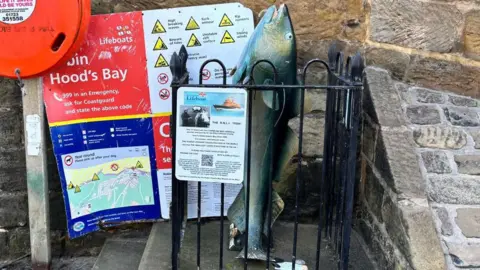
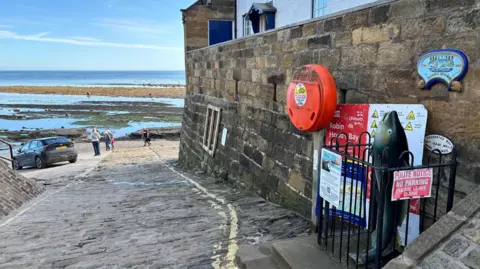
Overlooking the sea on the North Yorkshire coast an unassuming - if unusual - Grade II listed sculpture can be found.
Despite its diminutive height, the cast iron codfish has been a fixture in Robin Hood's Bay since the late 19th Century, and is fondly thought of by visitors and residents alike.
But it is not just a quirky attraction; according to Historic England, the fish could be the oldest collecting box still in use by the Royal National Lifeboat Institution (RNLI).
Meanwhile, a sign on the railings surrounding it suggests it may be the oldest collecting box in the world as well as the smallest listed structure in the UK.
And, according to Jim Foster, chairman of the Robin Hood's Bay Lifeboat Branch, it also offers a glimpse into the maritime history of the coastal village.
"People think Robin Hood's Bay is a fishing village, but in the second half of the 19th Century there were three times as many people involved in the shipping trade as there were in the fishing trade," he says.
"It developed, possibly through the finance of smuggling, but there were 170 ships owned by people in this village at that time, which is amazing when you think about it."
The ships would travel south transporting coal - an often treacherous journey, Jim says, which is why the lifeboat station in the village was especially important.
 BBC/Oliver Wright
Feeling compelled to give back to the people who saved so many lives, local sailor Captain Issac Mills installed the sculpture in around 1885.
Weighing more than 17st (108kg) and standing at 3ft 9in (1.2m) tall, the fish has been maintained over the last century, but hasn't always stayed in Robin Hood's Bay.
"Back in 1963, Leeds University demolished the old coastguard station here, and the fish was taken away while they created a new marine laboratory," Jim adds.
In the 1970s, the fish was removed again, for emergency welding, after its tail broke off, but it has largely escaped mishaps since.
In 2006, it was registered as a listed structure by Historic England.
Although Robin Hood's Bay has not had a lifeboat since 1931, the money given to the cod goes to the RNLI.
There is a certain lore around what happens when the fish receives the donation too, with people reporting to have seen it move - although that is seemingly up for debate.
"It's true of course," Jim says with a wry smile.
"You need to try yourself - put a penny in the slot at the top, and watch the fish's tail move."
Listen to highlights from North Yorkshire on BBC Sounds, catch up with the latest episode of Look North.
