'My next-door neighbour was a Spitfire pilot'

 MoD/PA Wire
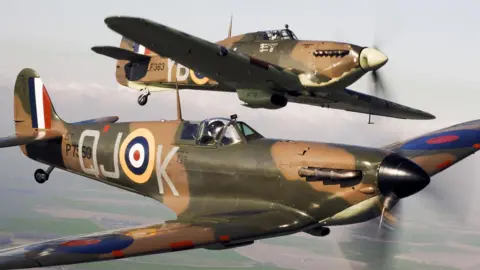
The Spitfire took its maiden flight 90 years ago this month. Hidden East Yorkshire's Sally Fairfax recalls growing up next door to a pilot who flew the plane in combat during the Battle of Britain and was later imprisoned in the camp made famous by the Great Escape.
When I was growing up, Bob Morton was my next-door neighbour, a kind and joyful man.
He used to come round for Sunday dinner and feed our cat when we were away. And, because he knew I liked to sing, he would get his gramophone and play Paul Robeson records.
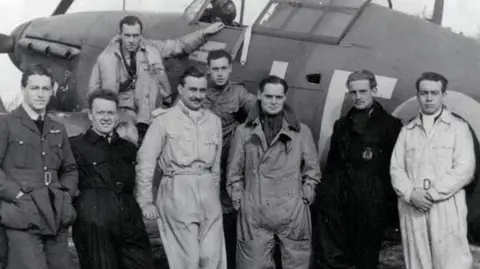
But, during World War Two, Bob was a Spitfire pilot and, for a time, the wing-man of Douglas Bader – the famed RAF ace who lost both legs in a crash, but went on to become one of the leading pilots in the Battle of Britain.
 Ron Fairfax
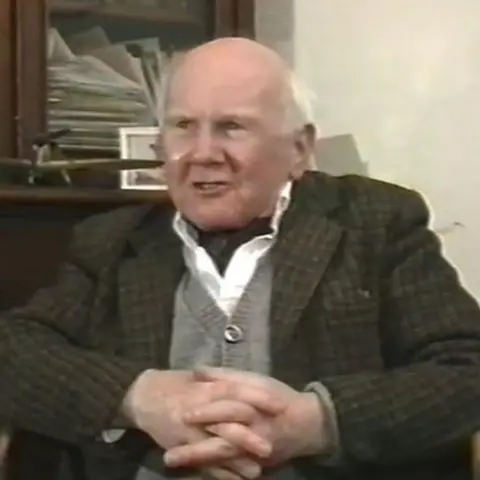
Bob was interviewed by my dad, Ron Fairfax, for his film Hull at War: The Blitz.
"We first met Bob when we bought the house in 1978," Ron recalls.
"Right from the beginning, we found Bob an extraordinarily interesting personality.
"But Bob was also a very modest kind of man. It was quite some time before I discovered that he'd had this experience – that he in fact was a Spitfire pilot.
"He said it was really quite a remarkably easy plane to fly. You switched it on, turned the fuel line on and there was a lever at the side that went, effectively, fast and slow."
Bob was stationed at RAF Kirton-in-Lindsey, Lincolnshire, in 616 Squadron.
In footage from Ron's film, he describes taking part in a dogfight with two German Messerschmitts.
"I had read in the Modern Boy, years before, that if two aircraft – a British aircraft and a German – were doing a head-on attack, the British pilot would never break away. They left that to the Germans.
"Well, I found myself doing a head-on attack with a Messerschmitt and I was holding my fire until I saw the smoke coming out of his gun muzzles, and suddenly he wasn't there.
"It wasn't bravery – I was just too dim to think of breaking away. I didn't realise our closing speed must have been 500 miles an hour."
In 1941, Bob was shot down over northern France.
"He landed very, very gently in a cornfield, not far from Saint-Omer," Ron says.
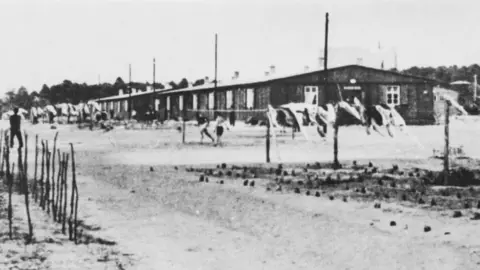
"He then went through a number of different prison camps before he actually arrived at Sagan, which was made famous by the Great Escape."
 Keystone/Hulton Archive/Getty
His time as a prisoner of war resulted in one of his most extraordinary stories.
Bob came from a theatrical family and, in addition to a few aborted escape attempts, he told us that he spent his time in the prison camp putting on concerts and plays.
One day he was rehearsing with a group of his friends and the camp's deputy governor came over to ask about the play they were reading. Bob explained and the deputy asked what they would do for costumes.
When Bob said they would make them, the deputy asked whether they would like to wear professionally made costumes instead.
Soon, the deputy arranged to send Bob to Berlin, accompanied by a German guard, where he visited a theatrical costumiers and was given a hamper of clothes to put on the play.
 IWM/PA Media
So, what was Bob's connection to Douglas Bader?
"For a time, Bob was at Tangmere [in West Sussex], which is where Bader was," Ron says.
"He said Bader was quite brusque. He was a difficult man but an excellent leader of the men he flew with."
Bader's story was later told in the film Reach For The Sky and he was knighted by Queen Elizabeth II.
But while Bader and Bob survived the war, many of their fellow pilots did not.
"There were hundreds of young men who were killed in the Battle of Britain – that, he said, was one of the most awful things about it," Ron recalls Bob telling him.
"You'd have breakfast with a friend. The next day you'd see that the chair that he'd occupied the day before was empty."
After the war, Bob was a well-loved teacher in later life. Ron describes him as an inspiration.
"He was such a generous personality, and so uncritical of people.
"He would probably say, if you have ambitions then realise them, because his greatest ambition when he was a boy was to fly, and he said, 'I realised it, I did fly'."
Listen to highlights from Hull and East YorkshireorLincolnshireon BBC Sounds, watch thelatest episode of Look North.
Download the BBC News app from the App Storefor iPhone and iPad orGoogle Play for Android devices
