Inside a recycling centre: What happens to our rubbish?

 Getty Images
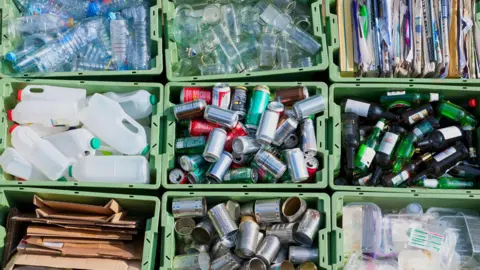
You have rinsed the jars, flattened the cardboard and dutifully lined everything up on the kerb - but what happens to your recycling once that bin lorry pulls away? To find out, the BBC has been given a behind-the-scenes look at a Berkshire recycling facility.
The Materials Recovery Facility (MRF) in Padworth is one of the places where dry mixed recycling is given a second life.
Inside, plastics, paper and tin cans begin a carefully choreographed journey through a wonderland of machinery and magnets.
Kerbside to conveyer belt
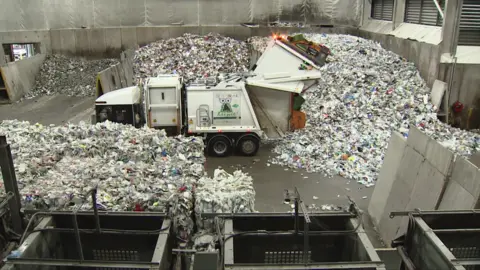
After dry mixed recycling is tipped off collection vehicles, it is loaded onto conveyor belts and enters the MRF - a large, loud and slightly niffy warehouse building.
The rubbish then goes through a series of machines to separate the waste.
Separation and sorting
Large magnets pull out tin cans - like those used for baked beans and tomato soup.
Fizzy drink cans, and anything else made of aluminium, are picked out by eddy-current separators. These use magnetic fields to flick them sideways into a separate chute.
And optical sorting machines are used to identify different types of plastic. These automated, high-speed devices use cameras, and sensors separate items like milk bottles from soft drinks.
Contamination crisis
But even the most advanced machinery cannot achieve everything quite yet.
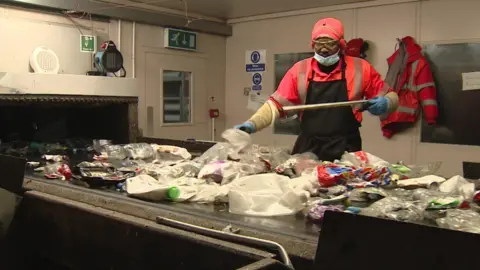
That is why site-owners Veolia also employ a dedicated team of pickers to remove the items that should never be put in recycling.
Hazardous things like vapes and batteries can pose a serious danger. Inside a high-speed facility, these contaminants can explode, spark fires or damage machinery.
Baling and dispatch
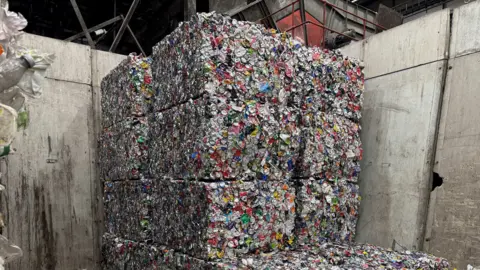
Once sorted, materials are compacted into dense cubes called bales - for those familiar with noughties children's films, think Monsters Inc. or Wall-E.
These plastic bottles, tins and cans then get sent to reprocessors across the UK and Europe, where they become new products like milk bottles, drink cans and food packaging.
After being sorted and graded, they are baled and sent to reprocessors to become new products such as milk bottles, drink cans, and food packaging.
Elsewhere in the facility, paper, card and glass is separated into different bays.
The paper is then taken to mills across the UK, where it is turned into more paper and card.
Glass goes to smelters in London where it is melted down and used to make new jars and bottles.
You can follow BBC Berkshire on Facebook, X (Twitter), or Instagram.
