Isometric exercise: The most efficient fitness regime?

 Getty Images
Isometric exercises – which involve holding certain poses – can build strength and reduce our blood pressure. All you need to invest is 14 minutes a session, three times a week, to see large benefits.
When most of us think of fitness, we imagine spending hours in the gym pounding the treadmill, cranking out burpees or lifting iron.
But recent research shows you don't need to put in an enormous effort to reap some of the benefits. In fact, you barely need to move at all – just holding a pose for a few minutes at a time can help. Isometric exercises such as remaining in a squat position or sitting down on a chair with a leg extended in front of you, can improve your heart health and enhance your muscular strength.
That's good news for the many people who are struggling to build an exercise regime into their current schedule. Most of us know the importance of physical activity; we just struggle to put it into practice. According to the World Health Organization, levels of inactivity across the world actually increased by five percentage points to 31% between 2010 and 2022. Might isometric exercise be the answer?
Mounting evidence
The case for isometric physiology has been growing for decades, with some indications that it could lower blood pressure dating back to the 1990s. We can only read so much from individual studies, however, which is why scientists often conduct meta-analyses that combine data from multiple experiments. In 2023, a meta-analysis of trials published between 1990 and 2023 compared the effectiveness of different kinds of exercise regimens for lowering blood pressure, drawing on the results from nearly 16,000 people who had been exercising for at least two weeks.
The studies considered examined three specific exercises: handgrip (squeezing a device or ball), wall squat and leg extension. And the trials often used the same basic training plan: four times two-minute bouts of the exercise in question, with either one or two minutes of recovery in between. This 14-minute session is carried out three days a week – something that should, in theory, fit into anyone's daily routine.
The results were extremely attention-grabbing for anyone who cares about their health, showing that isometric holds were more effective than cardio, weight training, combined training and high-intensity interval training (Hiit). Blood pressure is measured with two numbers which represent when the heart is beating and resting; a healthy reading is considered anything below 120/80 mmHg. The reduction in blood pressure from aerobic exercise was just 4.49/2.53 mmHg compared to 8.24/4.00 mmHg for isometric exercise.
By comparison, standard medications for lowering blood pressure typically reduce it by about 9/4.00mmHg – only a shade better than the isometric exercise. Given that high blood pressure is a major risk factor for cardiovascular disease and premature death, the potential benefits to our well-being as we age are enormous.
 Getty Images
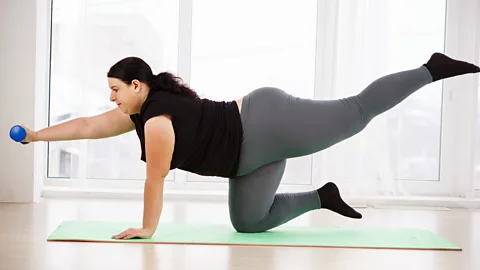
The sheer accessibility of the regime makes it highly attractive, says Melanie Rees-Roberts, a senior research fellow at the Centre of Health Services Studies at University of Kent, UK. "You can do it in your house; you don't need equipment. You don't have to go outside if it's raining. You don't break too much of a sweat doing it."
Jim Wiles, a co-author of the meta-analysis and professor of exercise science at Canterbury Christ Church University in the UK, agrees, arguing it can be particularly helpful for people who have joint or mobility issues and struggle with dynamic, weight-bearing exercise such as running or lifting weights ."The isometric wall squat, as long as it's done properly, is probably safer from a cardiovascular and musculoskeletal perspective than other types of exercise."
Why it works
When you do an isometric exercise, you contract a muscle (or several muscles) and hold it, meaning the length of the muscle does not change as it does in other types of exercise that involve continuous movement. Such static holds compress the blood vessels, leading to a lack of oxygen and a build-up of waste products in the active muscle. This stimulates the brain to try to send more oxygen to the area, which, combined with the increased resistance, raises blood pressure. When the muscle contraction stops, the blood vessels can expand again, increasing blood flow to the area and causing a temporary reduction in blood pressure. The idea is that the repetition of this process can lead to lower blood pressure in the long run.
And the benefits extend beyond blood pressure. By stimulating the blood vessels, isometric exercise reduces the stiffening of the arteries and recent studies suggest it also improves overall heart function.
 Getty Images
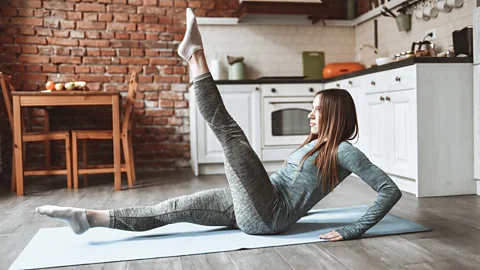
Isometric exercise can also boost muscular strength by helping us to generate more force. That's because it engages neurons in the brain and spinal cord that turn on "motor units" – collections of nerves going into the muscle – making them contract. "Once you hold that muscle statically, all it does is just turn on motor units," explains Dan Gordon, a professor of exercise physiology at Anglia Ruskin University in the UK. He adds this can help improve overall athletic performance.
Gordon, a world-record-holding track cyclist, has personal experience of this. Training in Manchester's velodrome facility for Great Britain, he used to hold a very heavy bar (150kg/330lb) in a squat position before cycling. "I'd then have somebody pull the bar off and get on the bike. Because I'd fired all the motor units – bang, I could accelerate more," he says.
This isn't just useful for athletes, says Gordon. Elderly people struggling to get out of a chair, for example, could start by pushing down on the arms for a while before relaxing, similarly turning on motor units before lifting themselves all the way up.
How to get started
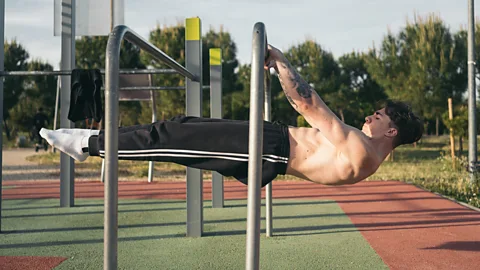
If you don't yet do much physical activity, isometric training could be the perfect way to get started with exercise. If you're already pretty active, though, you should not necessarily replace your existing regimen, Wiles warns, since those other types of workouts may bring their own benefits. Cardio, for example, is far more effective for weight loss and increasing the body's maximal oxygen uptake, which can improve physical stamina and cardiovascular health. But if you're especially focused on lowering blood pressure, you may want to incorporate isometric exercise, such as a static squat, into that routine.
 Getty Images
Given that the meta-analysis only focused on those three specific exercises, we cannot assume that other forms, such as a plank, will work in the same way, though Wiles suspects they "probably will". A 2025 small randomised controlled trial of 12 young adults showed that a single session of four 2-minute planks reduced blood pressure 24 hours later. But the authors themselves say more research will be needed in larger groups over longer time frames to confirm this.
More like this:
And while it may be tempting to ease into isometric training by starting at less than two minutes and extending over time the evidence regarding blood pressure is normally based on doing it for two full minutes at a time. Wiles therefore suggests starting with lower intensity rather than shorter duration. Most people can't hold a wall squat at 90 degrees for two minutes, he says, so it's advisable to start in a more upright position between 110-130 degrees.
It is possible that reducing the time of each exercise may also work, of course – we just don't have the evidence yet. "We don't really know where the two minutes has come from," says Gordon. "It may be that two minutes at 40% workload produces the same effect as 10 seconds at maximal load," he says. Other open questions include the long-term benefits (over months or years), for instance, and how it works for people who are already taking medications to treat hypertension.
These questions may soon be answered. Wiles, Rees-Roberts and other colleagues are currently carrying out a large randomised controlled trial. They've already recruited more than 700 people, all with clinically high blood pressure. The participants, some of whom are on medication, will be doing wall squats independently at home. They will also be followed for a longer period of six months, adjusting the isometric exercise difficulty to ensure optimal outcomes over time.
These findings will help refine our understanding of the benefits and optimise the exercises for different fitness levels, but given the evidence to date, there are already many good reasons to begin a basic regime. Whether you're a couch potato or a gym bunny, incorporating a few hand grips, wall squats and leg extensions into your daily routine could propel you to a healthier future.
--
For trusted insights on health and wellbeing, sign up to the Health Fix newsletter by senior health correspondent Melissa Hogenboom who also writes the Live Well For Longer and Six Steps to Calm courses.
