'Predators that just run in and grab, stab and kill': The deep cave bacteria resistant to modern medicine

 Chris Howes
Ancient bacteria, trapped in caves for millions of years, live in a miniature world of terror. Their only food source is each other. The survival tactics they develop make them resistant to almost all antibiotics. Now scientists hope to use their tricks to inspire new drugs and treatments.
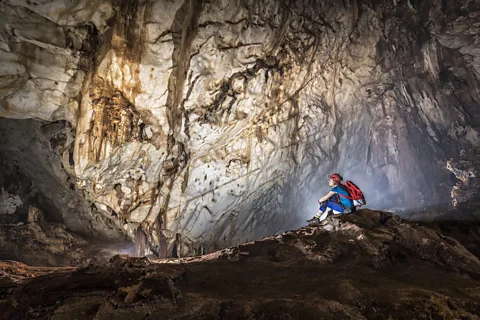
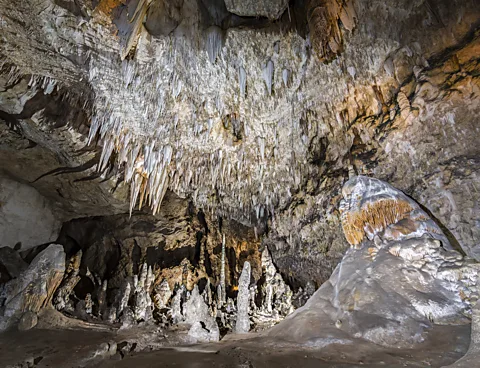
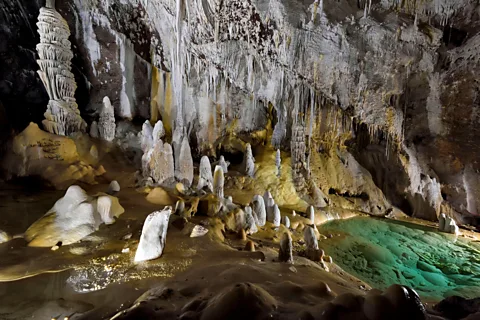
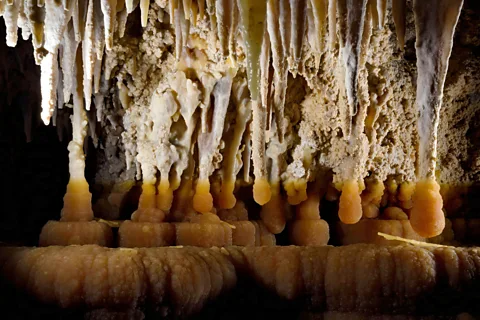
Deep underground, plunging 1604ft (489m) beneath the Chihuahuan Desert in southern New Mexico, lies the Lechuguilla Cave, a cavern which stretches on for 149 miles (240km). There is no light, and little to eat either. Any living thing must eke out an existence under conditions of near starvation.
"You can go in an entrance and travel for 16 hours in one direction before you get to the end of it," says Hazel Barton, professor of geological sciences at the University of Alabama.
"So you're a very, very, very long way from the entrance. You're isolated, and there are places in that cave where more people have walked on the moon than have been in that area."
Yet despite the darkness, there is a dazzling diversity of microbial life. Because the bacteria have been isolated for millions of years, they offer a unique window into the past. What's more, each has evolved a different strategy to survive. Some extract energy from rocks and the atmosphere. Others are predators, feeding off other bacteria.
"Like in the rainforest, we see predators that just run in and grab, stab and kill other microbes," says Barton. "But we also see other microbes that work together to get nutrients and energy out of a system that otherwise wouldn't be able to yield enough energy to survive."
The bacteria also have an even more surprising trick up their sleeve – they are resistant to most antibiotics, despite the fact that they have been trapped in a cave that formed six million years ago, most of which was completely sealed off from humans until 1986. Not only is this resistance a remarkable natural phenomenon, it is now helping guide researchers to drugs that can withstand the onslaught of antimicrobial resistance in modern medicine.
 Chris Howes
But let's rewind slightly. Today, the emergence of antibiotic-resistant bacteria, often called "superbugs", is a growing global health crisis. These pathogenic, disease-causing bacteria have developed resistance to multiple types of antibiotics, making infections harder to treat. Bacterial antimicrobial resistance (AMR) was found to be directly responsible for 1.14 million deaths in 2021, and an estimated 39 million people are expected to die due to AMR between 2025 and 2050. Already, it's estimated that millions of children are dying each year from infections resistant to antibiotics.
The cause of the AMR crisis is usually attributed to the misuse and overuse of antimicrobials in humans, animals and plants. Yet this isn't the whole picture. In 2006, for example, Gerard Wright, professor of biochemistry and biomedical studies at McMaster University in Ontario, discovered soil-living bacteria packed full of antibiotic resistance genes. The mud-loving microbes had the exact same resistance genes that are found in bacteria that cause disease in humans.
"These were not pathogenic bacteria. They weren't causing disease. They were just sitting around minding their own business," says Wright.
This suggested that antimicrobial resistance wasn't new and was in fact hard-wired into many bacteria, a finding backed up by the fact that bacteria with resistance have also been found in glacial ice cores extracted from Antarctica, as well as the soils, seas and rocks of this isolated continent. AMR bacteria have also been discovered in ancient permafrost, as well in the gut bacteria of villagers from an isolated Amazonian jungle tribe.
Yet Wright's finding by itself was not enough to convince the scientific community that AMR had emerged without human contact. After all, the overuse of antibiotics in agriculture is well documented. The soil bacteria could have come into contact with antibiotics this way.
"We're living in the anthropogenic age, so there's no place that is without evidence of human activity, whether you're at the top of Mount Everest or at the bottom of the Mariana Trench," says Wright.
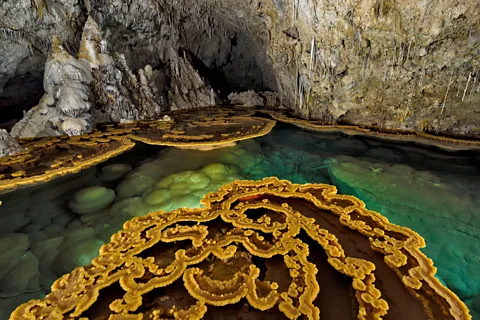
What was needed was a pristine environment. One that had been cut off from humans for millennia. Enter the Lechuguilla Cave. This cave formed millions of years ago from rainwater trickling deep underground. The water combined with hydrogen sulphide in the depths of the Earth, creating sulphuric acid. The acid was then forced upwards under immense pressure, dissolving the limestone as it went. Eventually the acid-rich water hit a cap rock made of insoluble sandstone.
 Alamy
Alamy"Because of that cap rock, nothing can get into the cave," says Barton. "The caves formed millions of years ago, and it takes about 1,000 years for any surface water to get to that part of the cave where we were sampling. It was also a newly discovered passage that we know no humans had ever been before."
In other words, there's no possibility that antibiotic drugs could have washed into the caves.
Barton has been studying microscopic life in caves for more than 20 years. She is one of the few people who have access to the Lechuguilla Cave. So in 2012, she teamed up with Wright to investigate whether these microbes could be resistant to antibiotics too. Barton went down into Lechuguilla Cave to collect samples. The cave is over 1,200ft (366m) in depth, so getting samples required abseiling down a dozen ropes. The effort was worth it though.
"Not surprisingly, we found that all the microbes in there were resistant to basically every natural antibiotic that's ever been used in the clinic," says Barton.
This actually makes sense from an evolutionary perspective.
"The mechanisms and pathways that lead to antibiotic resistance don't form quickly," says Barton. "If you look at the structure of an antibiotic, that's a molecule that probably took hundreds of millions, if not billions of years to form, and so it's likely that resistance to those antibiotics is as old as the antibiotics themselves."
The bacteria were still killed by synthetic or semi-synthetic antibiotics, however, as they had never been exposed to them.
More like this:
• The New Mexico cave expanding our search for alien life
• The scientists venturing into the deep, dark Earth
• Billions of bacteria are hiding in your shower
One microbe, a non-pathogenic strain of bacteria called Paenibacillus sp LC231, was resistant to 26 of 40 antibiotics tested, including daptomycin, a relatively new antibiotic that is considered a last resort against drug-resistant bacteria like methicillin-resistant Staphylococcusaureus (MRSA).
The researchers sequenced the entire genome of Paenibacillus sp LC231, and found that many of the resistance genes were identical to those found in known drug-resistant bacteria. However, the team also identified five resistance genes that had never been encountered before. Interestingly, a cousin of the ancient, isolated Paenibacillus –a spore-forming species found widely above ground – also has the same resistance mechanisms. This means that resistance to antibiotics evolved before the bacteria were trapped in the cave, not after.
"The punch line for us, and the reason why we were trying to do this, was to say that antibiotic resistance is part of the natural history of microorganisms on the planet," says Wright.
"Most antibiotics come from bacteria and fungi, so they've been making these and fighting with each other for hundreds of millions, if not billions of years."
 Alamy
AlamyAccording to Wright, for most of the Earth's history, antibiotic resistance has been confined to non-pathogenic strains of bacteria – ones that don't cause disease. Our extensive use of antibiotics to treat infections, however, has provided a strong selective pressure that has encouraged pathogenic microbes to adopt these defences too. As bacteria can quickly pass genes to each other, antimicrobial resistance has spread fast.
There may be something about the harsh environment of caves that has encouraged the bacteria to keep and hone their defences, however. As nutrients and resources are so scarce, bacteria must compete with one another to survive, says Barton. Microbial warfare is a likely outcome.
"If you reduce the number of resources available to a community, then it's going to get a lot more aggressive, and there's going to be a lot more infighting in the way that microbes fight each other," says Barton.
True to form, the biologists found cave microbes that were lobbing out antibiotics left right and centre. One specimen produced 38 different antimicrobial compounds, with three novel antibiotic structures.
Using cave microbes to combat AMR
So could we use this new knowledge to help us in the fight against antimicrobial resistance?
It's possible that uncovering the treasure trove of bacteria's secret arsenal could help produce new treatments. Traditionally the way scientists have discovered new antibiotics is by going out into nature, taking samples from water and soils, and painstakingly trying to purify and extract those compounds that might be beneficial. In 2025, the first new class of antibiotic in almost 40 years was brought to market – one discovered by Wright and his colleagues in the soil.
Finding bacteria in isolated, untouched areas could help with this, as it's possible that cave microbes could produce ancient antibiotics that surface bugs have long forgotten how to defend themselves against – or never even encountered.
For instance Naowarat (Ann) Cheeptham, a microbiologist at Thompson Rivers University in Canada, is aiming to do just this. Over the last decade, Cheeptham's team has explored caves, taken soil samples, and cultured the resulting bacteria in a petri dish. The bacteria were then screened against known superbugs to see if the cave microbes could kill them.
Cheeptham has so far tested more than 2,000 bacteria and has identified many promising candidates. For example, her team found two species of bacteria in the Iron Curtain Cave in Canada that could kill multidrug-resistant strains of Escherichia coli. She also discovered five microbes in the White Rabbit Cave, located in the Monashee Mountain range in south-central British Columbia, that produced antibiotics that were effective against MRSA.
 Alamy
AlamyHowever, the lack of funding for antibiotic discovery research has led to her pausing her search for new drugs, at least for now.
"We found potential compounds, but it will take us a lot of time and financial investment to get us to a point where pharmaceutical companies will work with us," says Cheeptham. "They [the promising candidates] are still in the refrigerator, so when we have money, we will look at them again."
Alternatively, cave microbes could help the fight against AMR by allowing scientists to predict when bacteria might evolve resistance to a new class of antibiotics.
"The first thing you need to know is, what are the mechanisms of resistance that already exist out there?" says Wright.
"Because if I'm going to discover an antibiotic tomorrow and I want to bring it to the clinic, it'd be a good idea for me to understand what its liabilities are, what its vulnerabilities are to what exists out there, because then you'll be better prepared for the emergence of resistance, not if, but when it occurs."
Common mechanisms of resistance include simple pumps that simply spit the antibiotic back out of the bacteria. While others involve much more complicated enzymes that either modify or somehow degrade the antibiotics.
Knowing how a bacterium destroys the antibiotic could help scientists design new drugs to overcome its defences. For example, penicillin by itself often doesn't work anymore, because many bacteria have an enzyme that binds to the antibiotic and inactivates it. However if you add a compound called clavulanic acid, this molecule binds to the enzyme instead and inhibits it. So by adding clavulanic acid to penicillin, you counteract the resistance mechanism, and penicillin works again. It's hoped that identifying similar processes in cave bacteria could therefore give medical researchers a powerful advantage.
"By figuring out what mechanism a microorganism might use to overcome an antibiotic, you can actually figure out how to defeat it before it ever shows up in the clinic," says Barton.
--
For essential climate news and hopeful developments to your inbox, sign up to the Future Earth newsletter, while The Essential List delivers a handpicked selection of features and insights twice a week.
For more science, technology, environment and health stories from the BBC, follow us on Facebook and Instagram.
