The Moon brings a wild but precarious fish orgy to California's beaches

 Karen Martin
Millions of small fish fling themselves on Californian beaches to have sex – strictly under the full or new Moon. This incredible mating ritual is threatened, but citizen scientists are diligently working to save it.
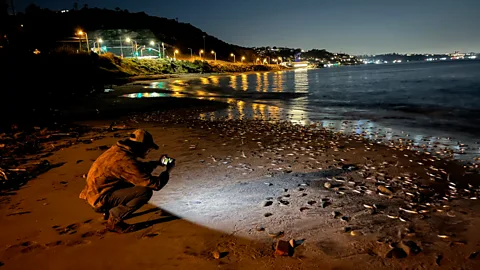
On a Southern Californian beach in the middle of the night, a citizen scientist stood observing thousands of fish having sex. "Unruly thousands, all making noise," they duly jotted down. "Looked like some post-apocalyptic marine Mad Max."
This unique mating ritual is known as the grunion run. Unlike most other fish, the small silvery grunions actually spawn onshore, flinging themselves from the ocean onto the sand. In addition, they only spawn during full or new moons – because they need a high tide.
Since 2002, the rituals have been observed by "grunion greeters" – citizen scientists who volunteer to observe the fish at 50 California beaches. They report their observations back to Karen Martin, a scientist at Malibu's Pepperdine University, who has been studying grunion for decades. To date, more than 5,000 people have contributed to Martin's project. "We couldn't do it without them," says Martin. "There is no other way for us to get this kind of data. It's pretty remarkable, actually."
The fish are near-impossible to count. They are smart enough to avoid nets, and they don't take bait on a hook. "The 'normal' methods for stock assessment do not work for these species," Martin explains.
As a result, there's no formal statistic for how many there are – and so they don't have a conservation status either, although Martin says they are certainly under threat and numbers have declined significantly in the past decade according to her research.
The fish are only found along the Pacific Coast, primarily between Punta Abreojos in Mexico's Baja California, up to Point Conception, in central California. Scientists believe the fish, which grow to around five inches (13cm) long, have declined in numbers over the past century. Beach erosion, light pollution and development along coastlines are the main threats to the fish, as well as overfishing and habitat destruction.
 Doug Martin
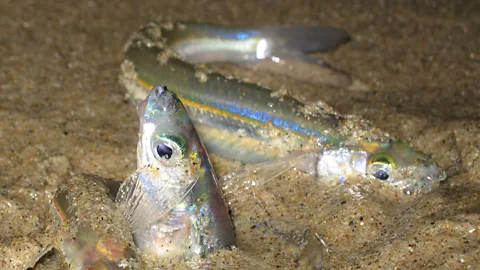
The grunion's mating behaviour is unique, to say the least. Females swim as far up as they can and then fling themselves out of the water onto the sand, wiggling their tails to dig a hole, into which they release their eggs. Males follow behind and fertilise the eggs. The eggs remain buried in the sand until the next tide that is high enough to reach the them, usually around 10 days. Then they hatch.
This behaviour puts the grunion at risk, though – and not only because they are easy prey when they're spawning on the sand. The beaches the fish use happen to be some of the most popular tourist destinations in California, which are groomed almost daily with heavy machinery, meaning the eggs are often destroyed. "Everything that people do on those beaches is going to impact the environment," Martin says.
Although gathering data on the fish has been challenging, there have been some successes with implementing regulations to protect grunion.
In 1927, the first regulations to protect grunion were put in place by the California Department of Fish and Wildlife after scientists observed the fish being caught in enormous amounts when they came ashore – people would use nets made from bedsheets to catch grunion en masse. Gear restrictions were introduced during closed season – April until June – meaning locals could only use their bare hands. In the 1940s, marine biologist Boyd Walker observed every grunion run in La Jolla, California, for three years. His dissertation mapped the grunion's range, mating habits, and developed a method to count grunion, now known as the Walker Scale.
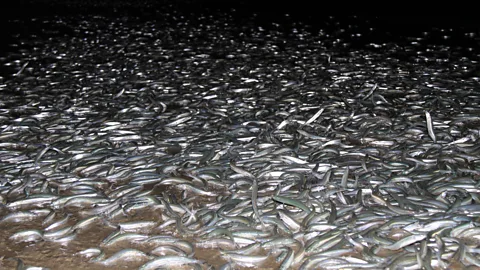
This is what Martin's grunion greeters use to compile their reports. The scale ranges from W0 meaning "no fish or only a few individuals", to W5 meaning "fish covering the length of the beach, several individuals deep, impossible to see sand between fish". The latter is a rare event, making up only around 1-3% of observations in a year. The citizen scientists assess the number of fish on shore, the duration of the spawning event, and the extent of the shoreline the fish cover.
Data gathered from the most popular grunion beaches gathered shows an overall decline in the fish. Martin's study, which she published in 2019 using citizen science data, found from 2002 to 2010 the median average ranking on the Walker scale was W2, indicating 100-500 fish at the peak of a run. From 2010 to 2018 this ranking dropped to a median of W1 – fewer than 100 fish at the peak. Furthermore, a median of W0 – "no run" with little or no spawning – was recorded in both 2014 and 2016.
"Despite local concentrations, California grunion are not abundant," says Dianna Porzio, senior environmental scientist at the California Department of Fish and Wildlife. "Although [the grunion greeters] data has limitations, the findings show a decrease in the number of spawning California grunion across much of their southern California range over the past decade."
The citizen scientists' data has led to further protections for the fish. "The data has been useful for a number of reasons," says Martin. "Knowing where the grunions are running has been helpful for finding eggs and tracking the human impacts on them. We found beach raking was happening where the grunion nests are."
In 2020, California Fish and Wildlife increased restrictions on the take of grunion, which are typically harvested for individual consumption. The restrictions directly cited the data obtained by Martin's grunion greeters as evidence of a declining population. The department added another month to the no-take season – April until June – and in 2022, imposed a limit on how many grunion people could take outside of the no-take season.
 Haris Lakisic
On several beaches in southern California, grunion-friendly beach raking protocols have been introduced, helping protect the eggs.
The data has also led to the discovery that grunions are expanding further north. "We've been able to identify their range," says Martin. "Now we know they're found north of San Francisco, not just in central California."
Moreover, the programme has created an army of defenders for the grunion. "People get very protective over the grunion," she laughs. "Some of them even approach other people who are disturbing the fish, or taking too many, and will explain the importance of following the regulations."
It's a prime example of how the public can be trained as citizen scientists and make a marked impact, says Martin. "In the past scientists frowned upon using them," Martin adds. Even Walker warned against relying on the public to gather data, saying their reports were typically unreliable and inconsistent.
But Martin insists that public participation is valuable. "People are excited to know that they've made this sighting, and that their knowledge is useful – that somebody cares about what they've seen," she says. "And it leads to people appreciating what's in their environment, being aware that this wonderful wildlife exists."
--
For essential climate news and hopeful developments to your inbox, sign up to the Future Earth newsletter, while The Essential List delivers a handpicked selection of features and insights.
