Florida's manatees are addicted to power plants. Scientists are weaning them off

 Save the Manatee Club
Pollution drove Florida's manatees from warm springs to power plants. As the state switches to renewable energy, their new manmade homes are disappearing.
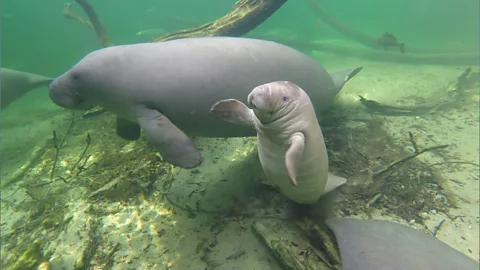
The large, grey, barnacled Florida manatees lazily float near the surface of the sheltered canal next to Apollo Beach, on the state's Gulf Coast.
The water is heated to the perfect temperature for the manatees, who can't survive in conditions below 20C (68F). The manatees' natural habitats are the warm water springs found across Florida, where the mammals spend up to eight hours a day grazing on seagrass.
But these Apollo Beach manatees – also affectionately referred to as "sea cows" – aren't feeding off the seafloor of aquamarine artesian springs, which are lined with limestone rock and surrounded by Spanish moss-draped trees. Instead, a large coal power plant looms over the creatures, pumping out warm water – an industry by-product.
 Save the Manatee Club
An 'unbelievable' conundrum
These manatees have become dependent on the coal and gas power plants, because their historic feeding grounds, the natural springs along the Atlantic coast, have been all but destroyed through development, explains Elizabeth Fleming, a conservationist and manatee expert at the non-profit Defenders of Wildlife.
It's reaching a crisis point because as the US moves towards renewable energy, these power plants will be decommissioned and the artificial warm water source for the manatees will disappear. "It is one of the most unbelievable human-wildlife conundrums I've ever seen in my life," says Fleming. "We have totally reengineered their whole habitat."
For years, the manatees have flocked to these power plants, including the facility in Cape Canaveral, in Indian River Lagoon. But the power companies will likely phase out these warm water discharges over the next 30 years, as Florida moves towards net zero by 2050.
"We have destroyed all their springs on the Atlantic Coast," Fleming says. "We've got to figure out how to get these manatees to go to other places." A 2023 warm water Florida manatee action plan noted that "we must begin [transitioning manatees] now to avoid catastrophic losses of the Florida manatee population".
In 1997, a power plant frequented by manatees was modified to meet water quality standards – therefore eliminating its artificial warm water discharge, which is produced by using cold water to cool steam and produce electricity. The manatees, used to relying on the warm water to survive the winter months, did not leave the area, and died of cold stress.
Even though the power plants provide the warm water manatees need, it doesn't mean there's seagrass, though – which can't survive in polluted waters. Between 2011 and 2019, 47,000 acres (19,000 ha) of seagrass in the Indian River Lagoon – amounting to 58% – died off, caused by nutrient runoff and pollution. Other estimates from Save the Manatee, a non-profit group which monitors manatee populations and advocates for stronger protections, put the seagrass loss at almost 90%.
The manatees, who by now are habitually drawn to the Indian River Lagoon for the artificial warm water, wouldn't leave. And so they starved to death. During 2021 and 2022, 1,900 manatees died. "It was unprecedented," says Pat Rose, founder of Save the Manatees.
"It took a tragedy for people to understand what was happening to these manatees." So many of the animals perished that the Florida Wildlife Commission's scientists simply stopped performing necropsies, which are usually carried out every time a manatee dies.
Desperate measures
The manatee population was in crisis – and so scientists came up with a desperate plan: if there wasn't any seagrass to eat, scientists would feed them romaine lettuce. Almost 600,000lb (272,155kg) of lettuce was fed to the manatee population on Florida's east coast, mainly around Cape Canaveral, over two years in a programme named Let Them Eat Lettuce, which Rose helped oversee. It was a success, and the manatees had recovered sufficiently that they could pause the programme during the 2023 winter period.
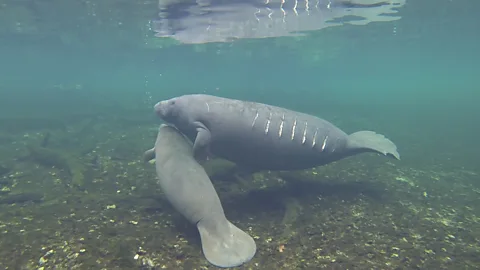
But manatees aren't just threatened by a loss of habitat and seagrass; 96% of manatees in Florida have some kind of scars on their bodies – from boat collisions. "Virtually every manatee alive has been within an inch or two of losing its life," explains Rose. "The leading cause of their injuries and mortalities is still watercraft collisions." In Florida, manatees share the waterways with hundreds of thousands of boats. Manatees can sustain both blunt and sharp force trauma from propellers, and collisions account for almost a quarter of mortalities. And yet, motorised boats are still permitted in many of the natural springs that manatees rely on for survival.
 Save the Manatee Club
"The sanctuaries we have for them are just much too small," says Rose, who helped write the 1978 Florida Manatee Sanctuary Act, which states it is unlawful for "any person, at any time, intentionally or negligently, to annoy, molest, harass, or disturb any manatee". The act also established protection zones, which either prohibit vessels from entering certain areas, or require they stick to a low speed limit. Despite these protections, at least 104 manatees were killed by human-related activity in 2023. "We're far from protecting all of the areas we need to protect," says Rose. "We've come a long way but we've got much farther to go."
Securing a future
Progress is slow, but it is underway, says Rose. In 2023, a new set of questions were introduced to the boater safety course that anyone operating a boat in Florida is required to take. The questions included how to protect manatees from being injured by watercraft. There have also been steps taken to restore natural springs. The Florida Fish and Wildlife Conservation Commission (FWC) completed a restoration at Warm Mineral Springs late last year, which had been damaged by extreme flooding. From winter until spring, the area is a no-entry zone so the manatees can access their warm water refuge undisturbed – although the FWC has yet to release manatee figures for the previous winter.
In 2019, Florida allocated more than $50m (£40m) to manatee programmes, and in 2023, the state measured the lowest manatee mortality rate since 2017. A further $325m (£258m) has been invested to restore Florida's springs. In January 2024, Blue Spring State Park, which has been working on restoration efforts since 1970, counted a record 932 manatees. When it first began its restoration work, park rangers counted just 14 of the mammals.
 Save the Manatee Club
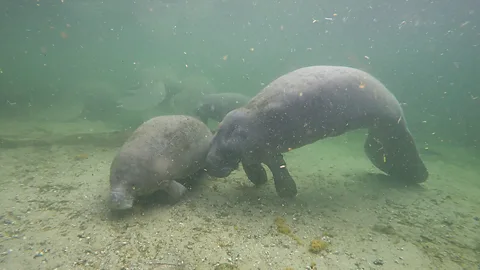
Some natural springs in the state have been dredged to improve manatee access, whilst in some places, entire thermal refuges have been constructed by the US Army Corps of Engineers. A series of three 20ft-deep (6m) basins on a 10-acre (4-ha) area south of Port of the Islands, in the Everglades, was constructed in 2015, providing manatees with warm enough water to survive the winter. The US Fish and Wildlife Service reported that manatees had been using the purpose-built refugium. A spokesperson for the FWC, which monitors the refugium, told the BBC their latest count was 48 manatees, although this is a third lower than previous years as temperatures just outside the refugium are still warm enough for manatees. Essentially, thanks to warmer weather, the manatees have options of where to winter. Other ideas, though yet to be tried, include solar powered heaters or deploying a moveable heating system that manatees could follow. (In 2011, water heaters were turned on for manatees shortly after a power plant was decommissioned, to help them survive the winter.)
Sign up to Future Earth
Sign up to the Future Earth newsletter to get essential climate news and hopeful developments in your inbox every Tuesday from Carl Nasman. This email is currently available to non-UK readers. In the UK? Sign up for newsletters here.
Elsewhere in the state, scientists are experimenting with growing seagrass in large tanks and transplanting it to Indian River Lagoon. Florida Atlantic University is establishing a seagrass nursery which will create a standby supply of seagrass available to transplant for restoration efforts. They are also researching genetic diversity of seagrass and how they could breed strains that are faster growing and have a broader environmental tolerance.
However even the most optimistic of estimates predict seagrass recovery could take 12 to 17 years. Other approaches focus around education, like convincing people who own waterfront lawns not to fertilise them, to prevent pollution runoff in manatee habitats. As for moving the manatees, it will be a long, expensive process. Even the government recognises it has taken 50 years to develop the manatees' dependency on power plants – and it could take the same amount of time to wean them off.
More like this:
• Florida is paying bounty hunters to control its python population
• The rewilding project bringing back an ancient breed of cattle to Portugal
• The women, poems and menus saving Ecuador's beloved blue crab
"It's a fascinating wildlife management situation," says Fleming. "We have a moral obligation to ensure these animals can live their lives safely."
Working to save the manatees will be beneficial for the entire aquatic ecosystem, says Rose, because the to protect the manatees, the environment has to be protected too – primarily against development and pollution. Rose remains positive despite the challenge of weaning the animals off power plants. The key is finding areas where the groundwater is warming – and not necessarily focusing on natural springs. "We'll need a combination of new and old technology," he says. "And it's not hopeless – because we do believe we can find a transition out of this."
--
If you liked this story, sign up for The Essential List newsletter – a handpicked selection of features, videos and can't-miss news delivered to your inbox every Friday. Click here for the BBC’s full range of newsletters available outside of the UK.
