Why we may be hardwired to shun those who scratch

 Getty Images
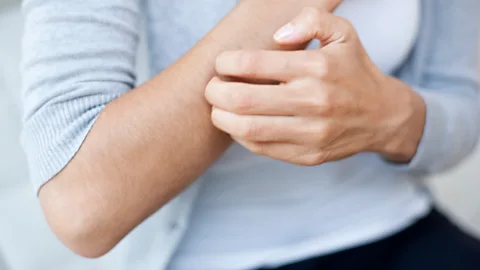
We derive pleasure from scratching an itch – but may have evolved to shun those who scratch.
It's possibly the most maddening sensation there is. Prick your finger and you can ignore the pain. But try and ignore an insatiable itch? No chance.
But why is this? Until recently researchers had only, well, scratched the surface when it came to itch science. But that's starting to change. Now scientists know that the sensation of itch is relayed by a number of itch-specific neurons and pathways, opening the way to a whole new batch of treatments.
But why do we itch in the first place? It's thought that mammals originally evolved the sensation as a kind of reflex, helping them to expel invading pathogens and escape noxious chemicals in their environment. But it's clear that there is also a psychological aspect to itch that we don't yet fully understand.
Take the phenomenon of contagious scratching – where people who see someone else scratch suddenly feel itchy themselves. In 2011, Gil Yosipovitch, professor of dermatology and a physician scientist at the University of Miller School of Medicine in Miami conducted an experiment. He asked healthy controls and people with atopic dermatitis (AD), a disorder which causes chronic itching, to watch short video clips of people either scratching or sitting idle.
Participants were either injected with histamine – a chemical that causes itching – or a harmless saline solution. While both groups reported increased itching, the phenomenon was more pronounced in AD patients, with 82% reporting an increase in itch sensation after watching the videos of people scratching.
 Getty Images
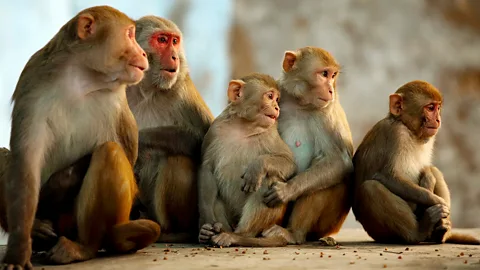
The phenomenon isn't just restricted to humans either. In 2013, Yosipovitch showed that when adult rhesus macaque monkeys watched a video showing other monkeys scratching, they also began spontaneous scratching themselves, suggesting they also experience contagious itch.
There's even evidence to suggest that we, and other mammals, are hardwired to avoid itchy people, possibly because scratching can be read as a signal of infestation or infection with a parasite or disease.
Brian Kim, a clinician and neuroimmunologist at the Icahn School of Medicine at Mount Sinai in New York, observed during a lab experiment that mice who see another mouse scratch tend to move away. However, when a mouse sees another mouse in pain, they try to lick and groom their nestmate instead. In other words, it appears that mice approach other mice in pain, but avoid those that itch.
This makes sense from an evolutionary perspective, as scientists believe we evolved itch as a way of brushing away parasites, body louse and mites from our bodies, preventing infestation. There's evidence that scratching offers some protection against infection. For instance in nursing homes where people are immobile and not able to scratch, epidemics of scabies are common. So in other words, people who scratch a lot may inadvertently be sending a signal to others that they have a transmittable infection.
"I think instinctively it's survival," says Kim.
"I live in New York City and if I go into the subway and see someone scratching themselves, I tend to stay away instinctively. I think its hardwired into a person's nervous system that if someone is scratching they may be infested with something that's contagious," he says. "However if someone's in pain it's human instinct to go to that person, it's a survival of the tribe instinct."
 Getty Images
Perhaps for this reason, sufferers of chronic itch report feelings of shame, embarrassment and stigma associated with their condition. Many suffer from anxiety and depression, as well as low self-esteem. However unfortunately stress can exacerbate itch, leading to a never ending itch-anxiety cycle.
Yet, according to Yosipovitch, the last thing a clinician should do is tell sufferers of chronic itch to stop scratching.
"It's like telling someone to stop yawning - you can't, it's a reflex," says Yosipovitch.
You might also like:
So why is scratching an itch so irresistible? One theory holds that when we scratch ourselves it causes pain signals to be sent to the brain. These signals act as a distraction, causing the itch sensation to abate if only for a second. Scratching also releases the neurotransmitter serotonin, which could be responsible for the pleasurable sensation. However the true reasons why it feels so good to scratch are complicated and not fully understood.
"There seems to be something about the way the skin experiences or transmits information to the brain that it can't handle too many things in one place at the same time," says Marlys Fassett, professor of dermatology at the University of California, San Francisco.
"What happens in people with chronic itching, is they experience pleasure from the act of scratching," she says. "Neuroscientists are interested in pleasure sensory neurons that innervate the skin, because breaking that pleasurable scratching and that addiction to scratching is a really important therapeutic issue."
--
If you liked this story, sign up for The Essential List newsletter – a handpicked selection of features, videos and can't-miss news delivered to your inbox every Friday.