The new drugs that may bring an end to constant itching

 Getty Images
While for most people, an itch is an annoying, temporary nuisance, one in five of us will experience chronic itch lasting weeks or months. New treatments finally offer hope.
Shayanne Boulet was 18 and at the end of her first year of college when, out of nowhere, she developed an excruciating itch.
"I thought at first it could be eczema, but it was so much more debilitating," she says.
"I couldn't take hot showers, I couldn't focus on my homework at school, I couldn't sleep because I would have to itch for almost two hours in my bed. I would have to get up to clean myself because there was blood on the sheets."
Shayanne was diagnosed with prurigo nodularis (PN), a chronic inflammatory skin disease which translates as "itchy nodules".
The condition is one of many that causes chronic itch – medically defined as an itch lasting greater than six weeks. Chronic itch is associated with dermatologic disorders such as eczema, hives and psoriasis, but also with other medical conditions including chronic kidney disease, liver failure, and lymphoma. In some cases, chronic itch can last for years.
The sensation can be maddening. In Dante's Inferno, liars were condemned to the eighth ring of Hell where they suffered "the burning rage of fierce itching that nothing could relieve". That may be something that sufferers of psoriasis can relate to, as itch that comes with this condition has been compared to being attacked by fire ants.
Patients with liver disease have received transplants because they can't cope with the sensation. Some cancer patients stop taking life-saving medications because of the itching the drugs can cause.
 Getty Images
"Studies have shown that chronic itch is equally as debilitating as chronic pain, but I would actually argue it is more so," says Brian Kim, a clinician and neuroimmunologist at the Icahn School of Medicine at Mount Sinai in New York.
"With chronic pain you have a dull aching sensation – it's like 'six out of 10' pain that just won't go away – but you can sleep. Chronic itch is different because it doesn't let you rest. Sufferers stay up all night scratching. From that standpoint it can be considerably more debilitating."
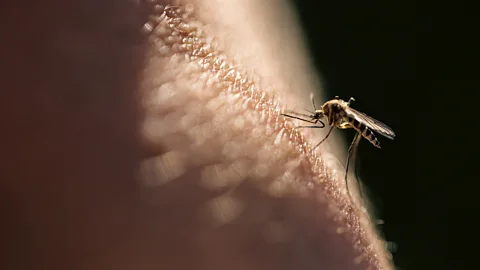
However, despite its pervasiveness, until recently scientists didn't really understand what causes chronic itch. Acute itch, on the other hand, is relatively well understood. If you get bitten by a mosquito, or come into contact with poison ivy, immune cells in the skin release histamine and other factors, which bind to little receptors on the surface of sensory nerves, causing them to fire and send an itch signal up to the spinal cord and brain. Although annoying, acute itch can be treated with antihistamines or topical steroids. But antihistamines have no effect on chronic itching.
As a result, there have been few advances in itch treatment for 360 years, when itching was first medically defined.
One reason for this is that scientists were convinced that itch was just a mild form of pain. This misconception can be traced back to the early 1920s, when Austrian-German physiologist Max von Frey prodded the skin of his lab participants with minute sharp-pointed objects called spicules. He found that the initial feeling of pain was followed by an aftersensation of itching.
However, in 2007, scientists led by Zhou-Feng Shen at Washington University School of Medicine, St Louis, discovered a dedicated itch receptor on a subset of neurons (nerve cells) in the spinal cord. Mice without the receptor were incapable of feeling itch. No matter how much they were tickled or irritated, they didn't scratch themselves. Yet they felt pain normally.
In other words, scientists had found a bunch of neurons in the spinal cord that specifically transmit the sensation of itch to the brain.
 Getty Images
Since then, researchers have discovered other itch-specific receptors and neurons. For instance, Mas-related g-protein-coupled receptors are found on sensory neurons that innervate the skin. They project directly to the brain and seem to play a pivotal role in transmitting itch.
Meanwhile, in 2017, Brian Kim and colleagues at Washington University's Centre for the Study of Itch and Sensory Disorders, discovered that inflammation in the skin can cause immune cells to release chemical messengers called IL-4 and IL-13. These chemicals, known as cytokines, also bind to sensory neurons in the skin, causing itch.
"One cool thing about Brian Kim's work is he discovered that not only do these molecules bind to itch neurons, but they lowered the threshold for other molecules in the skin to activate itch neurons, so they generally sensitised people with allergies to be more itchy," says Marlys Fassett, professor of dermatology at the University of California, San Francisco.
Fassett has concentrated on another 'itch cytokine', IL-31, which has also been shown to trigger itch-specific neurons. According to Fassett, work soon to be published shows that, just like other itch cytokines, IL-31 also lowers the threshold of itch neurons, causing them to fire more often and easily.
In a 2023 study, Fassett found that as well as causing itch, IL-31 also reduces nearby inflammation so that the itchy feeling eventually subsides. Her team removed a gene in mice that codes for IL-31, and then exposed the mice to the house dust mite, a common, itchy allergen. As expected, the dust mite didn't cause itching in mice that lacked IL-31. However, inflammation in the area skyrocketed.
"It's been known for 15 years now that when you inject IL-31 in the skin or the spinal fluid of mice, the animal immediately starts scratching uncontrollably," says Fassett.
"But what remained a quandary was that if you removed that itch cytokine, instead of having inflammation go down in the tissues, it went up. And that didn't make a lot of sense, because in most tissues where there is itching and inflammation together you should expect those things to move in concert."
It appears that the neurons in the skin that are activated by IL-31 also squash the immune response, keeping inflammation in check. The finding is important, because it means that anti-itch drugs targeting IL-31 may have unintended consequences, causing inflammation to run out of control.
Treating itch
Such drugs are already in development. For example nemolizumab, which targets the IL-31 receptor, recently completed phases 2 and 3 clinical trials for the treatment of Atopic dermatitis (AD), a form of eczema that causes dry, itchy and inflamed skin.
People suffering from this debilitating condition can already be prescribed dupilumab, a recently licensed drug that inhibits both IL-4 and IL-13 receptors. Other drugs such as EP262, abrocitinib, and upadacitinib are also in phase 3 trials for AD treatment. EP262 blocks the Mas-related G protein-coupled receptor X2 (MRGPRX2), while abrocitinib and updacitinib interfere with IL-4 and IL-13 pathways by inhibiting a receptor called JAK1.
 Getty Images
Other itch conditions could also benefit from new treatments. For instance this year, Gil Yosipovitch, professor of dermatology and a physician at the University of Miller School of Medicine, worked with Brian Kim and others to complete two phase 3 trials for the use of dupilumab to treat PN, the condition Shayanne suffers from. After 24 weeks, 60% of participants receiving dupilumab saw a significant and life-changing reduction in their itch compared to 18.4% of participants receiving a placebo. As a result, the FDA has now approved dupilumab to treat PN patients.
"PN is one of the most itchy conditions that dermatologists encounter, and until recently there weren't any good treatments, so patients were suffering a lot," says Yosipovitch.
"It's an exciting era for our patients. They feel that finally there is hope. I had so many patients that were so frustrated and so miserable, and they have come to me and said, 'The drugs saved my life'."
You might also like:
- Why it feels so good to scratch an itch
- The curious ways your skin shapes your health
- Itching and scratching 'a vicious cycle'
Meanwhile Brian Kim's new lab at the Icahn School of Medicine is testing difelikefalin for the treatment of notalgia paresthetica — a nerve disorder characterised by a persistent itch in the upper back.
Difelikefalin is already approved by the FDA for the treatment of moderate-to-severe itching associated with chronic kidney disease in adults undergoing hemodialysis. However, in a phase 2 trial, it was also shown to be moderately effective at treating notalgia paresthetica too.
Together these drugs provide hope that, until recently was severely lacking.
"I feel like I'm myself again, and I can continue to live my life the best way I can," says Shayanne, who was one of Yosipovitch's trial participants.
"Sometimes I itch a little, but it's only for 10 minutes, my quality of life is much better than before," she says.
While dupilumab doesn't cover all patients, more drugs are in the pipeline.
"I believe in the next five years we'll be able to control the majority of these patients, so it's a very rewarding time for doctors like me who deal with this suffering of these patients for so many years," says Yosipovitch.
--
If you liked this story, sign up for The Essential List newsletter – a handpicked selection of features, videos and can't-miss news delivered to your inbox every Friday.
