The fashion created in the clouds

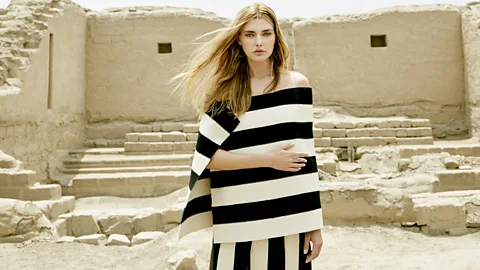
Known traditionally for their folksy appeal, Peruvian textiles created high in the Andes mountains are being re-invented for the 21st Century. By Dominic Lutyens.
With their strong, saturated colours and dazzlingly vibrant patterns, traditional Peruvian textiles at first glance appear to have funky, folksy, homespun, even naïve, qualities. But these textiles are in fact culturally complex – the result of different regions of Peru specialising in specific techniques, handed down from generation to generation. Currently on display at Weavers of the Clouds, an exhibition at the Fashion and Textile Museum in London, the patterns and motifs of these textiles were markers of wealth and even of marital status, and their designs can be decoded to reveal where the weavers were from.
More like this:
- The designer who freed the female body
Also displaying artefacts such as looms, paintings, photographs and films – some lent by the British Museum – this multi-media show celebrates Peruvian textiles dating from the pre-Columbian era to the present day. Other objects include examples of quipu, a method of tying knots to keep records of populations, and samples of cochineal and indigo dyes used to create crimson and blue cloth respectively. There is a 1980s BBC documentary by Paul Yule about Martín Chambi, the 20th-Century photographer known for his portraits of people from the Peruvian Andes, and images by famous Peruvian snapper Mario Testino.
 Marta Tucci
Global interest in Peruvian textiles received a boost with the rise of Indigenismo in the 1930s, a political, artistic and literary movement co-founded by Peruvian painter José Sabogal, and inspired by Mexican muralist Diego Rivera, who promoted local culture. Sabogal depicted traditional costumes worn in the southern region of Cusco. Soon after, Elena Izcue, a cosmopolitan artist and designer based for some years in Paris, also flew the flag for Peruvian and pre-Columbian art.
“This exhibition mainly focuses on textiles made in the mountainous central highlands of the Andes, surrounding Cusco, hence its title’s reference to clouds,” says curator Hilary Simon. “It’s where the finest weaving is practised. One reason why textiles thrive there is that the alpaca, whose fibre is used to make them, are locally reared.”
 Fashion and Textile Museum
The superfine fibre of young baby alpaca is particularly prized, but Peru’s textiles are also created using fibres from llamas, guanacos and vicuñas. When the Spanish began colonising Peru’s Inca empire from the 1530s, they introduced sheep’s wool and cotton.
Based in relatively isolated regions, Peru’s textile centres have resisted globalisation for many years. Contributing to this isolation was a massive migration in the 20th Century from the countryside to cities on the western coastline, chiefly Lima but also Trujillo, Chimbote and Arequipa, where employment opportunities were greater.
 Fashion and Textile Museum
While the weavers today aren’t immune to globalisation, many contemporary Peruvian or Peru-based designers champion indigenous techniques and use them in their work. “The show also highlights the work of artists, designers and innovative collectives looking at Peruvian rather than European textiles and helping to preserve them,” adds Simon.
Mountain high
Among these is the Center for Traditional Textiles of Cusco, a non-profit organisation founded in 1996, whose mission is to “promote the empowerment of weavers through the sustainable practice of Peruvian ancestral textile traditions in the Cusco region”. Lima-born fashion designer Chiara Macchiavello, who founded the globally-successful label Escvdo in 2013, is one of the country’s most prominent advocates of Peruvian textiles. The label, which bills itself as “Devoted to design, committed to heritage”, is based in Barranco – Lima’s arty neighbourhood and home to Testino’s MATE museum, which showcases Peruvian art.
 Vivienne Westwood
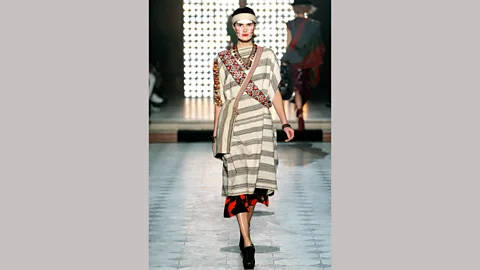
Increasingly, Peru’s young fashion designers don’t look to the West for ideas. Yet some Western designers have recently looked to Peru for inspiration: Weavers of the Clouds displays a 2015 outfit by Vivienne Westwood influenced by the Asháninka people, an indigenous population who live in the Peruvian rainforest. The design was inspired by her visit there with Cool Earth, a non-profit organisation that campaigns to stop its deforestation.
Macchiavello studied a theatre design course at London’s Central Saint Martins, and while there, discovered that her real interest lay in costume design. “I’ve always felt very connected to Peru’s heritage,” she says. “In the 1980s, terrorist activity in the Andes resulted in many people moving from the mountains and rainforest to the coast. But my parents travelled inland. From a very young age, I came into contact with artisan communities and our ancient textile traditions.”
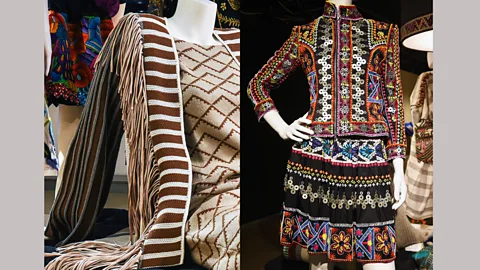
Items of Escvdo clothing, such as fringed jackets, gilets and columnar dresses with strong graphic patterns, are on show at Weavers of the Clouds. These are inspired by a sophisticated range of cultural references, from Pre-Columbian culture to the art of Peruvian textile designer Elena Izcue, and Reynaldo Luza, an artist and illustrator whose work regularly appeared in Vogue in the 1930s.
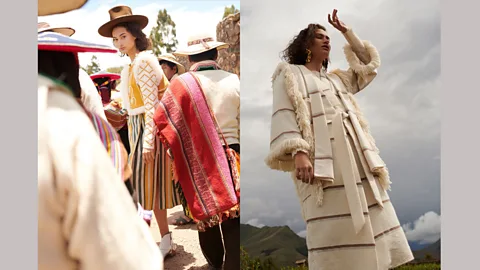 Escvdo
“The clothes are hand-knitted and embroidered, using natural fibres found in Peru, such as high-quality Pima cotton and superfine alpaca fibre,” says Macchiavello. A determinedly green, socially responsible label: “We employ skilled artisans to hand-make the pieces, thereby contributing to local economies and financially supporting age-old textile traditions.”
Also sharing a strong interest in these traditions is contemporary fashion label Mozh Mozh, whose work is included in the show, too. “I’ve been interested in textiles ever since I was a young girl,” says Mozdeh Martin, who set up the label five years ago. Her work was shown at the British Fashion Council exhibition Local/Global in Somerset House, London in 2017. “I was born in the Peruvian Andes and started visiting textile-making communities there in 2008, aged 21. This led me to studying fashion in Peru. I’m interested in preserving Peruvian textile traditions by co-creating clothing and accessories with artisans from all over Peru.”
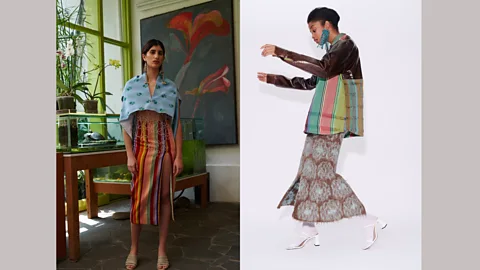 Mozh Mozh
Her ponchos and jackets are often adorned with beadwork created by artisans from the Shipibo community based in the Amazon rainforest. Different textile specialisms are found all over the country: embroidery is widely practised in the cities of Huancayo and Ayacucho in central and southern Peru respectively. Ikat, meanwhile, a technique used to pattern textiles by binding yarns with a tight wrapping and then dyeing them, is commonly deployed in the northern Andes.
One of Martin’s aims is to help stem a widespread reliance in Peru on synthetic materials: “Most textiles in Peru are now made from polyester. Tourism has grown so much in the past years that this has influenced the local market.”
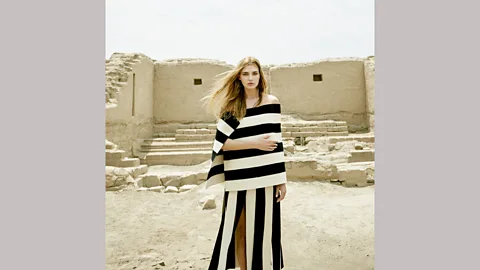 Meche Correa
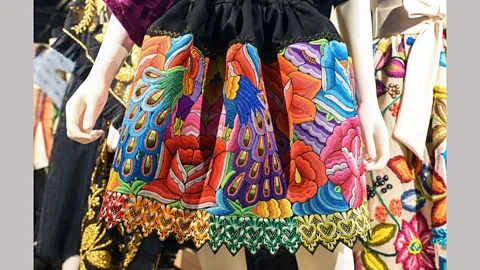
Even more decorative are the confections of established designer Meche Correa, who founded her eponymous label 25 years ago. Her clothing nods to traditional techniques and silhouettes found in Peruvian clothing. One of her ensembles at Weavers of the Clouds is a skirt typically found in Peru – the pollera, a kind of gathered, flouncy mini-crini whose hem is flamboyantly embroidered with colourful flowers; her version is worn with a plain top that emphasises the vibrancy of the skirt.
“Flowers are a motif brought to Peru by the Spanish,” says Correa who has long collaborated with Peruvian artisans. She raises awareness of their work by organising trips to central Peru to show young designers how these skills are carried out. “But I want my own work to feel contemporary and universal, so it can be worn anywhere.”
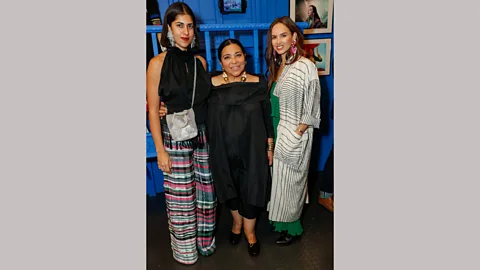 Getty Images
She says that one of the country’s key strengths is the transparency of the supply chain that still exists in its traditional weaving world: “We have a wealth of raw materials, from alpaca fibre to gold and copper, and can see how manufacturing processes work from start to finish. Coupled with that, we have so much expertise at our disposal. Effectively, what we have is what we call ‘cultura viva’ – cultural traditions that are still alive despite being centuries old.”
Weavers of the Clouds is at the Fashion and Textile Museum, London, until 8 September.
If you would like to comment on this story or anything else you have seen on BBC Culture, head over to our Facebook page or message us on Twitter.
And if you liked this story, sign up for the weekly bbc.com features newsletter, called “If You Only Read 6 Things This Week”. A handpicked selection of stories from BBC Future, Culture, Capital and Travel, delivered to your inbox every Friday.
