The photo that captures the power of nonchalant protest

 Orlando Sierra/AFP/Getty Images
After a photo of a protestor in Honduras lying down in front of a line of police officers was circulated widely, Kelly Grovier considers the history and significance of the posture.
In the Frame
Each week Kelly Grovier takes a photo from the news and likens it to a great work of art.
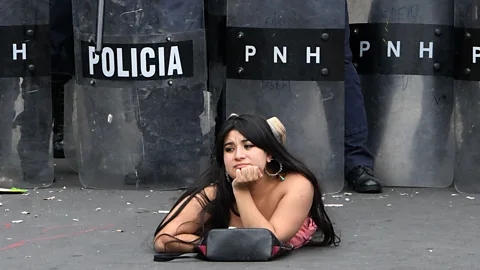
There is an art to lying down. Not everyone can do it with the same power or panache. Properly adopted, a supine posture is indomitable – a display of inner strength. The young woman in a photograph that was circulated widely this week, captured on the streets of the Honduran city of Tegucigalpa, is a good example of someone who’s got it. The image depicts a supporter of the defeated presidential candidate Salvador Nasralla lying lackadaisically on the pavement before a line of police officers.
Stretched out on her stomach as if she were lolling on her own bed at home, the nonchalant figure rests her head on her hands with bored defiance. No one since Uma Thurman posed similarly for the film poster of Pulp Fiction has looked quite so nonplussed. Though there is a physical rationale for the young woman’s posture (to help block the country’s roads in protest against the start of re-elected President Juan Orlando Hernández’s new term of office), it’s something immaterial – her unassailable air and attitude – that truly overwhelms the photo.
 Orlando Sierra/AFP/Getty Images
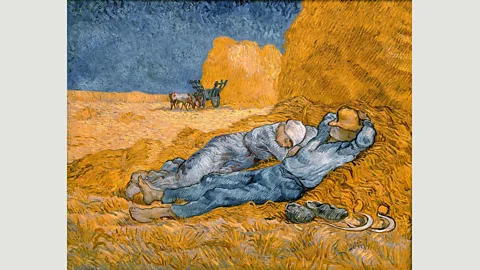
Art history is chock-full of virtuoso loungers who have made themselves comfy on the linen canvases of museum walls. The farmers dozing at midday on a luminous divan of dishevelled hay in Vincent van Gogh’s 1890 Noon: Rest from Work (inspired by an earlier work by Jean-François Millet) have magnificently mastered the technique. So self-possessed are they in their recumbent position, their physiques appear on the verge of taking root in the very landscape in which they’ve spent their lives toiling – reclaiming the earth and seasons by recycling themselves into the thrumming heat of summer.
 Wikimedia
Stretching out both before and after Van Gogh’s lazy landscape, a whole horizontal history of art is waiting to be told. Essential to such a story would be the long lineage of lounging Venuses that extends from at least as early as the 2nd Century BC and the endless stony cat-nap captured in marble by the classical sculptor Polycles in his Sleeping Hermaphroditus to Edouard Manet’s scandalous portrait of a reclining prostitute, Olympia, two millennia later; from the self-regarding Rokeby Venus, who has vainly stared at herself in a mirror held by Cupid since Diego Velázquez painted her between 1647 and 1651, to Francisco de Goya’s pair of clothed and naked portraits of a mysterious Spanish woman whose identity remains the subject of great debate. Taken together, these works constitute a bloodline of imperturbable confidence at curious odds with the perennial objectification that has conjured it.
The mute eloquence of sit-ins and the power of kneeling have been recognised as forms of political protest. But the act of lying down has a profundity all its own – one that places it apart from any other deportment of our bodies. To lie down is to alchemise one’s energy from physical assertiveness to something more spiritually steadfast – to fight back by giving in. What’s remarkable about this photo and the courage it captures, when placed in the context of countless recumbent women before her in the history of image-making, is the young woman’s emphatic reality. She’s not prepared to take things standing up. Unlike the objectified Venuses, her verve and stubborn stare aren’t the product of male fantasy. She’s real: and the world had better get out of her way.
And if you liked this story, sign up for the weekly bbc.com features newsletter, called “If You Only Read 6 Things This Week”. A handpicked selection of stories from BBC Future, Earth, Culture, Capital and Travel, delivered to your inbox every Friday.
