Sitting down to make a stand

 John Yarmuth/Twitter
After 20 Democrats carried out a ‘sit-in’ at the House of Representatives to demand action on gun legislation, Kelly Grovier looks at the posture of human courage.
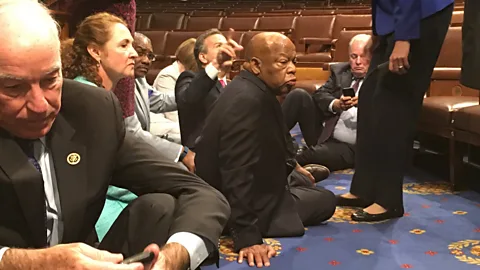
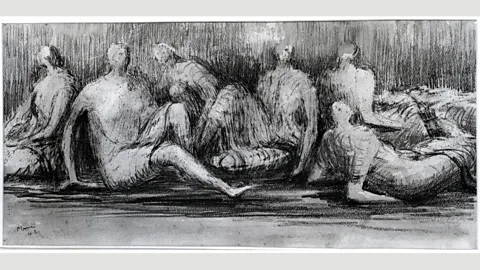
At first blush, it would be difficult to conjure two places less similar to each other in the western world than the plush grandeur of the US Congress and the dark grotty tunnels of the London Underground. Yet images that went viral this week of congressmen stretched out on the floor of the House of Representatives during a ‘sit-in’ to demand action on gun legislation eerily echo the comfortless deportment of Londoners seeking subterranean cover during bombing raids in World War Two as sketched by the English artist Henry Moore. Though the cultural contexts of the two scenes could hardly be more different, the uncanny mirroring of languid physiques – now lounging in political defiance, now waiting with listless valour – invites us to reflect on the very posture of human courage.
John Yarmuth/TwitterLed by the Civil Rights leader John Lewis, on Wednesday a spirited contingent of 20 Democrats abandoned the relative comfort of their leather seats on Capitol Hill in the hope of preventing an adjournment of Congress before members could vote on legislation that would tighten federal gun-control laws. The extraordinary action comes in the wake of the deadliest incident of gun violence in US history, in which 49 people were killed on 12 June 2016 at a gay nightclub in Orlando Florida. Despite overwhelming popular support for changes to gun laws in the aftermath of the shooting (one survey conducted by CNN indicated support had swollen to around 90 per cent), the Senate (Congress’s upper chamber) on Monday voted down a string of four measures, including a so-called ‘no fly, no buy’ bill that would have prohibited anyone on a terrorist watch-list from purchasing a gun.
Fearing the new proposals represented the thin end of a wedge intended ultimately to prise Americans loose from their constitutional right to bear arms, Senate Republicans made certain the draft bills fell short of the 60 votes needed to pass. No stranger to peaceful political sit-ins, Lewis’s determination to disrupt the easy adjournment of the House of Representatives (Congress’s lower chamber) until after the 4 July holiday unless the measures were also brought to a vote there, included robust chants by the participating Democrats of “No bill, no break!” For many political commentators, the gravitas of Lewis’s dignified leadership in the action invested the protest with powerful historical resonance, calling to mind similar postures adopted by Lewis and other activists for Civil Rights in the 1960s.
 The Henry Moore Foundation
But the images that have pulsed through social media in the past 48 hours, captured on smartphones from the strange vantage of the supine lawmakers themselves, vibrate with an intimacy and an emotional embeddedness that has no parallel in protest-era photographs. Rather, the postures chronicled in these images are reminiscent instead of the awkward ergonomics of a bravely embattled people, who hunker in determination that they will survive the next assault. Henry Moore’s unsettling Shelter Drawings, which document the huddled heroism of Londoners forced to bunker down from the Blitz in 1940 and 1941, likewise rely for their power on the quiet muscularity of unflexed fortitude and ungainly courage.
100 Works of Art That Will Define Our Age by Kelly Grovier is published by Thames & Hudson.
If you would like to comment on this story or anything else you have seen on BBC Culture, head over to our Facebook page or message us onTwitter.
And if you liked this story, sign up for the weekly bbc.com features newsletter, called “If You Only Read 6 Things This Week”. A handpicked selection of stories from BBC Future, Earth, Culture, Capital, Travel and Autos, delivered to your inbox every Friday.
