Film review: The Disaster Artist is ‘an uproarious farce’

 A24
A24Known as ‘the Citizen Kane of bad movies’, The Room is a subject of a new film, directed by James Franco. But is it any good? Nicholas Barber takes a look.
Anyone who has seen The Room will know that it isn’t just a terrible film. It isn’t just one of the most terrible films ever made. No, what’s spellbinding about it is that it’s one of the most terrible films ever made, and yet the person responsible for it obviously believed it to be a masterpiece. It’s this combination of once-in-a-generation incompetence and insanely deluded self-confidence that turned a sloppy, plotless melodrama into a horribly fascinating, can’t-watch-can’t-look away cult sensation. And it’s this same combination that is captured in The Disaster Artist, an uproarious, star-studded, behind-the-scenes farce, nimbly directed by James Franco.
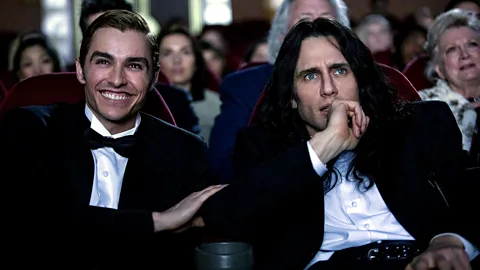
As well as being a life-affirming yarn, The Disaster Artist works as a sincere bromantic comedy about two men with a shared dream of Hollywood stardom. And in fact, the bromance is played out by actual brothers. Despite being a lot better-looking than the real thing, Franco does an uncanny, Oscar-worthy impersonation of Tommy Wiseau, the mesmeric weirdo who wrote, directed, produced and starred in The Room. And, despite being less good-looking than the real thing, Dave Franco plays Tommy’s best friend and co-star in The Room, Greg Sestero, who also co-wrote the riveting tell-all account on which The Disaster Artist is based.
Tommy and Greg meet in a San Francisco acting class in 1998. Greg is marginally more talented, but whenever he is on stage he has the mortified rictus of someone who has just remembered, mid-job interview, that he doesn’t have any trousers on. Greg’s long-haired and musclebound classmate Tommy is far, far less self-conscious. He may speak in an indecipherable Eastern European drawl, and he may look like a member of Guns N’ Roses halfway through a transformation into the Hulk, but he behaves as if he is a more handsome reincarnation of Marlon Brando; if people don’t perceive him as a potential superstar, then that’s their problem, not his.
We’re encouraged to laugh at these two naive outsiders, but the Francos want us to be touched by their friendship, too. Tommy has found someone who admires him, rather than treating him like a freak, and Greg has found someone with the can-do attitude he can only dream of having. As eccentric as Tommy is, he is the kind of energising guy who, if you mention your admiration of James Dean, will insist that you drive together to the site of Dean’s fatal car crash that very night. You can see why Greg would be drawn to him - even as you can see why more sensible and secure observers would avoid him at all costs.
Inspired by each other, Tommy and Greg move to Los Angeles, where Tommy has an apartment. (Whether he owns or rents it is a mystery.) And when neither of them has much luck getting acting work, Tommy decides he’ll simply write and direct a film of his own. He then spends a fortune on booking a studio and constructing a set which happens to look exactly like the alley right outside. And he hires a professional cast and crew, including a script supervisor played by Seth Rogen and actors played by Zac Efron, Jacki Weaver and Josh Hutcherson. At first, Greg is ecstatic. But as Tommy’s dictatorial tendencies go from bad to worse to much worse, everyone around him realises that his grip on reality is even looser than his grip on the English language.
One of the many awful things about The Room is how maddeningly slow it is. The Disaster Artist is the opposite. The film’s screenwriters, Scott Neustadter and Michael H Weber, race from one stranger-than-fiction anecdote to the next, and the editors cut down every scene to its key moments, so it’s as if someone is blurting out the best parts of a fantastic story and skipping past the rest. It’s never boring for a second - which is a claim no one could ever make about The Room.
The only trouble with the film’s breathless speed is that it skims along the surface of events, without ever slowing down and plunging into them. We learn at the start of The Disaster Artist that Tommy won’t share any personal details: where he got his money, how old he is, where he comes from. (When I interviewed him for BBC Culture, all he would say was that his parents came from “France-slash-Germany, Poland, whatever”.) But we haven’t learnt much else by the end of it. A more ambitious biopic would have investigated Tommy’s past and his psyche, but The Disaster Artist simply accepts that he is a wacky enigma, and leaves it at that. There are hints, for instance, that he is in love with the elfin room-mate he nicknames “Baby Face”, but they’re never more than hints. Ironically, one aspect of The Room that Franco mocks is its tendency to introduce and then abandon various tumultuous subplots - a cancer diagnosis, a drug deal gone wrong. But his own handling of Tommy, as well as the other characters, isn’t much more rigorous.
All the same, The Disaster Artist is still approximately 783 times better than the film it’s lampooning. Intoxicating fun, it deserves to be on a double bill with The Room whenever the so-called ‘Citizen Kane of bad movies’ is shown. But, unlike The Room, there’s no way that anyone involved with The Disaster Artist ever believed it to be a masterpiece. I can’t help feeling that while the real Tommy Wiseau put everything he had into his abysmal passion project, Franco and his collaborators weren’t quite so committed.
★★★★☆
And if you liked this story,sign up for the weekly bbc.com features newsletter, called “If You Only Read 6 Things This Week”. A handpicked selection of stories from BBC Future, Culture, Capital and Travel, delivered to your inbox every Friday.
