Five stars for new film Happy End

 Sony Pictures Classics
Don’t be misled by the title of Michael Haneke’s new film, writes Nicholas Barber. Happy End is an intricate and gripping story - but a grim watch.
It takes quite a while and quite a lot of concentration to figure out what exactly is happening in Michael Haneke’s Happy End. There are scenes in which somebody is watching a disturbing event from a distance, but we aren’t shown who is doing the watching; scenes in which somebody is typing messages on a laptop, but we aren’t shown who is doing the typing. Gradually, though, the pieces of Haneke’s jigsaw form a deeply repulsive portrait of a family so wealthy and entitled that it doesn’t know how abhorrent it is.
An ambitious dark comedy - albeit with more darkness than comedy - the film is a kind of update of Jonathan Coe’s anti-Thatcherite satirical novel, What a Carve Up!. There are even similarities to The Royal Tenenbaums and to another of this year’s Cannes debuts, The Meyerowitz Stories. But if Happy End is reminiscent of anything in particular, it is the Austrian writer-director’s own previous films, with their surveillance videos, their guilt, their severity, their deaths. In short, it’s Haneke through and through. You have been warned.
If the story isn’t clear straightaway, the ingenuity is. The opening sequence - of a woman in a bathroom, getting ready for bed - appears to be shot on a phone by someone who is spying on her, but whoever’s doing the spying is also texting accurate predictions of what the woman is about to do: “Spit.” “Rinse.” “Hand towel.” “Hair.” With this one unsettling scene, the 75-year-old Haneke proves that he can still generate tension more deftly than most horror directors half his age, and he can still comment on dehumanising digital technology more incisively than any number of hand-wringing documentary makers.
The next sequence, also shot by that mysterious phone-user, but this time involving an unlucky hamster, is even more grippingly weird. And then, just when it seems as if the whole film is going to be a series of Facebook Live videos, Haneke switches to security footage of a crater-like building site where foundations are being laid. If you don’t watch carefully, you might not notice when one side of the site caves in on the labourers below.
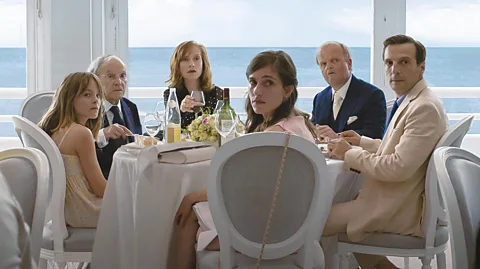
Eventually, we learn that the company in charge of the construction site is owned by the Laurents, a cultured, well-groomed clan which shares a grand Calais mansion. The head of the household is Georges (Jean-Louis Trintignant, who starred in Haneke’s last film, Amour), an imperious 84-year-old who has started to lose his faculties, but not his scowling hauteur. His two children, Anne (Isabelle Huppert) and Thomas (Mathieu Kassovitz), initially come across as caring parents and personable, decent professionals. It’s a long time before we see the depths of their contempt for their Moroccan servants, the area’s migrants, and anyone else who isn’t them.
The next generation doesn’t disguise its issues so well. Anne’s grown-up son Pierre (Franz Rogowski) still has enough of a conscience to be maddened by her, a madness demonstrated in spectacular fashion in a bout of drunken karaoke-breakdancing. As for Eve (Fantine Harduin), Thomas’s 12-year-old daughter from his first marriage, she can best be viewed as the Wednesday Addams of this Addams Family. In Haneke’s The White Ribbon, he envisaged a village of children who were so damaged that they would grow up to be Nazis. I dread to think what Eve might grow up to be.
As the family’s secrets are revealed, and its motives are uncovered, there are a couple of shocking moments of sudden, brutal violence, but, like the most effective Hollywood horror movies, the film skips over the worst atrocities - an indication that the Laurents themselves don’t give these atrocities a second thought. More appalling still are the calm, civilised dialogue scenes that have no violence in them at all, but which showcase the family’s callous assumption that money and lawyers can steamroller over anyone who dares stand in their way.
Happy End, then, is not the easiest film to watch, nor is it the cheeriest: this is Europe’s master of feel-bad cinema we’re talking about, after all. But when it reaches its not-so-happy end, Haneke’s complex jigsaw puzzle is satisfyingly complete. It isn’t just a meticulous picture of a family, but of the world.
★★★★★
If you would like to comment on this story or anything else you have seen on BBC Culture, head over to our Facebook page or message us onTwitter.
And if you liked this story, sign up for the weekly bbc.com features newsletter, called “If You Only Read 6 Things This Week”. A handpicked selection of stories from BBC Future, Earth, Culture, Capital, Travel and Autos, delivered to your inbox every Friday.
