The strange allure of the pillow fight

 Getty
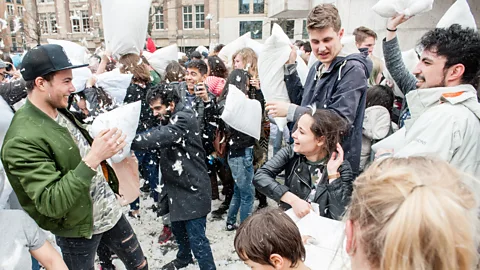
GettyThousands of people around the world have taken part in International Pillow Fight Day. It’s all good fun – but these fluffy flurries are actually weightier than you might first think, writes Kelly Grovier.
In the Frame
Each week Kelly Grovier takes a photo from the news and likens it to a great work of art.
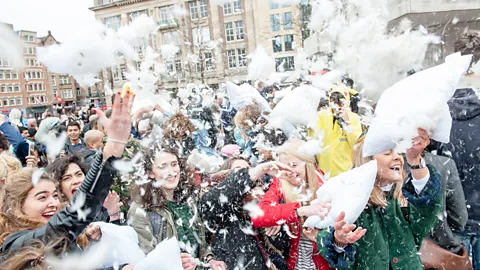
What are pillows really stuffed with? Not physically, but symbolically? The question occurred to me this week with the circulation in the news and social media of a flurry of photos from the 50 cities around the world that staged public celebrations for International Pillow Fight Day. Armed with nothing more than bring-our-own sacrificial cushions, strangers walloped each other in blizzards of playful plumes from Amsterdam to Atlanta, Warsaw to Washington DC. All told, thousands participated in the gleeful bash. But why? Is there anything more to this delightful duffing-up than smacks the eye?
As a cultural sign, the pillow is deceptively soft. After all, what could be less edgy than an object that is, by definition, cushy and filled with fluff? And yet, since at least the 16th Century, the humble pillow has been rumpled into unexpected profundity. The Chinese playwright Tang Xianzu who tells a famous story about a wise man who meets a despondent young scholar at an inn and offers him a magic pillow filled with the most vivid dreams of a seemingly more fulfilling life. When the young man awakens to discover that his gratifying 50-year dream has in fact come and gone in the short space of an afternoon’s nap, our impression of the pillow’s power shifts from wonder to terror.
 Getty
GettySubsequent writers have likewise seized upon the pillow as more than merely a comfy metaphor for easy sleep. When the 19th-Century English novelist Charlotte Brontë poetically observed “a ruffled mind makes a restless pillow”, she didn’t just scrunch up the expected order of the adjectives and nouns, but instead tossed-and-turned the sentence’s syntax in order to blur the boundaries between mind and matter – the thing resting and the thing rested upon.
In Brontë’s phrase, the pillow and mind swap places and, for a instant, merge into the same substance. It’s a trick perhaps she learned from the Renaissance philosopher Montaigne, who once insisted (with double-edged discomfort) that “ignorance is the softest pillow on which a man can rest his head”. On the multi-textured mattress of Montaigne’s thinking, intelligence and happiness face off forever in an existential pillow fight that only one can win. By Montaigne’s logic, there’s no sleep for the wickedly smart, only the invincibly stupid.
With the words of Tang, Brontë, and Montaigne buffeting our brains, we can perhaps more easily measure the allure of the global fluff-tussle that broke out across the world this week. Like a ritual of release, the annual international pillow fight amounts to a kind of cleansing, a brushing off of the fleeting flimflam of daily life: an emptying of the world’s collective mind. Rather than a launch-pad for weightless rest, the pillow is a subliminal emblem of heavy thought: an anchor that drags the world’s soul down – one that must be lightened.
 Chris 9/Flickr
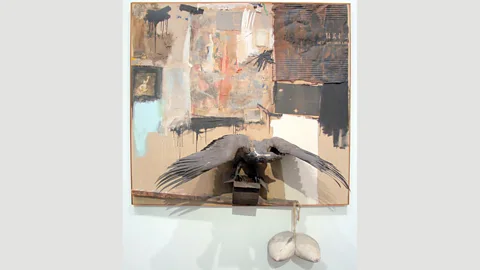
The tension between feathers that tether and those that provide propulsion invigorates a masterpiece of modern art: Robert Rauschenberg’s enigmatic multi-media work Canyon, which the US artist created in 1959. Hovering somewhere between painting and sculpture, readymade and collage, Canyon belongs to an idiosyncratic class of works Rauschenberg called ‘Combines’. Against a hodgepodge of photos, abstract splotches, and patches of cloth, the taxidermied body of a salvaged bald eagle perches on a small box that in turn rests on a protruding plank – the feathers of the bird’s unfurling wings are endlessly poising for flight. But the sense of outward movement that lifts the work’s spirit is counterbalanced by the strange, immeasurable weight of a pillow that sways surreally below the bottom edge of the Combine – dangling like the pendulum of a stopped clock.
In Rauschenberg’s work, the pillow is not just a ballast, it exemplifies the fight between the soul’s urge for freedom and the inescapable forces that pull everything back to Earth. Placed alongside the exultant photos from International Pillow Fight Day, Canyon reminds us what’s at stake if we never take time to pause and shake the feathers loose.
If you would like to comment on this story or anything else you have seen on BBC Culture, head over to ourFacebookpage or message us onTwitter.
And if you liked this story,sign up for the weekly bbc.com features newsletter, called “If You Only Read 6 Things This Week”. A handpicked selection of stories from BBC Future, Earth, Culture, Capital and Travel, delivered to your inbox every Friday.
