Why the shape in this photo has meaning in ancient Asian art

 Reuters/Mohammad Ismail
Kelly Grovier looks at the powerful geometry at work in a recent photo of an Afghan martial arts group.
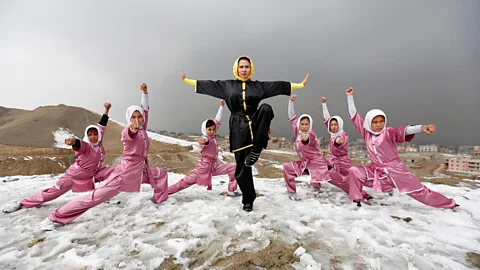
Clad in the ancient robes of a Shaolin monk and hoisted balletically on one foot, an instructor in Wushu, a modern form of traditional kung fu, rises above a tattered scrap of snow on a hilltop west of Kabul. What is truly remarkable about her statuesque stance (captured in a recent photo) isn’t merely its athletic grace or poetic air. Flanked on either side by a retinue of crouching students poised for combat, the female instructor strikes a formidable pose that is, in fact, socially audacious – one in elegant defiance of what is typically expected of her gender in Afghanistan.
Reuters/Mohammad IsmailUndeterred by those locals who believe practising the Chinese martial art is unbecoming of women, 20-year-old Sima Azimi (who learned Wushu in Iran) is committed to broadening the prospects of Afghan girls. While it is tempting to read in the Samsonian thrust of Azimi’s outward-stretching arms a metaphor for the shoving-over of chauvinistic norms, the allure of her fearless physique may be invigorated by even subtler symbolism.
Consciously or not, our eyes respond to a geometry in Azimi’s pose, as her body unexpectedly assumes the shape of a hexagram – a six-pointed star comprised of two overlapping triangles oriented in opposite directions. The upside-down triangle that is created by Azimi’s horizontally outstretched arms down to her planted foot is easy enough to discern. Superimposed against that, an upwards-pointing triangle is traceable from Azimi’s head through the slanting torsos of the two students nearest to her on either side – their bent thighs suggesting the base of the shape.
 Metropolitan Museum of Art, New York
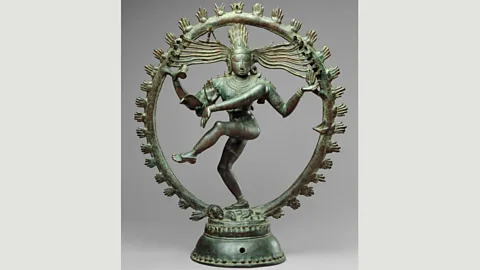
In ancient Asian artwork, the hexagram symbolised the harmonious fusion of masculinity (represented by the upwards-pointing triangle) and femininity (the downwards-pointing triangle). Among the most hypnotic embodiments of that merging of opposites is a famous depiction of the Hindu deity Shiva in the guise of Nataraja (the Lord of the Dance), whose carefully choreographed limbs echo the shape of the hexagram. Placed alongside Nataraja, the image of Azimi and her students is suddenly loaded with iconoclastic potential. Set in an otherworldly landscape of desert and snow, the photo announces the birth of a new and powerful cosmic talent with which the universe must contend: the indomitable Ladies of the Dance.
If you would like to comment on this story or anything else you have seen on BBC Culture, head over to our Facebook page or message us onTwitter.
And if you liked this story, sign up for the weekly bbc.com features newsletter, called “If You Only Read 6 Things This Week”. A handpicked selection of stories from BBC Future, Earth, Culture, Capital, Travel and Autos, delivered to your inbox every Friday.
