Film review: Does Natalie Portman soar as Jackie?


 Fox Searchlight Pictures
Capturing the former First Lady is a challenge, because she so carefully controlled her own image. Critic Sam Adams finds out how the Black Swan star fares in the role from the Toronto Film Festival.
With the prospect of a Hillary Clinton presidency on the horizon, there's been speculation about whether her First Spouse would wield undue influence in the prospective administration. But Pablo Larraín's Jackie, which dwells on the days immediately following the Kennedy assassination, suggests that powerful presidential partners are hardly a new phenomenon, even if they found it more effective to work in secret in the past.
As played by Natalie Portman and conceived by screenwriter Noah Oppenheim, Jacqueline Kennedy isn't just JFK's grieving widow but the immediate guardian of his legacy. The story is framed through interviews with a fictional journalist played by Billy Crudup, who's come to her house at Hyannisport hoping to peel back her famously composed exterior and reach the raw nerve underneath. But he finds almost immediately that Jackie is the one who will control the encounter. Even when she seems to let the mask slip, when she recalls what it was like to hold the fragments of her husband's shattered skull as their open car whizzed away from Dealey Plaza, she has enough composure to remind the journalist that he won't be allowed to use any of what she's just said. The meeting is entirely on her terms, and so, it's implied, is the movie itself.
Worth a thousand words
When the journalist tries to press Jackie into cooperating by suggesting that his written account will come to define how her late husband's legacy is perceived, she counters that the language of words is being replaced by the language of images. Writing may not be perfect, he argues, but "it's all we have." "It was," Jackie responds. "We have television now."
Jackie is centred around JFK's assassination, but far more screen time is devoted to the 1962 TV special in which Jackie spent an hour showing off the newly restored White House to some 80 million viewers. A Tour of the White House With Mrs John F Kennedy was, along with Robert Drew's documentaries Primary and Crisis, a turning point in the relationship between the presidency and the moving image – as, eventually, was Abraham Zapruder's endlessly studied footage of Kennedy's death. Jackie was known then mainly as the camera's subject, a vision in Chanel suits and pillbox hats, but Jackie makes a case for her as a star-auteur, consciously crafting not only her own image but the presidency's as well. When Lady Bird Johnson tries to help Jackie out of her blood-spattered suit on the Dallas tarmac, Jackie refuses: "I want them to see what they've done."
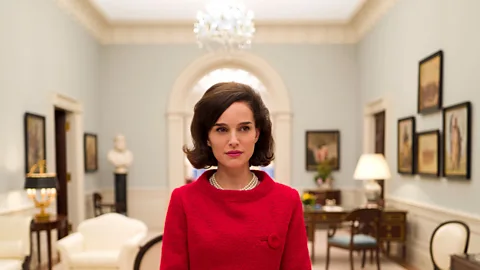
Portman's highly affected performance is deliberately off-putting at first: even with her cheekbones broadened by makeup, she looks too small for her bobbed wig and boxy clothes, like a child who's just raided a dress-up box. But the artifice becomes more engrossing the longer she sustains it, especially amid the more naturalistic portrayals of Bobby Kennedy (Peter Sarsgaard) and Lyndon Johnson (John Carroll Lynch). (Danish actor Caspar Phillipson appears as JFK, but he never speaks, although he's an uncanny ringer, especially in profile.) It's as if she's the only one who's never allowed to let down her guard, whose conscious presentation of self has eclipsed whatever might have preceded it. "I lost track somewhere what was real, and what was performance," she reflects. Jackie suggests that distinction may be moot.
Portman's never been one to disappear into her roles, but here that's a strength. The fact that she always feels like she's acting lends the character a tragic dimension: even her most intimate feelings are the subject of public speculation, and rather than duck the press and let them invent their own story to fill the vacuum, she takes the reins herself. When she returns to the White House, she calls for books on the funerals of presidents who died in office, those who are remembered and those who aren't; eventually, she opts to emulate Lincoln's. The movie even contrives to have Jackie write part of the script herself: Larraín recreates Jackie's TV tour of the White House with painstaking detail, an event which showed the First Lady's desire to 'control the narrative' and engage in mythmaking about her husband's place in history.
Larraín doesn't a knack of mixing the meta with melodrama; Jackie goes dead in the moments when we're meant to simply feel its protagonist's pain rather than dissect it. It's an intellectual experience rather than an emotional one, but the ideas in play are so heady they're enough to sweep you away on their own.
★★★★☆
If you would like to comment on this story or anything else you have seen on BBC Culture, head over to our Facebook page or message us onTwitter.
And if you liked this story, sign up for the weekly bbc.com features newsletter, called “If You Only Read 6 Things This Week”. A handpicked selection of stories from BBC Future, Earth, Culture, Capital, Travel and Autos, delivered to your inbox every Friday.
