The 500-year-old hidden ‘Easter egg’

 Hieronymus Bosch/Wikipedia
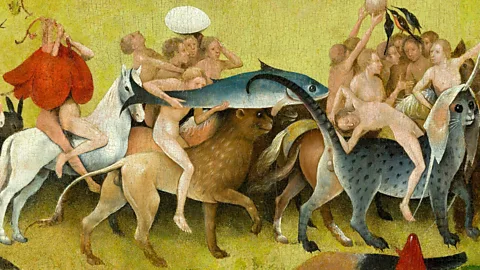
One of the most famous paintings in Western art features its own kind of covert ‘Easter egg’. Kelly Grovier finds a secret cipher in The Garden of Earthly Delights.
Did you know that the world’s first Easter egg was created in 1979? No, not the kind that children hunt in gardens. (That tradition is ancient and dates back to early Christians in Mesopotamia.) I mean the type of hidden messages, or inside jokes, that computer programmers conceal inside their products. The American electronics company Atari first referred to these secret communiqués as “Easter eggs” 37 years ago, after it was revealed that one of its designers tucked his name into one of its games for players to discover.
 Holger Hollemann/AFP/Getty Images
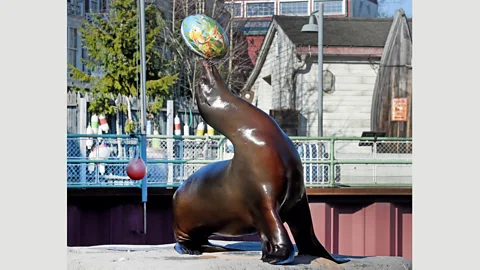
The role of covertly planted “Easter eggs” from which deep truths hatch is nothing new in the history of art. Once spotted, these camouflaged messages are as obvious as a rainbow beach ball in an empty white room. The practice of concealing secret ciphers just under our noses (or above them) was brought to mind by a photo in the news this week of Pamela, a sea lion at the Hanover Zoo in Germany, caught balancing an oversized Easter egg. The colourful ovoid is suspended like a planet hoisted gracefully in the firmament, reminding us that life’s precarious beauty and fragile joy are often to be found staring us right in the eyes if we just know where to look.
 Hieronymus Bosch/Wikipedia
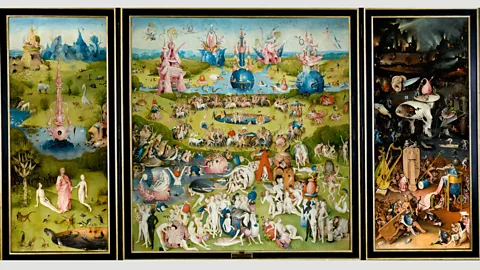
Do you know where to look? What if I were to give you a great garden – the most famous garden in the history of art – could you find the Easter egg that’s concealed in plain sight: the secret symbol that centres the eye and ties the work together? Lose yourself, if you dare, in The Garden of Earthly Delights (c. 1490-1510), the mesmerising Renaissance triptych by the early Netherlandish painter Hieronymus Bosch, whose death 500 years ago in 1516 will be commemorated this August.
The precise meaning of the masterpiece’s three intensely intricate panels – which appear to take the viewer’s eyes from Eden (in the leftmost panel) to a realm of sensual abandon (in the centre) to Hell (on the right) – is the stuff of endless art-historical debate. Amid the carnal romp and riotous revelry of the central panel, Bosch has preserved purity teetering perilously above a surging sea of temptation and sin.
 Hieronymus Bosch/Wikipedia
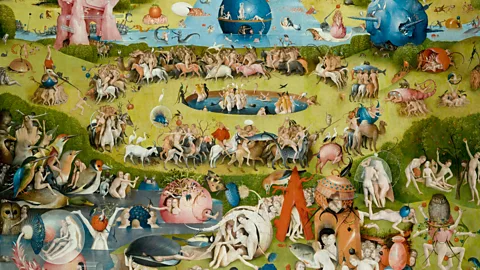
To find the one un-cracked egg in the garden of earthly delights, one need not look behind a single leaf of grass, or pry open a single man-crushing mollusc, or peer into a single strange translucent bulb of Bosch’s bizarre vision. To find it, one’s eyes need merely draw an ‘X’ from the four corners of the work and an egg marks the spot, smack before us at the dead centre of the painting. Suddenly, the tempestuous vision collapses into a mystical vanishing point. Through the timeless symbol of the unhatched egg, Bosch offers us a way out of his troubled work: the hope of a birth that’s evermore about to be.
100 Works of Art That Will Define Our Age by Kelly Grovier is published by Thames & Hudson.
If you would like to comment on this story or anything else you have seen on BBC Culture, head over to our Facebook page or message us onTwitter.
And if you liked this story, sign up for the weekly bbc.com features newsletter, called “If You Only Read 6 Things This Week”. A handpicked selection of stories from BBC Future, Earth, Culture, Capital, Travel and Autos, delivered to your inbox every Friday.
