Film Review: Idris Elba is chilling in Beasts of No Nation

 Netflix
The British actor takes on a role unlike any he’s played before, as a warlord who leads child soldiers into battle. It’s haunting film-making, says critic Owen Gleiberman.
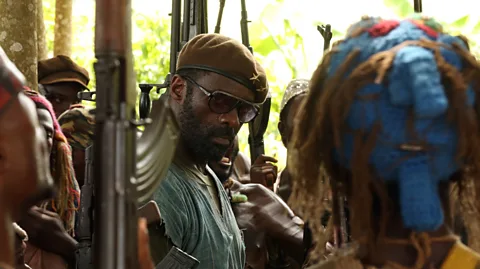
There are moments when a film proves its power with a scene so devastating it makes you want to turn your eyes away from the screen. In Beasts of No Nation, Cary Joji Fukunaga’s brutally intense movie about a child soldier trapped in a civil war in an unnamed West African country, Agu (Abraham Attah) stands in the road with a machete in his hand. The knife has been given to him by Commandant (Idris Elba), a glowering warlord who has recruited the boy to join his mercenary army of stone-faced young killers. The time has come for Agu to prove that he too can kill. A victim-to-be kneels before him, weeping and trembling – his crime? Not belonging to the proper faction. Commandant instructs Agu on how to bring the machete down, as if he were chopping wood; his words whip up the boy’s bloodlust and the audience’s fear. By the time Agu does the grisly deed, we’re praying we don’t have to watch it. Yet there’s nothing exploitative in the blood-gushing horror; the scene carries a ghastly force. We’re seeing an innocent soul cross over to the other side.
Beasts of No Nation is about a society in full, terrifying breakdown, and the movie is shot with a vividness that mirrors the horror it portrays. Yet it’s also a supremely controlled and orchestrated piece of film-making. Fukunaga, coming off his potent direction of the first season of HBO’s True Detective, proves he is an artist who can work, with staggering skill, in the jittery, explosive tradition of movies like Oliver Stone’s Salvador. Beasts is based on a 2005 novel by Uzodinma Iweala, but the film’s true meaning lies in the flow of its images – the perpetual discovery of violence and the cold power of it as something that has taken over the identities of these boys and young men, filling up the space where their emotions used to be.

The price of power
Agu, who saw his father and brother executed in the street after a coup, is a rootless child who’s programmed into becoming a kind of murderous robot. If we wonder how a child could act so lethally, the film reveals that there’s a terrifying logic to it: children do what they’re told – so if they’re taught to kill, it will become ‘normal’ to them, even if they’re destroying themselves in the process.
Then again, they can’t be taught by just anyone. Idris Elba, bulky and towering, in sunglasses and a paramilitary officer’s beret, plays Commandant as a shrewdly manipulative cult leader. He teaches his charges that they’re on the side of right, and the movie is just sketchy enough about how this country first fell apart that we can almost buy that he’s right – that the military junta his guerrillas are fighting is a regime of oppression. But if Commandant pretends to stand for justice, the film implies that his true cause is violence for its own sake. He’s become addicted to power, and Elba, in a magnetically ominous performance, gives him the scary brilliance of a master criminal. He takes Agu under his wing, becoming the boy’s protector, and there’s something creepy about that even before we see the full evil of what he demands.
Beasts of No Nation is the first film at this year’s Toronto International Film Festival to generate major Oscar buzz, but I suspect it may struggle to find an audience, and not because it’s too violent. As accomplished and disturbing as the film is, there’s often something a little remote about it. Fukunaga adopts a mode of raw objectivity, and though the verité images are extraordinary, we often feel distant from Agu as a character. The movie could have used more dialogue-driven scenes like the one in which Commandant meets with his Supreme Commander and learns, to his outrage, that he’s being demoted. That said, the film has a haunting, indelible quality. Beasts of No Nation reminds you of a crucial thing that movies can do: they have the power to depict what’s happening in the world, so that things you thought you knew become heightened in the mind’s eye, until it feels you’re witnessing reality itself.
★★★★☆
If you would like to comment on this story or anything else you have seen on BBC Culture, head over to our Facebook page or message us on Twitter.
