Everest review: An uphill climb

 Universal Pictures
Marred by weak characterisation and a story that’s over as soon as it’s begun, Everest never gets beyond the foothills, writes Nicholas Barber.
The Venice Film Festival tends to open with prize winners. Last year’s opener was Birdman – a subsequent Oscar triumph – and the year before that there was Gravity, so 2015’s choice has, you might say, quite a mountain to climb.
On paper, though, Everest seemed likely to be just as feted as its immediate predecessors. Directed by Iceland’s Baltasar Kormákur, it’s a star-studded true-life survival drama about the climbers who were caught in a blizzard on the world’s highest mountain in 1996. A shoo-in for the Oscars? Sadly not. As appalling as the events it depicts may have been, the plodding narrative and weak characterisation mean that, as a piece of cinema, it never gets beyond the foothills.

It’s probably best to see it as an enlightening primer on the Everest industry. Starting his film with a huge number of captions and lectures on the subject, Kormákur tells us that, after Tenzing Norgay and Edmund Hillary conquered Everest in 1953, numerous small teams of professional mountaineers followed in their footsteps, many of them dying in the attempt. That all changed when a New Zealander, Rob Hall (Jason Clarke), set up his Adventure Consultants company to guide amateurs up Everest, and to guide them down again, for $65,000 (£43,000) a pop.
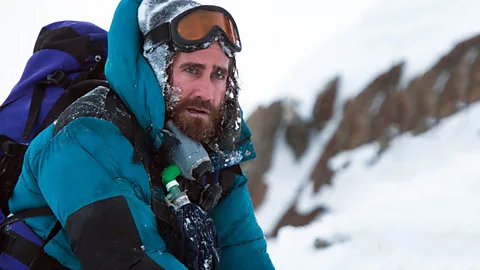
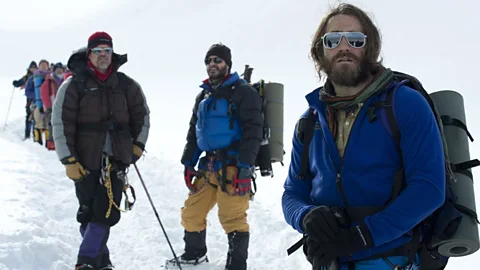
Unfortunately, Hall was so successful that other companies got in on the act, and Everest was soon crowded with inexperienced tourists, all hoping to reach the top during the two weeks in May when weather conditions were at their least heinous. By the time Hall and his clients (played by Josh Brolin, John Hawkes and others) set out in 1996, the mountain had a Spring Break atmosphere about it. Ropes hadn’t been mended, ladders were wonky, oxygen canisters weren’t where they were supposed to be. Meanwhile, a boozy rival guide (Jake Gyllenhaal) was having coughing fits and bouts of diarrhoea. His company was named Mountain Madness, no less. What could possibly go wrong?
 Universal Pictures
This background information is interesting enough, and it makes a persuasive case against the commercialisation of such an insanely perilous undertaking. But it always feels like background information, rather than a riveting story. The facts are laid out without any subtlety, and the characters never evolve from stereotypes to human beings.
Brolin, for instance, labels himself as “100 per cent Texan” – and that’s all he has to work with. At base camp, Emily Watson plays someone described as the Adventure Consultants’ mother figure – and so she is. As for Clarke, he plays an impeachable hero with a standard-issue pregnant wife (Keira Knightley, doing her best in a tiny role). “Just be back for the birth, Rob Hall,” she instructs him at the airport. “You try and stop me,” he replies, like a thousand movie explorers before him. The screenplay, by William Nicholson and Simon Beaufoy, definitely won’t be scaling the peaks of award-winning glory.
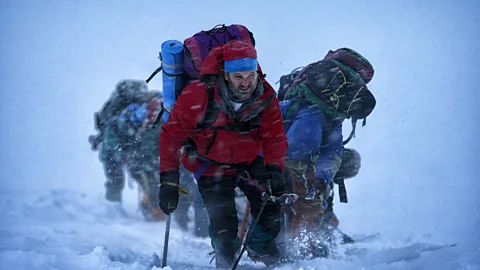
On and on this scene-setting goes, and we’re more than an hour into a two-hour film before anyone suffers anything more severe than a stomach ache. Then, when the snowstorm does hit, the story is over before it’s begun. Nothing spectacular happens. There are no brilliant rescue plans or amazing strokes of luck. It’s not even clear what the climbers have to achieve, or where they are in relation to each other, despite all the captions telling us that they’re on “The Balcony” or “The South-East Ridge”. (Ah, so not the North-West Ridge, then. Good to know.)
Essentially, everyone is immobile and helpless, so all we – and they – can do is wait to see which of them gets off the mountain alive.
 Universal Pictures
Still, even if Everest lacks an involving plot or characters, you can imagine Werner Herzog or Paul Greengrass staging the ordeal with such nerve-jangling immediacy that you’d stumble out of the cinema in a state of shock – as some of us did after seeing Gravity and Birdman. But Kormákur (who directed a couple of Mark Wahlberg action movies, 2 Guns and Contraband) makes the mountain look cleaner and brighter than the one where Elsa had her ice palace in Frozen.
The blatantly computer-generated storm clouds reassure us that no one is in any actual danger, and the tightly-framed shots remind us that the actors are never more than 10 feet away from a camera crew. If the view from the summit really was as anti-climactic as it appears in the film, I would have asked for my money back.
Indeed, I was so detached from the horrors endured by the unlucky mountaineers that, instead of feeling scared for them, I was wondering why they had paid to come to Everest in the first place. Couldn’t they have found something better to do with their $65,000?
★★☆☆☆
If you would like to comment on this story or anything else you have seen on BBC Culture, head over to our Facebook page or message us onTwitter.
