Film review: Beyond the Brick

 Getty Images
Beyond the Brick: A LEGO Brickumentary explores how the plastic building blocks inspire new levels of fandom and geekery. Owen Gleiberman reviews the film.
It wasn’t too long ago that geek culture, or obsessive fan culture in general, seemed quirky, eccentric, and maybe even a bit warped. To a lot of people, it has always been a cultish if benign phenomenon indulged in by others, something to stare at with a touch of mockery and befuddled awe. Trekkies. Deadheads. The superfans of The Lord of the Rings or Doom. And, of course, that annual Woodstock pilgrimage of arrested development: the eager, freakish hordes of Comic-Con. Yet just as computer nerds started off as marginal creatures who then took over the world, geek culture is now spreading so quickly that it’s threatening to become the new normal. In the splintered universe of the internet age, more and more people feel like they need a club, a guild of the like-minded.
Beyond the Brick: A LEGO Brickumentary takes us inside a whole new level of geekdom – the global phenomenon of Lego fanatics, many of whom are adults – and the hook of the film is how appealing they are in all their tinkering plastic mania. They’re on the cutting edge of 21st-Century geekdom, but they’re also a bit like the model-train enthusiasts of yore. They take something that was originally meant for children and build it, through the sheer scale and ambition of their imagination, into a skewed form of art.

The film starts by outlining the history of Lego, which was invented in 1949 by a humble Danish carpenter named Ole Kirk Christiansen. Two facts leap out: there are now more than 100 Lego pieces in existence for every person on the planet. And if you happen to have a Lego brick dating from, say, 1955, it will still fit perfectly into a Lego brick made today. Christiansen’s vision was to create a child’s construction toy whose parts would all be part of a system, one that was crisp and mathematical and finite. What he didn’t envision – and what no one could have – is that the system, in its form-fitting simplicity, would invite infinite possibilities.
‘Labours of love’
In Beyond the Brick, we meet a man who has built an entire live-in house out of Lego, and two others who’ve used thousands of the tiny pieces to manufacture a working automobile. There are designers who construct human-size replicas of Gandalf and Iron Man, complete (in the case of the former) with facial furrows. At a Lego factory inside the Czech Republic, a team assembles the largest Lego sculpture in history: a 45-foot-long replica of an X-wing fighter from Star Wars, which then goes on display in Times Square. That sounds a bit industrial, but most of the inventions we see in Beyond the Brick are highly personal labours of love, like the swirly textured scale model of Rivendell – the mythical city from The Lord of the Rings – built by a housewife who wins the People’s Choice award for it (“I went from doing laundry one day to having over two-and-a-half million hits on my Flickr pages”).
At Brick-Con in Seattle, we pick up on the lingo of Lego geeks, who favour acronyms like AFOL (Adult Fan of Lego), NLSO (Non Lego Significant Other), POOP (Parts Out of Other Parts), BURP (Big Ugly Rock Piece), and LURP (Little Ugly Rock Piece). What strikes you about these true believers is how blissful they look within their colourful modular alternate universe. They’re hooked on a near-spiritual metaphor: the tension between the rational, locked-in squareness of Lego and the endless possibilities that emerge from it.
Master builders
Still owned and operated in Denmark, Lego is now a $4 billion business, and Beyond the Brick is an act of branding, with Lego presented not just as a worldwide obsession but as a cause for the greater good. As someone who grew up on the Lego of the ’60s and ’70s, I would have liked to hear more about how the toy first infiltrated the lives of kids, but the film skims over those key early chapters of the Lego story. Beyond the Brick wants to cut right to the era of mini-figures and movie-tie-in models - an evolution that redefined the company, but nearly did it in during the early 2000s, when Lego scaled back production of its basic blocks in favour of prefabricated models. More crucially, Beyond the Brick is so intent on presenting its amateur master builders as fully realised artists that it barely even bothers to show us their methods. How exactly do you dream up and construct a scale model of Rivendell? That’s a big missing piece of the film.
What’s catchy and authentic about Beyond the Brick is that even as it strives to celebrate Lego as a Disney-like force of fun, it invites the audience to sink deeper and deeper into a kind of mania. There are a few celebrity Lego builders on hand, like Trey Parker of South Park, who explains that he needed an antidote to the chaos of putting that show together and found it in the therapeutic order of Lego. But then there’s the Danish mathematician who spends a week figuring out how many ways you can combine six Lego bricks (915 million, in case you were wondering). There are the makers of “brick films” whose insanely exploding stop-motion aesthetic inspired The LEGO Movie, and there’s Brickarms, an independent store in Seattle devoted entirely to Lego-ised weaponry, which leads people to construct vast battle scenes, from Normandy to Fallujah.
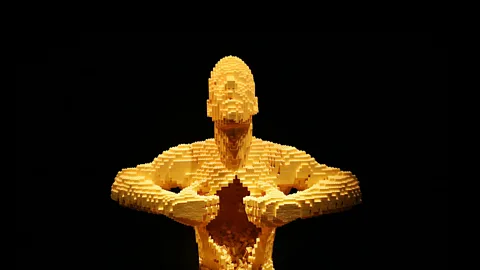
And then there’s Nathan Sawaya, the New York Lego artist whose sculptures and re-creations of legendary masterpieces are pure eye candy. He doesn’t simply replicate the Mona Lisa or The Starry Night; he captures the lighting of Rembrandt. In his way, Sawaya does something extraordinary: he deconstructs the very idea of beauty by constructing it, brick by brick. And that’s the true inner madness of Lego: It started off as a toy, but it’s become a drug whose main effect is to show its users that the world is greater than the sum of its parts.
★★★☆☆
If you would like to comment on this story or anything else you have seen on BBC Culture, head over to our Facebook page or message us onTwitter.
