Film Review: Is Still Alice really worthy of an Oscar?

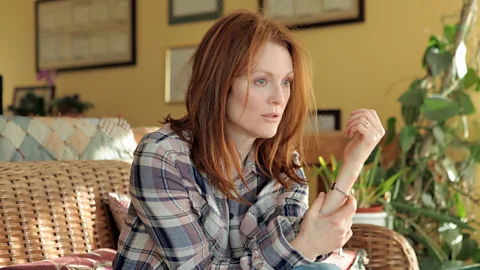
Oscar forecasters consider Julianne Moore’s performance as a woman with Alzheimer’s the frontrunner for best actress. But is the movie any good? Owen Gleiberman delivers his verdict.
Dramas that focus on intense physical or mental disability have always been popular during awards season, and for obvious reasons. If you're playing someone who's blind, or shrinking from paralysis into a wheelchair, or in the cruel throes of some degenerative brain disease, then you get to show off two things at once: the technical virtuosity of twisted limbs or contorted facial muscles and the linked ability to display crushing emotional devastation. These more or less cover the gamut of actorly skills as far as the Academy Awards are concerned.

Yet affliction dramas are seldom great art. Most of them are just feel-good horror movies: we observe the slow grip of illness with cringes of shock and dismay, generally coupled with moments of soft and gooey sentiment. The films are designed to inspire the feeling that next to the wracked and anguished souls on screen, we in the audience would do well to realise just how lucky we are. The rare exception – and I have no problem calling it the Citizen Kane of the genre – is My Left Foot, in which Daniel Day-Lewis laid out the Irish writer Christy Brown's passions and demons with such uncanny depth of spirit that we experienced his agony, his ecstasy and everything in between.
Maybe it's because affliction dramas are usually so overripe that the creators of Still Alice have now gone in the opposite direction. The movie, in which Julianne Moore plays a 50-year-old linguistics professor diagnosed with early-onset Alzheimer's, is about unruly and terrifying emotions: the fear of losing your memory, of being robbed of the very engine of your identity. Yet Still Alice has a controlled, almost painstakingly pristine surface that is seldom, if ever, disrupted by anything too messy. At the risk of sounding like I'm talking about some new nerve malady, the movie is a textbook case of the stiff-upper-lip weepie.
The film's pivotal irony, and it's both intriguing and a little obvious, is that Alice Howland (Moore), a scholar at New York's Columbia University, is losing her memory, yet she's a reknowned researcher and lecturer who has devoted her life and career to studying the enigmatic contours of the mind. “Look,” the movie practically shouts, “early-onset Alzheimer's can happen to anyone! Even someone this brilliant!” And even someone with the ideal bourgeois intellectual existence.
Alice travels the world to spread her insights on cognitive theory, and when she returns to New York, it's to a spacious Upper West Side brownstone she shares with her doting husband (Alec Baldwin), a research scientist whose only apparent flaw is that he tends to get a little obsessed with his own work – but then, that's why these two get along. The only problem this family has is its youngest child, played with deadpan tenderness by Kristen Stewart. She's trying to make it as an actress in Los Angeles, but Alice never misses the chance to point out what a subsidized and deluded thing her daughter's 'career' really is. These two can't have dinner without striking sparks of discord. Then again, in a movie like Still Alice, that's just setting the stage for a warm-and-fuzzy reconciliation.
The pain of forgetting
It’s during a holiday dinner that the fog Alice has been feeling in her head starts to reveal itself, though she makes a game attempt to keep it hidden, even from herself. Moore, in movies from Crazy, Stupid, Love to Far From Heaven, has proved peerless at playing a certain kind of outwardly composed, smiley and sincere middle-class paragon who will do anything to keep the anxieties that are nibbling away at her from flashing across her face. Here, Alice can no longer rationalise away her fear when she takes a routine jog around the Columbia campus and becomes utterly disoriented. Where is she? More to the point: where is her mind?
Alice visits a neurologist, and the film's directors, Richard Glatzer and Wash Westmoreland, stage these scenes with a clean-cut anxiety, keeping the camera pinned on Alice as she rifles through flashcards and tries to answer memory test questions. At first she does well, and we're as relieved as she is. Maybe it's nothing. But then a scan reveals evidence of the brain erosion associated with Alzheimer's, and Alice greets the news like the scientist she is, without much fuss. She accepts what's happening to her, in keeping with the film's stoic avoidance of anything that might resemble histrionic despair. When Alice hides a bottle of sleeping pills in a drawer and, on her laptop, records a message of suicide instructions meant for her future impaired self, it sounds like it should be a devastating scene, but instead it plays as if the filmmakers are saying, "Right, good decision." What Alice demonstrates isn't so much terror as the fading-memory version of grace under pressure.
This is admirable, touching and, frankly, a bit of an anti-climax. Still Alice doesn't build in intensity; it fades slowly, just like Alice herself. That's the challenge confronting any drama that deals with Alzheimer's: how do you portray this affliction honestly without having the person in question simply drift away from the audience? When Still Alice works, it's because the film isn't above tweaking our primal fears. A superb scene in which Alice, having made her condition public, reads a speech to a roomful of researchers, crossing off each sentence with a yellow highlighter so that she won't read it again, is clinically suspenseful, and when she fumbles and drops her papers on the floor, we're aghast in empathy.
Yet even that chilling moment suggests how Still Alice could have gone further. The movie should have shown us not just the textbook steps of the disease’s advance but the way that Alice's soul must surely be raging at the dying of the light. True to its title, Still Alice would like Alice to be herself, right to the end. But that comes close to making it the politically correct version of an Alzheimer's tragedy. The audience is invited to stay uplifted, even when faced with the prospect that all is lost.
★★★☆☆
If you would like to comment on this story or anything else you have seen on BBC Culture, head over to our Facebook page or message us on Twitter.
