'Complex, dangerous, sexual beings': The centuries-old origins of current fairy fiction

 Alamy
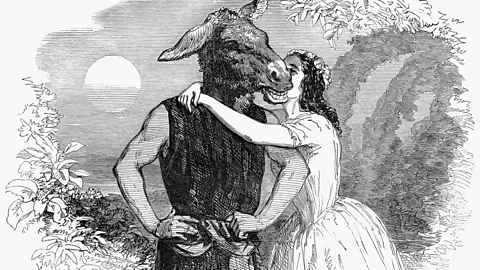
AlamyThe fairies in faerie romantasy – or erotic "fae" fiction – are not the glittery, do-gooding sprites of children's stories. They are dangerous, shape-shifting spirits – just as they were in centuries-old folklore, according to a new book about fairy history. From the ancient Nordic forest fairies and the 15th-Century Mélusine legend to Shakespeare's Midsummer Night's Dream, faerie folklore is full of deception and seduction.
Two new novels were announced in the romantasy series A Court of Thorns and Roses recently – and immediately the share price of the books' publishing house soared by an astonishing 20%. The series' author Sarah J Maas is a very big deal in publishing, with her books translated into 40 languages and global sales of more than 70 million. Her success is part of a wider surge of fairy romantasy – also jokingly referred to as "faerie smut".
The genre typically sees a female heroine facing challenging quests in an elaborate fantasy world, usually the world of the fae, an Old French word for fairies. She becomes romantically involved with a complicated, unpredictable and otherworldly figure. There is typically an erotic element – fans refer to the level of "spiciness", which can range from relatively chaste kissing scenes to explicit descriptions of sexual encounters.
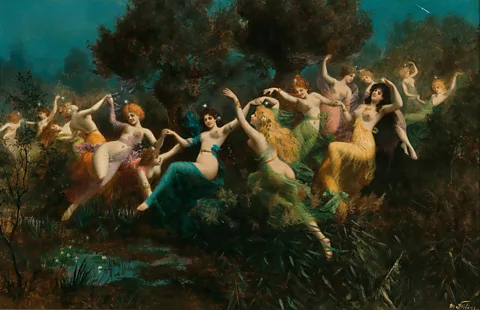
Yet the steamy element of the current genre is nothing new. The fairies of fae fiction are not the sparkly, wand-waving, wish-granting benevolent beings of young children's bedtime stories and Victorian imagery. They are complex, dangerous, sexual beings – which is exactly what the fairies of folklore were originally like.
"The connection between fairies and sexuality goes all the way back," says Francis Young, the author of new book, Fairies: A History. "It's there in the tradition of fairy women or fairy men seducing human women or human men. Probably the most famous example of a story like that would be the story of Tam Lin."
 Alamy
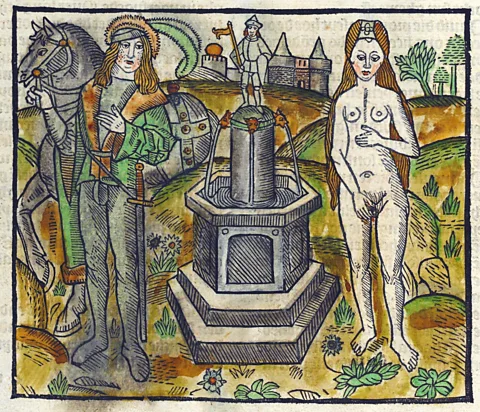
AlamyIn this old Scottish ballad of the 1540s, a woman named Janet plucks a rose in the forest of Carterhaugh and is confronted by a handsome young man named Tam Lin. Later she discovers she is pregnant and seeks out Tam Lin again. He tells her he is being held captive by the Fairy Queen but Janet can win him back if she follows his instructions.
There is a strong sexual subtext to the ballad. Janet wears green, associated with seduction, has possibly gone to the forest with the purpose of enticing Tam Lin, and in some versions she has to hold on to him tightly as the fairies magically transform him into various forms, ending with him as a naked man.
The traditional notion of the male hero rescuing the imperilled damsel is reversed here, and Sarah J Maas has cited the ballad as one of her inspirations. One of the main characters of the A Court of Thorns and Roses (ACOTAR) universe is called Tamlin.
Young points out that there are similar stories well beyond Britain and Ireland. "There is the Nordic skogsrå [forest fairy or spirit] who appears as a beautiful, seductive woman in the woods, but if you look closely you'll see she has the hooves of a cow. Anyone who has sex with her will die within a year," he says. "The skogsrå are similar to the Scandinavian huldra."
Otherworldly spirits
Another group of stories involving a sexual relationship between a figure from the supernatural "otherworld" and a human are collectively known as the Mélusine legend – a tale of a powerful water spirit or fairy. Kelly Fitzgerald, Head of the School of Irish, Celtic Studies and Folklore at University College Dublin, tells the BBC: "The Mélusine legend [1393] comes from the French tradition but is very strong in Ireland – the human male marrying the selkie or seal-woman."
 Alamy
AlamyThis type of story also has its converse – in which a female protagonist falls in love with a beast which turns out to be an enchanted man. Fitzgerald, who is the author of Irish Folk and Fairytales, offers the example of a Donegal tale about a princess who marries a man whose stepmother has turned him into a bull – another enchantment allows him to turn back into a man by night when he takes to the princess's bed.
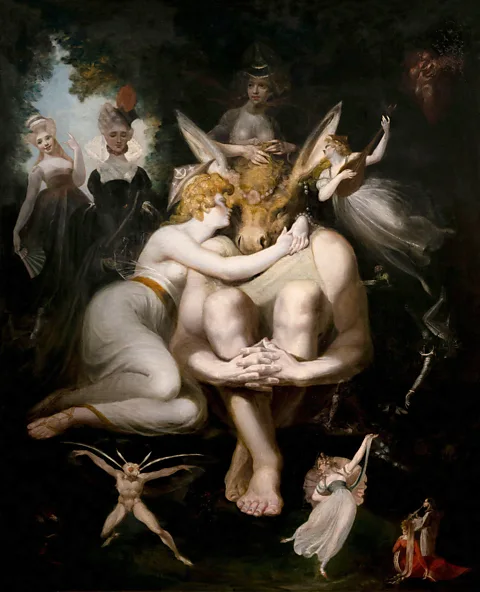
There are echoes of this type of folk tale in Shakespeare's A Midsummer Night's Dream, written in the mid-1590s. Titania, the queen of the fairies, under an enchantment, falls for a weaver called Bottom who has had his head changed to that of a donkey by Puck, the Fairy King's mischievous and sometimes cruel lieutenant (a puck is a type of fairy, related to the Irish "pucca", and a puck can also be addressed as Robin Goodfellow). Titania has four attendants: Moth, Peaseblossom, Cobweb and Mustardseed – and many productions emphasise the fairies' erotic potential. A 1999 RSC production directed by Michael Boyd was so sexually charged that a school party left at the interval.
Fallen angels and demi-gods
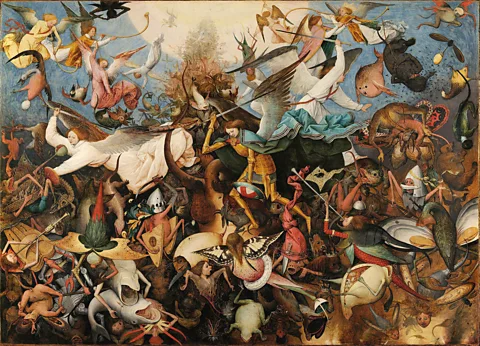
The debate over what exactly fairies are – fallen angels, demi-gods, the spirits of humans – continues, and some see their antecedents in the likes of Lilith. Possibly of Mesopotamian origin, Lilith was adopted into some Jewish folk traditions as the first wife of Adam who was cast out of Eden after demanding to be his equal. She has sex with men, often when they are asleep, in order to be impregnated. Lilith is often associated with Lamia, a figure from Greek myth. Lamia also seduces men and, like Lilith, steals babies, a common fae behaviour.
It is difficult to pinpoint exactly when or why fairies began to change from the capricious and frightening beings of folklore into the glittery-winged, delightful do-gooders many think of today. According to the book Magical Folk: British and Irish Fairies 500AD to the Present by Simon Young and Ceri Houlbrook, the first fairy wings "appear only at the end of the 18th Century in paintings, and were an invention of a cabal of British artists rather than a feature of traditional folklore. It took 70 more years for fairy wings to be mentioned in fairy tales, then another 50 for the first claims that people had seen fairies with wings."
 Alamy
AlamyThe same book points out that belief in fairies decreased from the mid-19th Century with the advent of the industrial age, maybe as a result of urbanisation and a decline in the sort of rural places the little folk favoured, or maybe as a result of an increase in scientific knowledge and scepticism about folk superstitions. Perhaps improving infant mortality also contributed to the fading of the fairies.
In some ways JM Barrie's creation Tinker Bell, from Peter Pan, represents both the older traditions and the new: she physically resembles the cuter sort of fairy but she is chaotic and cruel – and sexually jealous of Wendy.
Why fae romantasy is exploding now
If fae romantasy is drawing on traditions that are thousands of years old, why is its popularity exploding now? The core reader demographic is young women, though more men seem to be picking up on it recently. Book sales are rocketing and several TV adaptations are in the works.
"I think readers are wanting escapism now more than ever," The Bookseller's Katie Fraser tells the BBC. "These books provide comfort."
Fraser, who is a reader of fae romantasy, is not a fan of the phrases "fairy smut" or "fairy porn". "I strongly disagree with the 'fairy porn' moniker," she says. "It devalues work written by women and primarily read by a female audience. Yes, the books contain sex, but they also include propulsive plots and focus on female agency and empowerment."
 Alamy
Alamy"Historically, women have always been greater readers of romantic fiction than men," says Fitzgerald. "[Romantic fiction publishing imprint] Mills & Boon is fantasy and escapism. And a figure like Poldark, from the Winston Graham novels, is just as much a fantasy as a lover from the fae otherworld."
More like this:
She adds: "Obviously there is something about these timeless stories that really captures the human imagination. They have been told and retold and the way they are manifesting at the moment is perhaps a response to the way the world is now, and there is a need for them."
"Also," she laughs, "I understand the young adults of today aren't having as much sex as young adults of 10 years ago. Could that have anything to do with it?"
--
If you liked this story, sign up for the Essential List newsletter – a handpicked selection of features, videos and can't-miss news, delivered to your inbox twice a week.
