'One of the harshest places on Earth': The 1960s green 'Utopia' that tried to reinvent the world

 Gaviotas
In an extreme environmental and political climate in the Colombian savannah, one maverick village has relied on its homegrown inventions to survive, down to adapting children's see-saws to draw water for the community. None of the village's inventions are patented, but they have nonetheless made their mark on the wider world.
Amid the vast, remote and sparsely populated plains of eastern Colombia, known as Los Llanos, about a day's drive from the capital Bogotá, an 80 sq km (31 sq mile) patch of luscious man-made forest flourishes. There, for over half a century, a small and self-sustaining community called Gaviotas has been defying all odds, thriving on the inhospitable land, helped by a myriad of quirky, futuristic inventions.
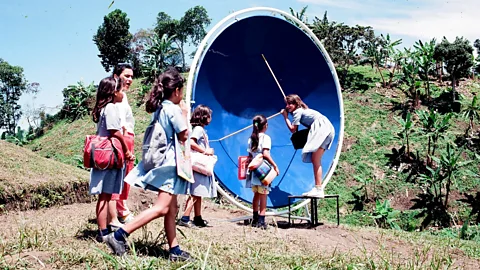
The pioneering technologies range from low-cost solar water heaters to a children's see-saw that doubles as a water pump, from edible forest gardening to biofuel. Some were inspired by traditional methods used by local indigenous communities, while others resulted from tireless, ingenious tinkering with the few available resources.
Once considered eccentric and outlandish, many of the village's inventions have stood the test of time. Initially developed in response to the village's very specific local needs, they have been successfully replicated elsewhere in Colombia and beyond. The philosophies born from these experiments have inspired other similar projects, and shown the world another way to approach sustainability.
And yet, the village itself, in its idiosyncratic approach to life in a harsh landscape, remains almost unique.
"I don't understand why something so simple – so simple that Gaviotas has accomplished it in one of the harshest places on Earth – I don't understand why it's not being done elsewhere," says Paolo Lugari, who founded the community in the 1960s.
As Gaviotas continues to adapt to a changing world, it also raises vital questions. How do you keep a sustainable community going in a world that shapeshifts so quickly? What does the community – and its ethos – win, and what does it lose, as it changes?
 Gaviotas
It was 1966 when Lugari, a 20-something Italian-Colombian from a prominent political family, travelled across Los Llanos by plane and was overcome by a fervent vision of creating a verdant, flourishing settlement here. For a couple of years following that first trip, he worked on the idea and recruited close ones who would build this community with him.
Finally, in 1971, Lugari bought a plot of land in the Vichada province under the ownership of a non-profit foundation, and the motley crew of about 20 people founded a new settlement. They called it Gaviotas, meaning seagulls in Spanish, in honour of the bright white river birds flying over them as they built their new homes.
From the beginning, they faced huge challenges. The climate in Los Llanos is notoriously brutal and ricochets between violent rains that flood the land and scorching sunshine. Over the years after their initial settlement, Los Llanos also became haunted by political violence, and different armed groups fighting for control of the land and profiting off drug trafficking and coca production.
But Lugari corralled people from different parts of his life. He travelled to Bogotá to recruit scientists and engineers, and persuaded young researchers to complete their theses by dreaming up sustainability projects in the savannah. He mingled with the nomadic, local indigenous communities and the llaneros, local farmers, offering them work. And by the late 1970s, the community grew to more than 200 self-sufficient inhabitants, Lugari says.
 Gaviotas
Living in 'right relation' with place
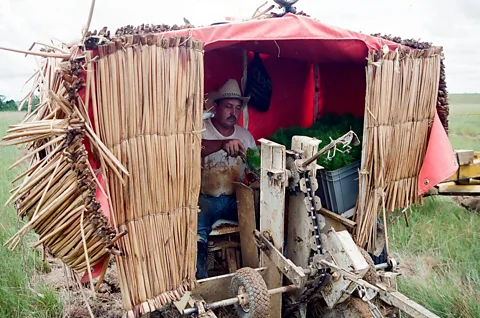
To carve out a life in these inhospitable conditions, the inhabitants of Gaviotas, including several newly graduated engineers, dreamed up a range of eco-friendly, low-cost and locally rooted solutions. Some ideas, such as ancestral longhouses and living quarters with roofs made from thick, thatched moriche palm fronds to withstand the rain and sun, came from the traditions of the indigenous Guahibo people, who had lived nomadically in Los Llanos long before the Gaviotas residents. From the Guahibo, the Gaviotans learned how to make nets and hammocks using the ribs of moriche leaves, how to extract a nutritious oil from the fruit, and how to craft canoes by digging them out of tree trunks.
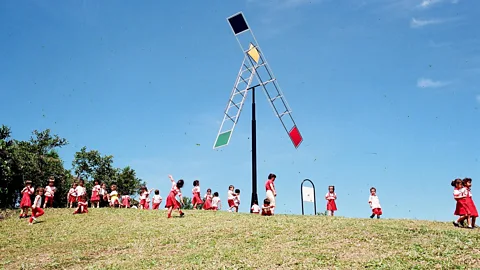
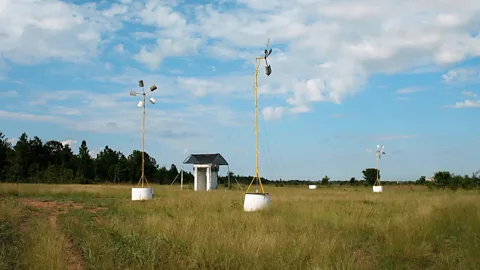
To generate electricity, the Gaviotans relied on the scorching sun of the plains. To access drinking water, they crafted a variety of types of water pumps – including one that could reach 40m (130ft)underground, latching it to a children's seesaw to make the most of their playtime. Lightweight wind turbines, capturing the soft, fleeting gusts of tropical winds that characterise the Colombian plains, were designed by local engineers after 57 prototype trials and errors.
"It felt really safe, it felt very welcoming. It felt very like when you are living in a community, there is a huge sense of belonging and sense that you know everyone around you," says Natalia Gutierrez, who was born in Gaviotas in 1996. Her mother was the community's teacher, and her father the community's hydraulics engineer. "I definitely took advantage of living my best life outside, catching frogs," she says.
 Gaviotas
Gutierrez now goes to university in Canada and is on her year abroad in Italy, but still keeps in touch with the community and recalls her time there fondly: "It was very quick from my house to my mom's office, from my mom's office to the community restaurant, the community restaurant to the river," says Gutierrez, who attended a small school, run by her mother, with only about 10 other children.
She recalls studying the standard national curriculum, including mathematics, biology, and art, but also Gaviotas-specific classes focused on how to plant trees, and how to purify water and bottle it. In the community's bottling plant, water was stored in containers that perfectly interlocked with each other: great for stacking, storing, and playing, like with makeshift Legos.
Gaviotas' home-grown approach is a typical example of what's known as the "appropriate technology movement", according to Chelsea Schelly, a professor of sociology at Michigan Technological University, US.
"No one technology fits everybody's needs in every place, so we should be developing technologies that are locally adapted and locally responsive," says Schelly, who has studied sustainable communities and eco-villages in the United States that follow a similar ethos to Gaviotas. "Living in right relation with the place where you are is probably a lesson we can all learn from, and that you could bring that into design, no matter what you're designing for, right?"
As with any experimental setup, there were also inventions that never truly panned out: such as a solar-powered fridge, which the engineers just couldn't get to work properly, and pedal-powered cassava grinders intended for local families. According to community members, the locals in Los Llanos didn't ultimately accept the grinders as cassava-grinding was traditionally a woman's job, while pedalling was seen as a man's hobby.
But even the failures yielded valuable lessons, according to a 1976 book about Gaviotas, subtitled A Village to Reinvent The World, by the journalist Alan Weisman. "I'd learned to take any idea broached at Gaviotas seriously, no matter how improbable," Weisman writes. "Even those that failed often led to something that worked."
Many of Gaviotas' inventions have travelled outside of the self-sustained community. Over 5,000 of their tropical wind turbines have been installed throughout Los Llanos, according to Lugari, and 12,000 of their special water pumps have been installed throughout other areas of Colombia.
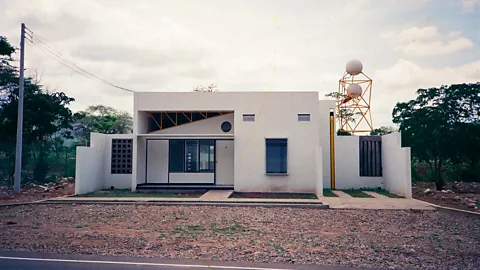
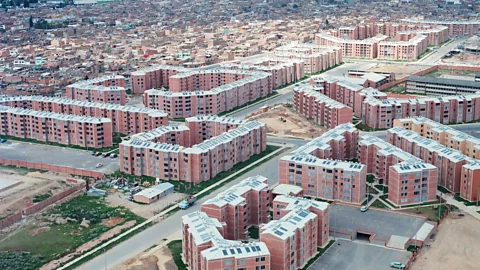
Thousands of replicas of a Gaviotas-designed spherical solar-water heating device with special solar panels that could gather energy even from diffused sunlight, adorn a 5,500-unit affordable housing complex called Ciudad Tunal in cloudy Bogotá. Thirty-thousand more units have been deployed throughout the rest of the world, from the former Colombian president's mansion all the way to Africa, says Lugari.
 Gaviotas
This transfer of technology to other environmentally similar places, says Schelly, can be seen as one of the measures of Gaviotas's success.
Nothing made by Gaviotas is actually patented, Lugari tells me: a decision in line with many eco-villages around the world that believe in open-source innovation to encourage replication.
"So people, fortunately, can imitate us and copy us all they want," says Lugari. "And if someone wants to patent one of our projects and paralyse it, well, the Gaviotas imagination, the only thing that's for sure, will work to make some changes and make something new again."
 Gaviotas
Pine-tree fuel and an edible forest
In the 1980s, after failing to grow a variety of crops, the people of Gaviotas started planting a variety of Caribbean pine, as had been suggested to Lugari while on a trip to Venezuela. With grants from the Colombian and Japanese governments, they planted 8 million pine tree seedlings, inoculating the roots with special fungi to help them establish. The lanky pines gradually provided shade and moisture for planting other species and crops, finally giving the village a chance at sustainable agriculture: more than 250 species of plants could now take root in the revitalized soil – after decades of aggressive leeching from violent rains that made it extremely acidic – and 60-something species of mammals, including deer, capybaras and tapirs came to populate the forest.
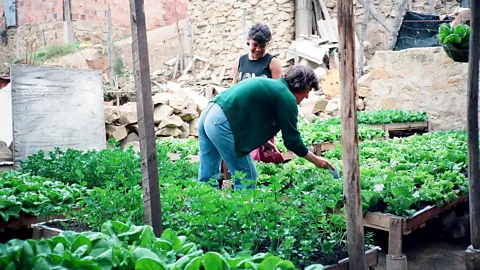
Today, about 30% of the community's entire food resources come from the forest, Lugari says. They grow lemons, oranges, lychee, tamarind, coffee, bananas, guayabas and much more. "It's edible, and the edible forest has an extraordinary advantage, because the [tree and shrub] species we have are permanent, they're here all-year-round, we eat the trees, the plants, the bushes," says Lugari. "There's a saying that sums it up: 'Plant once and harvest forever.'"
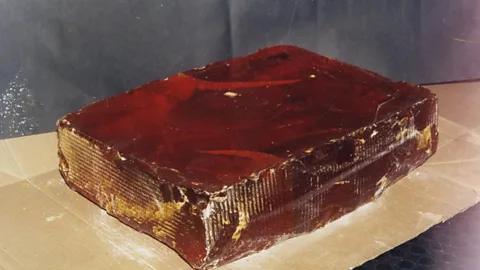
Gaviotas' scientists and botanists started harvesting the pine resin by tapping the tree, then processing the resin in a steam-powered biofactory. Gaviota now produces resin-derived chemicals such as turpentine – used as a disinfectant, and to make perfumes – and colophony – used to make paints, varnishes and some types of makeup.
Locals use biofuel made from their Gaviotas-grown Caribbean pine oil and mixed with palm oil power their tractors and motorbikes, with which they wizz through the human-made forest, and which they export to the rest of the country. (Research suggests that pine oil and other biofuels are a cleaneralternative to conventional petroleum-derived fuels, though they still produce emissions.)
 Gaviotas
'Reinventing the world'
"We've visited many communities in many places, but there has not been such a wonderful example as that of Gaviotas," says Gonzalo Bernal Leongomez, who served as Gaviotas' administrator in the 1980s and '90s. After dreaming of building a sustainable, eco-friendly community for many years, he saw a TV report on Gaviotas and immediately decided to move there with his wife, Cecilia Parodi, and their daughter in 1978. They stayed for more than a decade.
"It was very dynamic, very dynamic, I remember 150 very interesting projects in Gaviotas that were proposed by students, by engineers, by forestry specialists," says Bernal Leongomez. "But of course, most of them, as we say, were 1% inspiration and 99% perspiration. You have to sweat it, you have to fail and try again, you have to experience it."
Today, the village counts more or less a total of 50 families, with four residents currently collecting a pension for their years of hard work for the village, says Lugari.
Will Gaviotas ever be replicated?
Hundreds of scientists, artists, architects and engineers have passed through the village over the decades, each leaving their mark. And likewise, people from all over Latin America and beyond have visited Gaviotas over the decades to learn how to replicate its inventions. In the late 1970s, the World Bank provided funding to the Colombian government to start another Gaviotas-like community in the depths of Los Llanos, one called Tropicalia, but the budget ran out. Other attempts over the years to replicate Gaviotas were foiled by logistics or simply never went beyond the ideas stage.
"In order to duplicate these things, you need to have an approach. Not just a list of principles, but: how do you go on the ground and work?" says Pliny Fisk III, co-founder of the Center for Maximum Potential Building Systems, in Texas, US, who is not involved in the Gaviotas project. He studies eco villages and communities around the world as part of the Center's research projects. "I've always wondered, how do you duplicate Gaviotas? You need a technique."
Fisk says he sees parallels between Gaviotas and other sustainable communities such as Auroville, known as the City of Dawn, in India, and Curitiba, in Brazil. However, to become truly replicable, Gaviotas would need to standardise its inventions and formally describe its approaches and policies, which would make them less flexible and responsive to local conditions, he says.
 Gaviotas
A lot has changed since the community's early days, according to community members.
Today, Gaviotas doesn't have its own school anymore, and the community's kids go to nearby schools in other villages. On Gaviotas' grounds, they learn by a "bring your kid to work"-type mechanism, Lugari tells me, and six group coordinators who work in the areas of forestry, agriculture, renewable energies and biofuels, informally teach children too. The Gaviotas hospital shut down briefly after it was opened, as it struggled to find enough staff to run the facilities according to state standards. Half of the factory's workers today are from the local indigenous villages nearby; they come to the village to work on the resin and tree-planting projects throughout the week, then return to their families on weekends.
Gutierrez, who so fondly remembers her early childhood in the community, left Gaviotas at the age of nine and moved to a town called Villavicencio, an eight-hour car ride away, to live with a relative and go to a local school. Her parents wanted her to have a more global education and exposure to the outside world, hoping she would appreciate the intimacy of Gaviotas more once she'd had experiences outside it. Her father also left Gaviotas for some time, returning to his ancestral village in another part of Los Llanos after his own father was kidnapped from his farm and killed. He has now returned to Gaviotas, where Natalia's mother also still lives, 45 years after first moving there.
Natalia's daughter Gutierrez says that even today, her heart is always with Gaviotas. Gutierrez is studying for an MBA with a focus on sustainability in Canada, and is hoping to split her future years between Canada and Colombia.
"Just like any other community, there is no stagnation. Communities change and they evolve," says Schelly. "It's true of all communities, but it is maybe more highlighted in intentional communities because they're trying to do it in an intentional way that's aligned with values, rather than just being at the whim of market forces."
Gutierrez says the legacy of Gaviotas lives on beyond the actual village: "Some people left, some people stay," she says, about her childhood friends. "But I think the values of Gaviotas will persist wherever they go."
"Places like these cannot disappear," says Teresa Valencia, Gutierrez's mother.
Lugari is now 81 years old. He no longer lives in Gaviotas full-time, but rather in Colombia's capital, Bogotá, where he runs the Gaviotas Foundation's office. He drives around in a car that puffs fumes from resin-based fuels from its exhaust. His plans for who will succeed him as Gaviotas' spokesperson and leader were he to pass away are solid and in place, he says, declining to elaborate.
His tomb, he says, will say something along the lines of "excuse me for not being able to get up to greet you, but here I am, still dreaming of giving permanent life to Gaviotas".
--
For essential climate news and hopeful developments to your inbox, sign up to the Future Earth newsletter, while The Essential List delivers a handpicked selection of features and insights twice a week.
For more science, technology, environment and health stories from the BBC, follow us on Facebook and Instagram.
