'Jaw-dropping': The moment Cher wore the ultimate 'revenge' outfit

 Getty Images
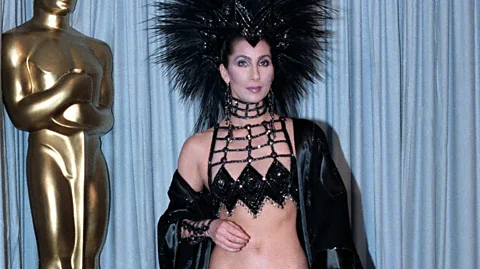
At the Oscars 40 years ago, the US singer and actress Cher was snubbed by the Academy – and got even. The legendary outfit she wore on stage went down in history – and now "revenge dressing" has become a part of our celebrity culture.
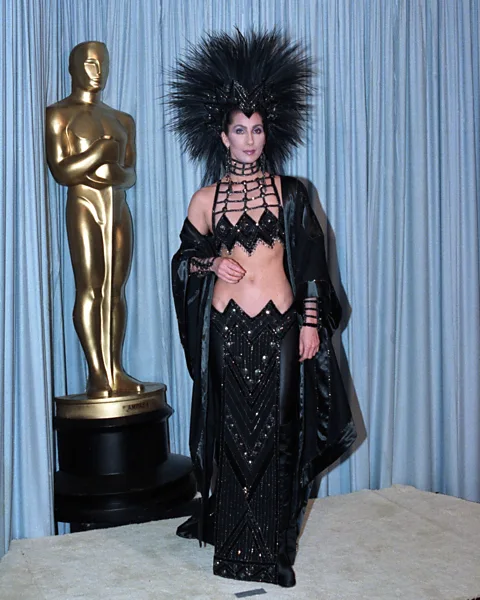
At the Academy awards 40 years ago, Cher wore an outfit that has gone down in Oscars history as one of the most outrageous, inspired, extravagant – and iconic – looks to ever grace the red carpet and stage.
It's a high bar, but Cher's showgirl-inspired outfit, which was the work of designer Bob Mackie, involved a theatrical, plumed mohawk of a headdress; a bare midriff framed by jagged hems above and below, almost like an open shark's jaw; beading and tassels. It might have been entirely black, but it was far from sombre.
There were, Mackie has said in an interview with The New Yorker since, "a lot of people who said, 'That's not fashion!' And I said, 'Of course it's not fashion. It's a crazy get-up for attention'. And it did get attention – people talk about it still." In the years since it's been called many things, from legendary to "a bat-crazy mash-up of witchy showgirl and Halloween Big Bird".
Seismic glamour
Cher had been snubbed for her own award that night – as she explained in the 2024 documentary Bob Mackie: Naked Illusion: "I didn't get nominated for a movie that everyone thought I would actually win for [Mask] – so was dressing that night for a kind of revenge."
She was in fact there to award Don Ameche with a best supporting actor Oscar for his role in Cocoon, but who remembers that? Even Jane Fonda, who introduced Cher on to the stage, highlighted the seismic glamour that was about to explode into the proceedings, saying: "wait 'till you see what's going to come out here". Mackie recalled saying to Cher: 'Don't you think you'll be pulling focus from who you're presenting to?' And she said, 'Oh, they won't mind!'"
 Getty Images
As Cher took her place at the podium in the Dorothy Chandler Pavilion of the Los Angeles Music Center, she quipped: "As you can see, I did receive my Academy booklet on how to dress like a serious actress."
As Josiah Howard, author of Cher: Strong Enough, tells the BBC, she was well aware that the way she dressed meant she fell foul of the archaic rules of the Academy. And, by dressing to shock, she was, in his view, saying, "let me give them even more of what they don't like about me… 'this is what you hate about me, and I'm going to tell you that I know you hate it about me, and I'm still going to give you it'."
Many people didn't even spot the detail that took things up another notch. According to Howard, she wore a blue contact lens in one of her brown eyes. "So she really was [saying] 'let me give you the freak show. Let me blow it way over the top for you'." It was, he says, "a wonderful moment for everybody who has a problem with how they're being seen, and knows they're being seen unfairly".
The whole look was brilliantly bold and courageous, especially given the fact that, as Howard points out, "[in] the '80s… women weren't standing up like that and she still wanted to continue to work in the industry… But she wanted that moment". Two years later she was awarded the best actress Oscar – beating Meryl Streep – for Moonstruck, and accepted the award in an only marginally less outrageous sheer gown with fringed bra.
 Getty Images
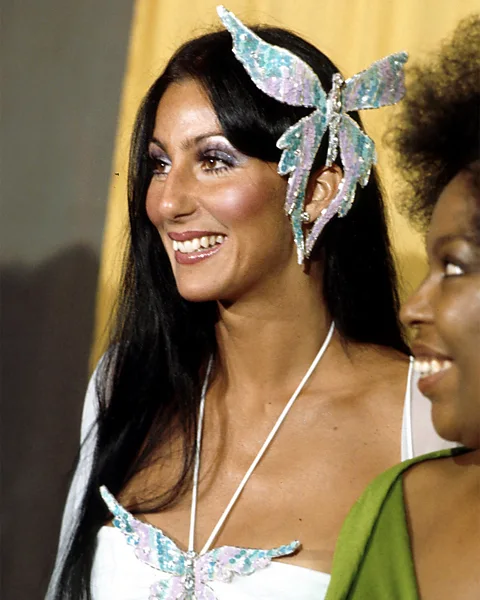
Cher's famous 1986 Oscars look is often cited as an example of so-called revenge dressing. In fact, as Howard points out, "it wasn't the first time that Cher had dressed in a way that took a kind of revenge. In 1974, following the breakup of her marriage to life and professional partner Sonny Bono, she reemerged at the Grammys – her first appearance with her new music mogul partner David Geffen – wearing a dress that was covered in butterflies" – a symbol of resurrection.
Rise of the revenge dress
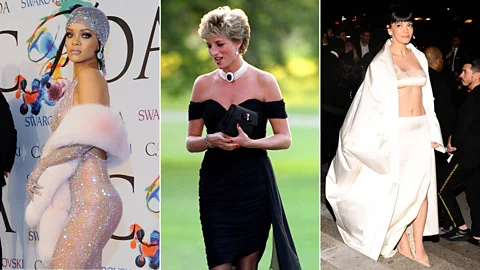
It wasn't until 1994 that the term "revenge dress" was coined, off the back of the clavicle-exposing black silk Christina Stambolian dress worn by Princess Diana at a public appearance, on the same evening that a TV documentary aired in which the then Prince Charles admitted to infidelity. In that instance the phrase was used by commentators to imply a dress that would be a kind of revenge for having treated her as he did.
Since then, the phrase revenge dress has increasingly been used in celebrity culture. Revenge dresses as they are understood by the mainstream have typically been flattering, revealing, and likely a bit risqué – a reminder of what an ex is missing out on. In 2014 Rihanna arrived at the CFDA Fashion Awards in a sheer Adam Selman dress that was allegedly a message to an on-off boyfriend Drake. As she told French Vogue a few years later: "Every time a man cheats on you or treats you badly, you need a revenge dress. Every woman knows that." In the case of supermodel Bella Hadid at the 2017 Met Gala, that was a revenge body stocking, which she wore to an event that was also attended by her ex-boyfriend The Weeknd and his then new girlfriend Selena Gomez.
More recently, Nicole Kidman appeared post-split from husband Keith Urban resplendent in a strapless black Chanel dress by Matthieu Blazy at Vogue World 2025. And much has been made of various ensembles worn by popstar Lily Allen in the wake of her chart-busting revenge album, West End Girl, which was written in the 10-day immediate aftermath of her split from Stranger Things star David Harbour. But arguably the most striking of her looks to channel the revenge dressing spirit was the barely-there Colleen Allen design she wore to the 2025 CFDA Awards.
 Alamy/ Getty Images
But for all of the delight that audiences can feel when seeing a wronged woman in an incredible outfit, the phrase "revenge dressing" – which usually is used in relation to a woman who lives up to the beauty ideals of the mainstream straight male gaze – has its critics. It's all about how you appear to an external source, not how you feel within. In an interview with the Guardian in 2021, Dr Angela McRobbie, a professor of communications at Goldsmiths College, University of London, said: "It's a deeply conservative idea. Its implication being that the young woman who has been cheated on can think of no further way to punish her untrustworthy lover than by extravagant displays of fashion and the body."
Confounding expectations
In the case of Cher, though, the revenge being had was more often against society's expectations than any one man's. Her bare midriff was a form of revenge, of sorts, throughout much of her earlier career, in no small part thanks to her celebrated working relationship with Mackie. Mackie, who has also worked with Tina Turner, Madonna, Bette Midler, Diana Ross and Elton John, had first met Cher on the set of The Carol Burnett Show in 1967. But, as he told the New Yorker: "It wasn't until a little later, when we started showing a little midriff, that people started getting excited."
She was, he said, "so different from what people thought an American beauty should look like – all Scandinavian, with blonde hair and blue eyes and a big poofy hairdo. Nothing intimidated her. Anything I put on her, she went, 'Oh, that's fun'. It never occurred to her to wear anything ordinary."
 Getty Images
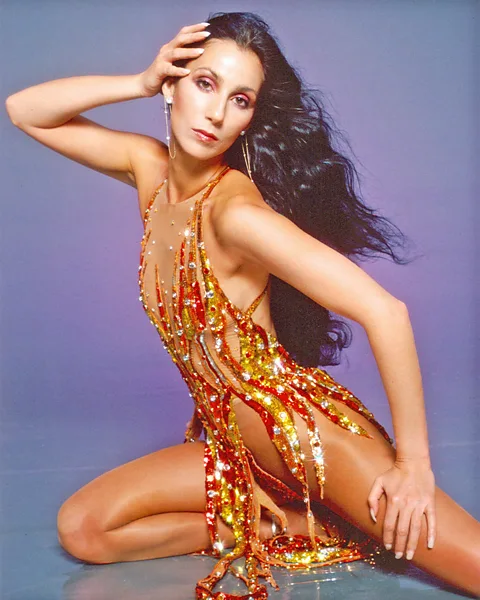
Having done a show with Bono, The Sonny & Cher Comedy Hour, for four seasons from 1971 to 1974, she became known on her post-split solo show for the moment she would make a grand entrance, peeling off an outer garment to reveal a much skimpier, often high-shine and high-glam, outfit underneath. According to Hammond, author of Cher: Her Style Principles: "She would come down into the audience just wearing the most incredible, literally quite jaw dropping outfits that had been personally designed for her by Mackie."
Back then, a bare midriff was political, and hers – she's widely reported to be the first woman to regularly display her belly button on North American television – became a kind of statement. As Hammond tells the BBC, her bare bellybutton was her way of "kind of constantly getting revenge on the CBS censors".
"She was always pushing the envelope," says Howard, "just trying to remind people that you don't get to dictate what I do and your ideas of women and how they should present themselves are outdated and you need to grow up."
More like this:
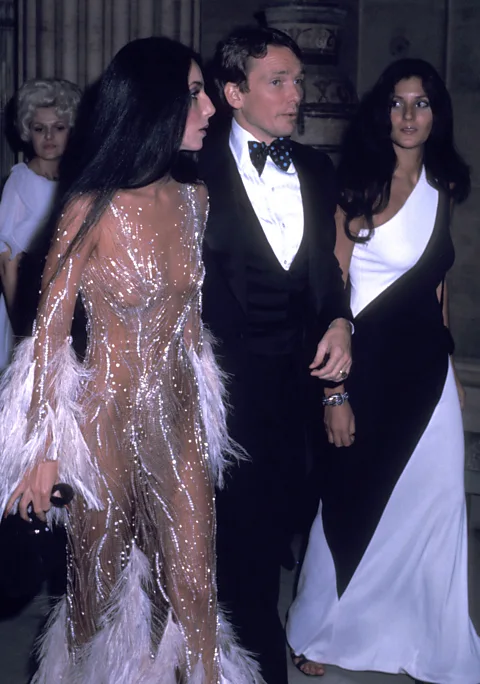
But it was with a dress that has since been hailed as pioneering the naked dress trend that Mackie and Cher made some of their biggest waves. Cher wore the sheer, beaded gown with feathered sleeves to the 1974 Met Gala, and again, later, to appear on the cover of Time magazine. "It created a lot of hubbub," Mackie has said of the dress. "In those days, Time [magazine] reserved its covers for world leaders or someone who invented something important, like a vaccine. Then there was Cher on the cover in that incredible piece of clothing, and newsstands sold out of it almost immediately. Some cities even banned it from being sold – it's funny considering how some stars can barely keep their clothes on today."
 Getty Images
It speaks more generally to Cher's rebellious style – and her refusal to fade into the background. For Hammond, it's worked because "it's not an act… it's authentic". Cher has, she says, "been working her whole life and has adopted many different guises. But a thread through all of that is that she just has such a sense of self."
"Cher wants to not be someone from the past, she wants to be someone current," says Howard. It's an attitude that has continued right up until today. As he points out, rather than rest on any laurels, for her recent appearance at the 2026 Grammys, accepting a lifetime achievement award, she chose a custom design by the 29-year-old Spanish-born designer Luis de Javier. She might be nearly 80 but, says Howard: "Cher, in her own mind's eye, is a rock 'n' roll girl first and foremost."
--
If you liked this story, sign up for the Essential List newsletter – a handpicked selection of features, videos and can't-miss news, delivered to your inbox twice a week.
