'She was standing in the way of certain individuals': The mysterious murder of gorilla researcher Dian Fossey

 Alamy
AlamyPioneering primatologist Dian Fossey destroyed the myth of gorillas as savage brutes before being killed by human hands, 40 years ago this month.
Dian Fossey was not the most obvious choice to lead the largest and most detailed study to date of mountain gorillas. For a start, she was not a trained zoologist but an occupational therapist. She also suffered from the lung disease emphysema and had a fear of heights, neither of which were ideal for working in thin air on remote mountain slopes. But what she lacked in expertise, she made up for in determination and a deep love of animals. When she moved in 1967, aged 35, from the US to the mountains of Rwanda's Volcanoes National Park, she set up the Karisoke Research Centre. It did not take long for her to realise the gorillas there were in serious danger. Their habitat was shrinking and poachers posed a growing threat. Fossey's relationship with the creatures would go far beyond observation. She would fight to save them from extinction.
Fossey had first visited Africa in 1963, where she met the renowned Kenyan-British palaeoanthropologist Professor Louis Leakey. Having established that the origins of human life began in Africa, Leakey believed that observing primates in their natural habitats was the key to understanding human evolution. He had already helped another female researcher, Jane Goodall, to set up long-term studies of chimpanzees and wanted to do something similar for gorillas. His theory was that women with no scientific training were best suited for studying apes as, he believed, according to a 1986 Vanity Fair profile on Fossey, that they would be "unbiased about the behaviour" they witnessed, less threatening than a man but also "tougher and more tenacious". At the time, little was known about gorillas.
Were they really violent brutes as depicted in films such as King Kong?
Fossey's early research demanded patience. To gain the gorillas' trust, she began to mimic their behaviour. She told the BBC's Woman's Hour in 1984: "I'm an inhibited person, and I felt that the gorillas were somewhat inhibited as well. So I imitated their natural, normal behaviour like feeding, munching on celery stalks or scratching myself." She had to learn her lessons quickly. "I made a mistake chest-beating in the beginning… because by chest-beating I was telling the gorillas I was alarmed, as they were telling me they were alarmed when they chest-beat." Instead, she learned to imitate their belch-like "contentment sounds". Demonstrating how she would make a noise like a gorilla, she added: "Wouldn't it be nice if humans could go through life belch vocalising instead of arguing?"
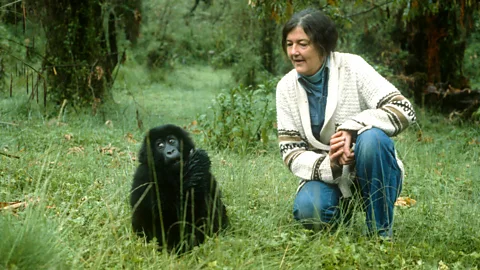
Fossey learned to communicate with gorillas by never standing taller than them: "When I approach a group, I do approach it knuckle-walking, as gorillas walk, so that I will be at their level. I don't think it's quite fair to them. After all, I am 6ft tall as well. But to be standing up, they don't know if you're going to attack or run after them or what." After years of gaining the confidence of the gorillas, she had habituated them to her presence, and they allowed her to sit alongside them without any concern. She had destroyed the myth of gorillas as being violent creatures.
Attenborough's encounter with her
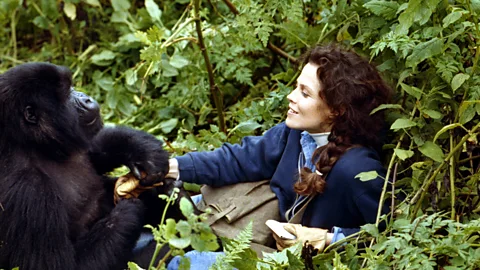
In 1979, the wider world witnessed Fossey's habituation work in practice via David Attenborough's groundbreaking BBC natural history series Life on Earth. At the time, mountain gorillas were on the verge of extinction. His encounter with a gorilla family has since become one of the most famous sequences in television history. As he sits surrounded by these "gentle and placid creatures", in a soft tone he says: "There is more meaning and mutual understanding in exchanging a glance with a gorilla than any other animal I know… We see the world in the same way that they do." He adds: "If ever there was a possibility of escaping the human condition and living imaginatively in another creature's world, it must be with the gorilla."
In the retrospective 2007 BBC documentary Gorillas Revisited with Sir David Attenborough, he admitted that he initially thought the plan to film the animals to demonstrate their evolutionary advantage of opposable thumbs (allowing them to grip onto objects, including branches, securely) was too ambitious. He said: "Mountain gorillas live 3,000 metres high, up in the Virunga Volcanoes, and are notoriously difficult to approach. Getting to them would mean carrying all our film equipment up 45-degree slopes through thick jungle. And most problematical of all, there was no way that we would be able to film them without the help of Dian Fossey – the only person in the world who was studying them in the wild." Attenborough said that from what he'd heard, there was no way she would allow a television crew to join her. Life on Earth director John Sparks wrote her a persuasive letter, but "it surprised us all that she wrote back a very nice letter saying, 'You're welcome'".
When they arrived in the jungle, Fossey's then-assistant, Ian Redmond, a young researcher from England, told them he had some terrible news. Not only was Fossey very ill with a chest infection, she was in the depths of grief because her favourite gorilla Digit had been murdered by poachers. They had killed the 12-year-old silverback with spears as he tried to defend his family.
Redmond recalled to Attenborough in Gorillas Revisited how discovering Digit's body was the worst experience in his life to date. He said: "It was clear that there'd been a frenzy of violence because his body was covered with cuts and they'd obviously just been in a bloodlust. They took his head and his hands and they left the rest of the body because people in Rwanda don't eat gorillas – it's not a part of Africa where gorilla meat is favoured – so they had no use for the body, and the only reason he was killed was that foreigners were buying bits for souvenirs." In a 1981 article in National Geographic, Fossey wrote: "For me, this killing was probably the saddest event in all my years of sharing the daily lives of mountain gorillas."
 Alamy
AlamyDespite her distress, Fossey calculated that filming the gorillas could help to publicise their plight and agreed that the BBC crew could film as planned. They were able to capture such astounding images thanks to her. Redmond told the BBC: "This was the gift that Dian gave the world; the technique of winning the trust of completely wild gorillas."
Her controversial interventions
But Fossey became so consumed by her battle to save her beloved gorillas from poachers that it overshadowed some of her other work. There are accounts of her capturing and interrogating intruders and even burning down a poacher’s house. She bought masks and pretended to use black magic to make some superstitious locals believe she was a witch. According to one former colleague, protecting gorillas was "her mission in life" but this passion made her a difficult person to work with. "I think she became more and more unstable, and she almost started viewing scientific research as a waste of time when all she really wanted to do was anti-poaching," Dr Kelly Stewart told the BBC's Witness History in 2014.
Attenborough's jungle encounter sparked renewed interest in mountain gorilla conservation, and a major fundraising campaign was launched. The Mountain Gorilla Project aimed to strengthen park security, educate global and local communities and develop a pioneering gorilla-focused tourism programme. Perhaps surprisingly, Fossey was opposed to the project. She felt education initiatives were not a priority and saw gorilla tourism as more of a hindrance than a help. The project's co-founder Bill Weber told Gorillas Revisited: "Dian believed that the gorillas ought to be protected for their own values. I think that's a noble sentiment, but it wasn't working."
For Redmond, it was a question of whether to prioritise saving gorillas who were in immediate danger or focus on developing a longer term strategy: when it came to these positions, he believed both "were right". Weber argued that some of Fossey's methods had been counterproductive. "I believed we were supporting exactly the same mission as Dian; we just used different techniques," he said.
In History
In History is a series which uses the BBC's unique audio and video archive to explore historical events that still resonate today. Sign up to the accompanying weekly newsletter.
While Fossey may have had her critics, there's no doubting her contribution to promoting worldwide interest in the plight of mountain gorillas. In 1983, her best-selling book Gorillas in the Mist attracted Hollywood attention and production began on a movie about her jungle life. But she would not live to see how her efforts had paved the way for successes in halting their decline.
On the night of 26 December 1985, she was murdered in a machete attack at her cabin at Karisoke. "It was really shocking, but at the same time, I think people who had worked with Dian were sort of waiting for something like that to happen because she had a lot of enemies," Kelly Stewart told the BBC.
 Alamy
AlamyThe question of who killed her has never been fully resolved. In December 1986, a Rwandan tribunal found Fossey's then-research assistant Wayne McGuire guilty of her murder and sentenced him to death by hanging in absentia, since he had fled back to the US in July 1986; he has always maintained he was innocent. Emmanuel Rwerekana, a Rwandan staff member at Karisoke, had also been charged with her murder – with the government alleging he and McGuire had been good friends – but he was reported as having hanged himself in his cell in August 1986. Ian Redmond said: "She was standing in the way of certain individuals making money. Whether because they were making money through the illegal bush-meat trade, or the gold smuggling trade, or someone's aspirations to turn Karisoke into a tourist camp and make a lot of money that way, if you stand in the way of someone who is ruthless and wants to make a lot of money, then it's not that surprising that she was killed."
More like this:
• The woman who changed our view of chimps
• The dark side of a US couple's wilderness dream
• The century-long search for the Loch Ness monster
Stewart said she didn't believe Fossey was murdered by a poacher or anyone who worked there. "I think it was somebody higher up who was doing bad stuff and Dian found out about it, so he had her killed," she said, adding: "I sometimes think if Dian was writing a script of her life, she would have ended it the way her life ended, violently at Karisoke where she was buried."
Three years after Fossey's death, the hit film Gorillas in the Mist told her life story. It was nominated for five Oscars, while at the Golden Globes Sigourney Weaver won the best actress award for her portrayal of Fossey. Weaver told the BBC in 2006: "Playing Dian gave me such an experience of how much of a difference one individual can make. I'd never played anyone real before and I was so moved by the fact that here is this woman, who came all by herself… (who) really started this whole movement, not just to study them but also to rescue them [gorillas] from what was certain extinction. I think that it's a very inspiring story."
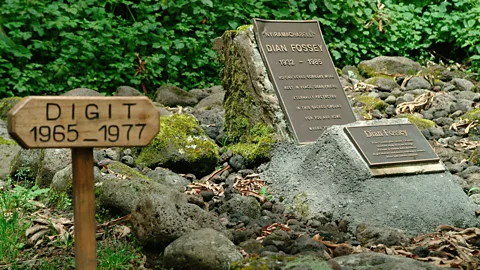
Dian Fossey was buried in a grave in the Virunga mountains in the very graveyard she had created for her gorilla friends, including her beloved Digit. On her headstone it says, "No-one loved gorillas more".
--
For more stories and never-before-published radio scripts to your inbox, sign up to the In History newsletter, while The Essential List delivers a handpicked selection of features and insights twice a week.
For more Culture stories from the BBC, follow us on Facebookand Instagram.
