Final Fantasy VII Rebirth and how it revisits the twist that changed video game history

 Square Enix
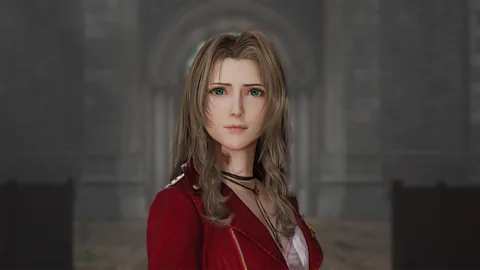
Classic 90s adventure game Final Fantasy VII is being remade in three parts – and the second instalment, released today, includes a brutal, tragic character death that left players of the original game stunned. How will it play this time round?
The Japanese video game Final Fantasy VII, a sweeping cyberpunk epic generally considered one of the greatest role-playing games ever made, is a miraculous feat of alchemy. As sombre as it is silly, as futuristic as it is fantastical, its international release in 1997 established the Final Fantasy brand – a long-running anthology series of Role Playing Games (RPGs), developed by a studio called Square – as a force to be reckoned with in the West.
Predecessor Final Fantasy VI, for instance, has sold 3.8 million copies worldwide; to date, Final Fantasy VII has sold 14.4 million. It has inspired a CGI-animated feature film sequel; a range of middling spin-off games; and most recently, a long-anticipated project to remake the original title as a trilogy, using the full high-fidelity might of modern video game technology. The second of that trilogy, Final Fantasy VII Rebirth, is released today.
More like this:
– The Japanese animation that flummoxed the US
– The film and TV facing up to death
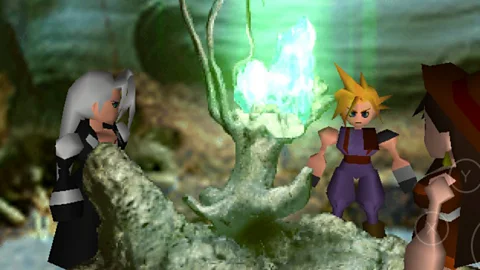
You could attribute this enduring reverence to the original Final Fantasy VII's technical achievements. By today's standards, of course, its blocky graphics and text-based dialogue could be considered crude, but for its time the use of 3D polygonal character models – deftly spliced against painterly pre-rendered backgrounds, interspersed with cinematic cut-scenes – served as an impressive showcase for the cutting-edge power of the PlayStation 1. You could also cite its elegant game mechanics: its intuitive magic system, its dynamic turn-based combat; its atmospheric score, its evocative setting, its rich, textured aesthetic and colourful character designs. Yet undoubtedly the reason why Final Fantasy VII endures is its story: a compellingly plotted, thematically bold tale of a broken mind and a dying planet, immortalised by the most famous twist in video game history.
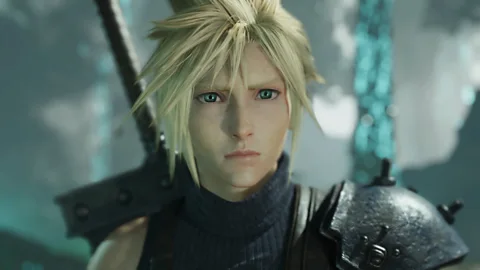
You play Cloud Strife, a cynical spiky-haired mercenary who has been hired by an insurgent group called Avalanche to infiltrate and bomb a reactor. In this world a fascistic megacorporation called Shinra has pioneered a way to suck the lifeforce out of the planet and convert it into an energy called Mako. The discovery has given rise to marvels like Midgar, a vast circular metropolis, built upon a base of polluted slums, which provides the setting for the first act of the game. For Avalanche's leader, Barret, a burly zealot with a gun for an arm, ridding society of Shinra's reactors – a mission not without collateral damage – is the only way to save the planet from environmental collapse.
The game's moral complexities
Back in 1997, such morally complex computer game protagonists were a challenging prospect: Final Fantasy VII invited the player to be complicit in the actions of characters who could easily be described as eco-terrorists. But they were born out of challenging times for Japan, which during the mid-90s was reeling from a series of economic and environmental disasters.
An inspired Hironobu Sakaguchi, the creator of the Final Fantasy series, wanted to use its seventh instalment to explore the big metaphysical questions: humanity's relationship with nature, the cycle of life and death. It is surely not a coincidence that the thematically similar animation Princess Mononoke, Studio Ghibli's dark, pensive eco-parable, premiered in the same year. In the age of climate change, where the ethics of direct action are a hot topic of debate, Final Fantasy VII's portrayal of a planet being destroyed in the pursuit of profit, and those fighting against that, has only grown more resonant.
The first instalment in the remake trilogy, released in 2020, covered events in Midgar, where Cloud, having taken on another job for Avalanche, finds himself caught up in the fight against Shinra. He blows up another reactor. He falls from a great height, crashing through the church of a flirty flower girl called Aerith. He becomes her bodyguard. He dresses up as a woman to rescue his shy childhood friend Tifa. He witnesses an atrocity. He storms Shinra's headquarters to save a captured Aerith, revealed to be the last of an ancient race with powerful magical abilities. He discovers that a man from his past, the legendary supersoldier Sephiroth, is somehow still alive.
The second part of the trilogy, titled Final Fantasy VII: Rebirth, follows Cloud and his ragtag crew of companions (Barret, Tifa, Aerith and a four-legged lab experiment called Red XIII) as they leave behind the suffocating concrete of Midgar and step into a wide, open world. The original game portrayed this vast landscape as an abstract miniature, with its various towns and cities resembling toy models. For Rebirth, however, it has been recreated as a living, breathing ecosystem. "The sheer scale of the world was the most difficult thing about this game," says Rebirth's director Naoki Hamaguchi. "We had to rethink the original's geography, dig deeper into what these places are, the people who live there. We had to make it feel like a planet, like a journey."
 Square Enix
Rebirth adapts what is arguably the most significant segment of the original game: in which Cloud, now on the run from Shinra, travels in search of Sephiroth, a former friend who has become a threat to the planet. The world our heroes find is as magical as it is melancholy. For every sunny seaside resort or glitzy amusement park, there is a polluted fishing village or a town traumatised by a tragic reactor accident. In classic RPG-style, you visit these places, learn their stories, fight monsters, invest time into making your characters stronger (levelling up), meet new companions (including a precocious ninja and a talking cat) and bond as a fellowship.
The beauty of Final Fantasy VII's storytelling is how deftly it marries the personal drama of these characters (the identity crisis of Cloud; the romantic rivalry of Tifa and Aerith; the destroyed coal mining village that inspired Barret's activism) with tightly paced plotting and steadily escalating stakes. The fight against an evil corporation becomes the fight against an aspiring god, Sephiroth; the fight against an aspiring god becomes the fight against an ancient extraterrestrial evil, against enormous Kaiju-esque monsters, against a meteor called forth to end the world. And then, suddenly, in the midst of it all, it happens: Sephiroth descends from the heavens and plunges his sword through Aerith's back.
An unbelievable moment
When this happened in the original game, players were dumbstruck. Surely she couldn't actually be dead? There was nothing new about a story unexpectedly killing off a main character. George RR Martin's novel A Game of Thrones, for instance, was published a year before. Yet for video games – a medium hardly known at the time for its sophisticated storytelling, where characters were ultimately invincible, and you could always reload and try again – the death of Aerith was groundbreaking. So much so in fact that many players, the majority of them children, simply refused to believe it. Rumours blazed through internet forums and school playgrounds about ways to bring her back. But there was no secret resurrection yet to be discovered. The permanence was the point.
"There was something that bothered me about the idea of characters coming back from the dead," explains Kitase, who oversaw the scene alongside artist Tetsuya Nomura (the originator of the twist) and writer Kazushige Nojima. "The princess who dies and the prince who brings her back to life using some kind of gimmick – those kinds of stories were prevalent in games. There was even a survey done in Japan at the time that asked 'when people die, will they come back again?' and the majority of the children who answered said 'yes'! I felt a sense of responsibility over that. I wanted to avoid using death as a cheap dramatic device. I wanted to treat it in that very frank sense of a character dying and that being something that just happens, that the player has to react to."
The scene itself has become fabled for making players cry. Aerith, her face a picture of shock, the sword withdrawn from her back, collapses lifelessly into Cloud's arms. There are no last words, no tearful goodbyes; she is already dead. "This can't be real," Cloud says, shaking. "Aerith is gone. Aerith will no longer talk, no longer laugh, cry or get angry… What is this pain? My fingers are tingling. My mouth is dry. My eyes are burning!" The English translation of the Japanese script is notoriously flawed (Aerith was mistranslated as Aeris in the West, for example), but this dialogue at least is largely faithful to Nojima's wrenching melodrama.
 Square Enix
Just as important, however, is the scene's visual language. The graphics alternate between the realistic style of the game's cut scenes and its more rudimentary default. These boxy characters seem dated now – hence the remake. Yet they are also precisely why the death of Aerith is so affecting. There is a disarming idiosyncrasy to their impressionistic bodies. They do not speak out loud, their faces do not emote, but somehow that doesn't matter. Their simple, evocative gestures are expressive enough; your imagination, along with Nobuo Uematsu's gentle, mournful score, fills in the rest. Barret looks at Aerith slumped on the ground, and wordlessly shakes his head. Tifa, kneeling, strokes her hair. Cloud, silent, picks up her lifeless little body and carries her to rest. Much as Final Fantasy VII's twee aesthetic belies the maturity of its themes, so too is there poignancy in the space between innocence and death.
The impact left
Yet for Kitase and his team, it was not enough that players experienced the shock of Aerith dying – they also had to be made to feel what comes next. "When people die in stories, it is often some kind of noble sacrifice that comes at the end," he says. "But that is not a realistic experience of death: the idea that you have lost something and it's gone now, you can only look back and regret. You have to live with that. And this is something that games are well placed to deal with."
Emotionally, the death of Aerith splits the world of Final Fantasy VII into before and after. This applies to the plot, too, of course. The fight against Sephiroth intensifies. The characters reflect and grieve. "She always used to talk about the next time," says Tifa at one point. "She talked about the future more than any of us." But her loss can also be felt in subtler, more practical ways. It is in the space where her picture used to be in the character select screen. It is in the attacks and weapons particular to her that can no longer be attained or used. It is in all the hours spent levelling her up, which have now passed into nothingness. Grief, like hunger, is absence with presence – and Final Fantasy VII uses the mechanics of the medium to never let you forget it.
"When you lose someone in the real world, you generally don't realise until after the event what's actually happened and what you've lost," says Kitase. "You think, 'If I'd have known, I would have talked to them more when they were alive'. It is the same with Aerith. You think, 'If I'd have known she died, I could have done this with the character. I wanted to have done that before but now I can't.' It was important to get the player into that mental state."
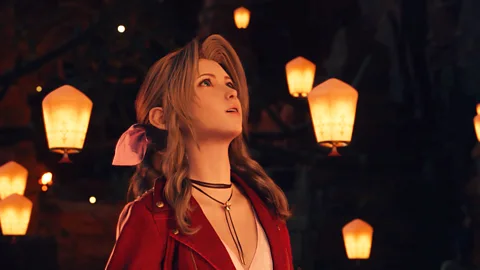
Final Fantasy VII: Rebirth promises to be a different experience, however. Most players – either through experience or osmosis – know what is coming at the game's end. "This is why the bonds and relationships between the characters are so important," explains Hamaguchi, who cites Rebirth's wealth of character-focussed side-quests. "It is all leading up to that. It has to mean something." For Kitase, revisiting and recreating the scene was a daunting task, not too unlike the modern trend of adapting animation into live-action. "We had a lot of work to do," he says. "The original version of that scene, with the low polygon count and over-emphasised acting, had to be completely reworked with super modern, really detailed, really in-depth and subtle depictions. There's a lot more nuance and movement. It really has changed the impact of the scene.
 Square Enix
There is also the intriguing possibility that this time, Aerith does not die at all. The first instalment of the remake trilogy introduced the idea of Whispers: spectral beings that try to intervene whenever the storyline of the new game is in danger of deviating from that of the original. Some have theorised that they represent the fans who do not want anything other than a direct scene-for-scene recreation. Yet their apparent defeat at the end of the first part suggested two things. The first is that this trilogy is something of a meta-sequel: a remake commenting on the challenges of remaking an iconic game. The second is that Kitase, Hamaguchi and their team are now free to take big creative risks.
Could Aerith living be one of them? Understandably, neither will say.
"I am confident that when the climactic event happens, whatever happens, people will react in exactly the kind of strong way the writers want them to," says Hamaguchi, laughing.
"It is a story where about half the audience are expecting a different ending," adds Kitase. "I really am looking forward to fans seeing it. I am almost certain that it is going to have a much more direct emotional impact than it did the first time around."
Final Fantasy VII Rebirth is available now for the PlayStation 5.
If you liked this story, sign up for The Essential List newsletter – a handpicked selection of features, videos and can't-miss news delivered to your inbox every Friday.
If you would like to comment on this story or anything else you have seen on BBC Culture, head over to our Facebook page or message us onTwitter.
