Why showing stress can make people more likeable

 Getty
GettyFeeling stressed? There’s no need to hide it. New research shows that exhibiting signs of anxiety may make people respond better to you.
Like many people, public speaking once filled me with a sense of dread. As a writer I felt much more comfortable expressing myself on the page, rather than from centre stage.
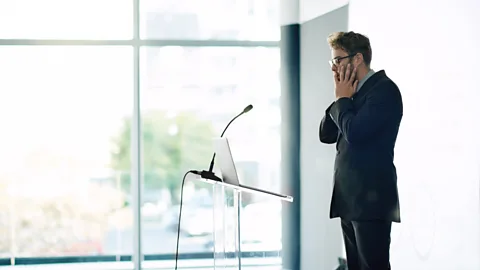
Strangely, I found that the feelings of anxiety themselves were perfectly tolerable; instead, I was preoccupied with the ways that others would perceive my nervous energy. A slight wobble of the voice, the unconscious biting of my lip – I assumed that I’d be judged harshly for any non-verbal signal that betrayed my lack of confidence. I was experiencing anxiety about my anxiety – a double whammy of worry that made the whole task feel much more daunting.
You might have noticed this yourself before a job interview or important work meeting in front of senior colleagues. And the more you try to suppress your feelings, the harder they bounce back.
According to a striking new study, however, these concerns may be unwarranted. Jamie Whitehouse, a research fellow at Nottingham Trent University in the UK, has shown that visible signs of stress are often appealing, leaving others predisposed to like us and treat us warmly. If so, we need not try so hard to maintain a calm-and-collected poker face – safe in the knowledge that people will relate well to our emotional authenticity.
Magnanimous monkeys
Whitehouse’s interest in stress is rooted in evolutionary theory. Stress is typically accompanied by many internal physiological changes which help us to prepare the body for a challenge. A racing heart, for example, helps to deliver oxygen to the brain and body, which will mean we can react with greater speed.
It is easy to see why these changes are adaptive. Yet many primates, when they are stressed, also reveal characteristic 'displacement' behaviours – such as nervous scratching of the skin – which don’t seem to serve any obvious purpose in handling the situation causing their discomfort. So why would they evolve?
One possibility is that these behaviours help smooth over social interactions within the group. Primate groups are often complex, with alliances between members and established hierarchies, and meeting a potentially hostile individual could be an important source of stress. The displacement behaviours may act as a subtle signal that shows this discomfort and reduces the risk of a needless confrontation. For the higher-ranking individual, it could be the cockier rivals who would most need taking down a peg or two, after all – not necessarily those who are already nervy.
In 2017 Whitehouse found some initial evidence supporting this idea. Observing a group of 45 rhesus macaques in Punta Santiago, Puerto Rico, he found that individuals tended to show more nervous scratching when they were around higher-ranking individuals and relative strangers with whom they did not already have a strong social bond. And that, in turn, seemed to change the nature of the interaction – resulting in gentler behaviour from the other monkey.
In the spotlight
Inspired by this finding, Whitehouse decided to test whether humans’ displays of stress might also alter individuals’ responses to us – perhaps through an empathic response.
In addition to the skin scratching seen in other primates, humans have many subtle behaviours associated with anxiety, including touching our face and hair, twisting the mouth, licking lips and biting nails – all of which might signal our sense of vulnerability and evoke a warmer reaction in others.
To find out if this was true, Whitehouse’s team first asked 23 participants to undergo the “Trier Social Stress Test” – an anxiety-inducing routine in which the participants must undergo a fake job interview, with a three-minute speech about why they are the ideal candidate and an on-the-spot mental arithmetic test.
A further 133 participants were then asked to rate videos of the fake interviews – with questions about how stressed the person appeared to be, and how much they liked the person they saw. Psychologists, meanwhile, counted how many times the participants showed non-verbal signs of stress.
As he had expected, the people rating the videos were able to predict how stressed the interviewees felt, and this seemed to come from those characteristic non-verbal signals. Most importantly, those perceptions then influenced the raters’ judgements of the interviewees’ likeability – for the better. The more the interviewees showed signs of stress, the more appealing they were to the people watching their videos.
“This tells us that these behaviours are not just functionless by-products of stress, but actually have communicative functions,” Whitehouse says.
 Getty
GettyRed-faced apologies
Whitehouse’s study chimes with experiments examining the effects of blushing from embarrassment. Many people feel uncomfortable with their shame being broadcast so overtly – but like the nervous mannerisms that Whitehouse studied, our reddening faces can actually improve the way we are perceived by others.
Consider a recent study by Christopher Thorstenson, an assistant professor at the Rochester Institute of Technology in New York state. In a series of experiments, he presented photos of embarrassed faces accompanied by vignettes describing socially awkward situations, and then questioned participants about the people’s reactions. The participants were told, for example, “You catch these people telling a lie. Which face looks more embarrassed?” and “These people apologise for cheating on a test. Whose apology is more sincere?”
Thorstenson found that a slight blush to the face increased the participants’ rating of embarrassment and sincerity, and it increased the likelihood that they would forgive the person for the transgression. “It signals appeasement to others,” he says – and unlike other non-verbal cues, like facial expressions, a blush cannot be faked easily. It is therefore seen as a sign of honesty which, in turn, makes you more likeable.
Whether we are nervously biting our lips or glowing like a neon sign, it can pay to show some emotional authenticity.
Missed cues
Leah Mayo, an assistant professor at the Center for Social and Affective Neuroscience of Linköping University in Sweden, is intrigued by Whitehouse’s results. Her research has examined the characteristic facial expressions that are associated with stress, and she suspects that people’s responses to our non-verbal signals will depend on context. When someone sees us giving a speech or presentation, for example, it is obvious why we might be feeling nervous – and this knowledge of the situation leads the other person to feel more empathetic. “In that case, you could get a ‘tend-and-befriend’ response,” she agrees.
But the reaction might not be the same if someone saw us scowling and jittery in the office, without any clues about the source of our worries, Mayo adds. In these situations, observers may easily misread stress signals for hostility or anger – and a further explanation may be necessary to help them read the cues correctly.
Clearly, we should be careful about making too many broad generalisations from this research. Whitehouse, however, hopes that his research can at least offer a breath of relief for anyone who is nervous about a presentation or a job interview – the specific context of his study. “A nice take-home from this research is that it’s sometimes OK to be stressed and look stressed,” he says. “You don’t have to try so hard to suppress it.” Provided that you can still reveal your knowledge and competence, you won’t be judged harshly for betraying your nerves.
When you allow your feelings to be more transparent, you may also find that the whole experience feels less overwhelming. Whitehouse points to a separate study which found that people who show more overt stress tend to get over their discomfort more quickly than those who keep their anxiety hidden. The altered attitudes of others could offer one mechanism, he suggests. “Producing stress behaviours may elicit a more co-operative response, which may in turn allow that individual to recover from stress much more quickly.”
There is also strong evidence that our mindset about stress can determine its consequences: people who see anxiety as energising tend to perform better in difficult tasks than those who fear the feelings and assume that they are inherently debilitating. A recognition of its social value could just be one more reason to view our discomfort a little more positively.
I’ve certainly found that this attitude can help with my public speaking. By learning to accept my pre-talk nerves, I have stopped feeling anxious about my anxiety. As a result, I find that I can focus more of my mental energy on the message I want to deliver – safe in the knowledge that my audience will react more warmly than I could have previously imagined.
David Robson is a science writer and author of The Expectation Effect: How Your Mindset Can Transform Your Life, published by Canongate (UK) and Henry Holt (USA) in early 2022. He is @d_a_robson on Twitter.
