The surprising perks of isolated work

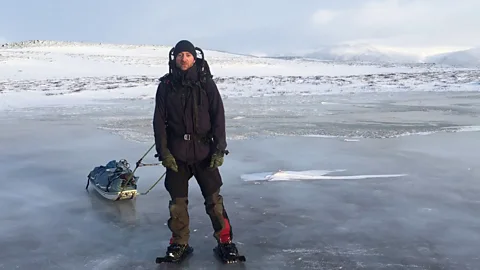 Morten Hilmer
Many are longing to return to the familiarity of an office. But others cherish the remoteness they get from their unique work environments.
For millions of people worldwide, widespread lockdown has cast isolation as a negative – a loss of group engagement and communal hubbub. Yet while many of us are clamouring to get back into the social rhythm of the office, there are people around the world who choose work lives involving long periods isolated in remote settings.
“Some people thrive on their own company,” says Sandi Mann, senior psychology lecturer at the University of Central Lancashire. “It gives the freedom of not having to worry about other people in terms of their needs or judgements. Others might like the challenge to see if they can cope on their own or to help them adjust to a different pace of life.”
Mann sees solitary times as beneficial contrasts to the pace of modern living. “We get used to high levels of dopamine from a busy, hectic and stimulation-rich environment, but dopamine is addictive. So, to wean ourselves off we need lower levels of stimulation.”
Or perhaps, rather than thinking in terms of lower levels of stimulation, those who choose to spend time out in the world in solitary are actually discovering different kinds of stimulation that crowded lives cover up.
BBC Worklife talked to some of these workers out on their own and asked why they like their isolated jobs. For them, being alone need not mean being lonely – even in the remotest of places.
Steve Fuller, Yellowstone National Park winterkeeper, US
Now aged 76, Steve Fuller has spent nearly five decades doing winter maintenance work in one of America’s most iconic wildernesses – Yellowstone National Park in the western US. And, since he began in 1973, Fuller sometimes spends weeks without seeing another soul.
“As Charlie Russell said, ‘People are best when they are few and far between’,” says Fuller, name-checking a 19th Century US artist famed for portraying the old Wild West.
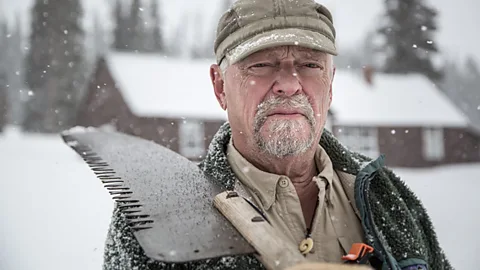 Steve Fuller
Intriguingly, Fuller started adult life amid modern hustle, working as a political journalist, then an emergency room technician at a Boston hospital. “In my youth, I relished living and working in city centres,” he says. But his decision to spend time living in Africa is what changed him. “My three years in East Africa were transformative. I came to realise I needed to live as connected with nature and animals as I practically could,” explains Fuller. “Yellowstone in winter was a good choice.”
Now, he works every winter from a remote 110-year-old wood-frame cottage in the Wyoming section of the vast nature reserve. “Some buffalo bulls I have known for years. My body language assures them I am just passing by,” says Fuller. “I speak with other animals, too. Pine martens, coyotes, foxes, wolves, bears, deer, moose.” Without camouflage clothes and a stealth approach, he says he’s ‘engendered trust’ with a simple greeting.
“Most other humans move too fast, and are noisy,” adds Fuller. “They’re ignorant of body language which communicates alarm or threat.” And that's important when he lives somewhere in which he can point to ten places outside his cottage window where people have been killed by bears.
Now, he captures Yellowstone’s enduring majesty in a photography portfolio, while also writing columns for the local Mountain Journal.
Reading is important, too. “Mine is the largest, most eclectic private library in Northwest Wyoming – not much of a claim,” he jokes. There’s also “cross-country skiing, conversation when available, sporadic efforts at ‘self-actualisation’ and Tat Tvam Asi [a Sanskrit phrase to describe a form of Hindu self-reflection] – interspersed with beer drinking and procrastination.”
Dee Caffari, Solo long-distance sailor
Isolated in the middle of an ocean, a person can seem more like an astronaut on the International Space Station than their fellow humans on land. And although more than 500 people have floated above the world as astronauts, barely a hundred have sailed non-stop, solo and unassisted around it.
British yachtswoman Dee Caffari – a veteran of six world circumnavigations on the ocean – was the first woman to sail single-handed non-stop around the globe in both directions. Her 178-day solo voyage in 2006 was also the first by a woman sailing ‘the wrong way’ – westward, against the prevailing winds and currents.
Her decision to set off alone was inspired by another famous British ‘round-the-world sailor, Sir Chay Blyth. “He suggested I become the first female to complete what was considered the impossible voyage. It was only a matter of time before a woman would do it, and why shouldn’t that woman be me?” says Caffari. “That conversation ignited a spark – I decided life is about opportunities – and this was too good an opportunity to let pass. There are not too many ‘firsts’ left to achieve in this world.”
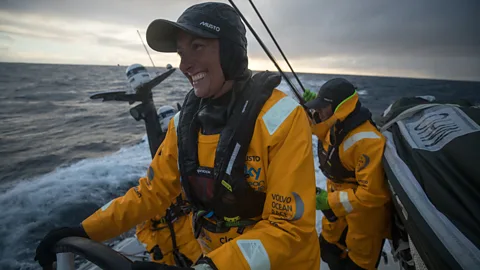 Sam Greenfield
Caffari, whose first solo voyage took six months, admits she hadn’t thought about the isolation aspect of her gruelling voyage. “It was just three months between returning from the Global Challenge Race and setting off alone, and there was a lot to do and get organised. I didn't really consider that I was about to spend all this time on my own.” The Global Challenge Race was set up in the 1990s by pioneering round the world yachtsman Chay Blyth to give amateur sailors a chance to tackle a circumnavigation led by a professional skipper. The last Challenge ended in 2005.
Have long solo voyages changed her? “They force you to think about your life. I am definitely more reflective,” says Caffari. “I have also had to learn to manage my emotions and avoid wasting energy dwelling on negatives. The bad times never last for long – and I only seem to remember the good times. That's what keeps drawing me back out there.”
Morten Hilmer, Sirius Dog Patrol, Greenland
The Sirius Dog Patrol tasks a tiny Danish army team to maintain facilities and oversee the world's largest national park, the North East Greenland National Park. Working in teams of six, the Patrol has sole responsibility for an area three times the size of Denmark.
Tours of duty last 26 months, during which team members including Morten Hilmer might travel 10,000 kilometres solo with just a dozen sled dogs for company. They traverse vast plains shared with arctic foxes and musk oxen – and polar bears, too. Hilmer is glad that only once during his time in Greenland did his team have to shoot a bear in the face of a deadly attack.
Raised amid forests and meadows in rural Denmark, Hilmer was inspired by his father's tales from three years working at a weather station in a place that acquired instant mystique to many people: Greenland.
“The adventure of exploring this huge desolate ice desert was a driving force,” says Hilmer.
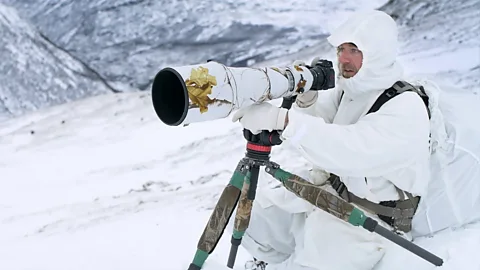 Morten Hilmer
In a recent podcast about his 26 months of remote Arctic duty, Hilmer said he was so beguiled by Greenland that, after an unhappy period back home in a Danish city, Hilmer talked his way into a chef's job at a facility back near the Sirius Dog Patrol headquarters – despite having zero cooking qualifications. There, he says, he became a master of the slow cooker, putting food on to cook for hours to allow himself time to head out alone into the vast wilderness that became a key inspiration for the nature photography he now earns his living from.
Virtual isolation in Greenland has left an indelible mark on Hilmer. “The isolation brought me an indescribable feeling of happiness and unlimited freedom.”
Harriet Reid, Farne Islands ranger, England
Harriet Reid is a National Trust Ranger on the Farne Islands off the northeast coast of England, spending nine months each year away from mainland civilisation. This rugged archipelago, where puffins glide and seals loll, is David Attenborough’s favourite British spot for magnificent nature.
Though there is always at least one other person on an island, Reid finds plenty of solitude. “I like being able to focus on the island.” That said, Reid is far from being a loner – she comes from a family of six. “I don’t seek out busy places, but I don’t avoid them. And I would never say no to a party.”
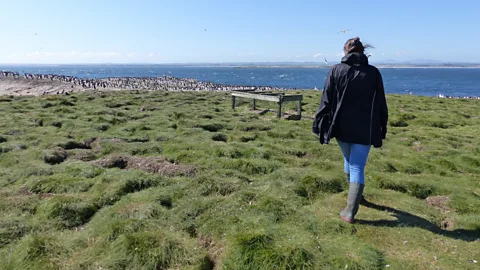 Harriet Reid
Her duties allow her off Farne one day a week – if weather permits in the sometimes-turbulent North Sea. “My longest time without coming off is 13 days, which is a quite a long time not to shower.” To pass quiet times, Reid investigates island rock pools, plays board games with any other colleague who may be about, plus reading, writing and “sketching badly”.
Like others, Reid's work setting has changed her. “It has made me much more responsible and determined. And if I can benefit the islands, that’s where I want to be.”
Leo Op Den Brouw, Gabo Island lighthouse keeper, Australia
Lighthouses have long been an iconic setting for solitude – until automation removed the need for people to man most of these coastal beacons around the world. But the lighthouse-keeper tradition continues on Gabo Island, a 150-hectare (380-acre) bit of land off the east coast of Victoria in Australia.
For two decades, Leo Op Den Brouw has been caretaker (officially, Field Services Officer) for Australia’s second-tallest lighthouse, fashioned in the 1860s from striking pink granite quarried on the island.
“I've always had an interest in history, all things nautical and, as a tradesman, working on heritage buildings. I also love the ocean and consider myself a saltwater person,” he says. “When the opportunity came to fill a short-term contract as caretaker on an iconic Australian lighthouse, how could I refuse? I never imagined I would still be here 20 years later.”
There’s a lot of alone time when the island's summer tourists vanish – but it isn’t a problem for Den Brouw. “I can go for long periods without seeing another soul. The longest has been 28 days. The quiet gives me time to catch up on the countless tasks that need doing.” He maintains old buildings on the island, and checks in with other infrastructure such as the its power system and water supply.
What draws him back each year? “The landscape is stunningly beautiful in all its various moods. And I love the work, the location, being part of a long-standing tradition of light-keeper,” he says. “The cares and woes of the world seem a long way away.”