The brilliant work of a diamond grader

 Yannis Zafeiriou
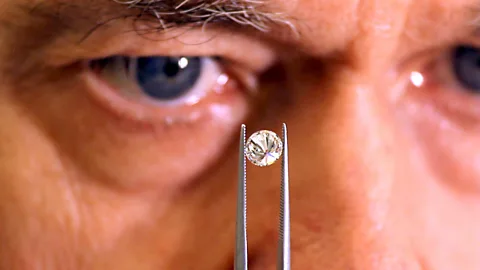
The clarity, colour and cut of a stone has an enormous effect on its value. No machine can do a better job of judging that than a human eye.
 Yannis Zafeiriou
The character of a diamond can be defined in part by its cut. How bright and reflective it appears is linked to the clarity of the stone, but is also dependent on the sophistication of the craftsmanship that has gone into the cutting.
Light enters the stone through the top and is reflected internally. Lots of small cut surfaces will produce a ‘brilliant’ effect, where light dances inside the stone and can look quite dazzling if executed with skill.
“[A round brilliant cut diamond] creates a beautiful symmetrical patterning of light and dark areas across the surface of the stone,” says John King of the Gemological Institute of America, holding a diamond over a light to produce the effect.
 Alamy
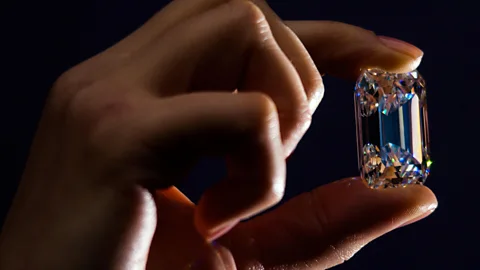
AlamyAn ‘emerald’ cut features long flat surfaces that produce an elegant effect. With fewer surfaces to reflect off, the light appears to move more slowly inside the stone, and the effect is generally less busy.
“A diamond grader can assess the quality of a stone by holding the diamond under a light and looking at how the light leaves the stone onto the table,” says Danielle Buckby of Graff, a jeweller in London. “If it’s well cut it will look bright and not dull. If the connecting edge is very thick it will cause a dark circle. Subtle things can make a difference.”
 Yannis Zafeiriou
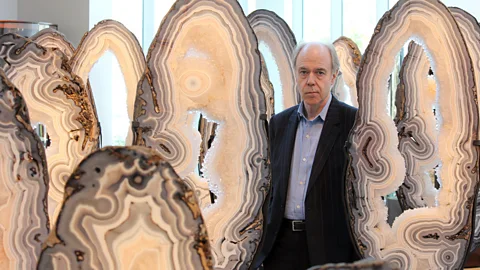
The eye quickly discerns depth, texture, form… that takes much more learning for instrumentation to be able to know those things.
John King
 Alamy
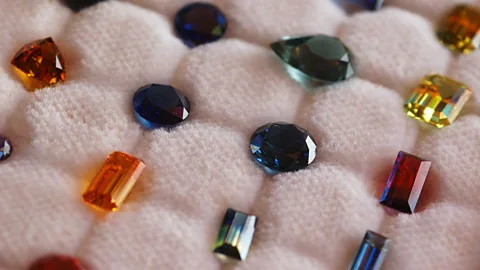
AlamyEverything about assessing the colour of coloured stones is done by eye,” says Buckby. “Judging colours has to be done by a human, but what you’re looking for really depends on the stone. Rubies, for example, are valued for their deep red. Pigeon blood rubies are widely regarded as the most sought-after. But because rubies are increasingly sparse, you see many pinker stones on the market that would have been less desirable.”
Rubies and sapphires are varieties of the mineral corundum and traces of chromium are what give rubies their red colour. Any other coloured corundum gemstones are labelled sapphires. Traditionally, this included pink stones, but the lines between pink sapphires and very light rubies are increasingly blurry.
There are lots of variations between stones, says Buckby, and it can be quite subjective. The governing bodies set guidelines, but every stone is different. Ultimately, it comes down to the judgement of the stone sorter.
 Yannis Zafeiriou
“I remember a blue diamond that I saw very early in my career that I think was one of those moments that turned me forever,” says King. “It was a richness of colour that I have never seen in a gemstone before. It has always stuck with me. Five years ago I saw that same stone again and had the same feeling.”
King holds a master’s degree in fine arts but found himself draw to working with gemstones after responding to an advert in The New York Times. King’s training in fine arts was the perfect preparation for assessing gems, he says, as it taught him to look deeper and seek uniqueness in each stone.
Both King and Buckby describe their vision as ‘normal’, and stress that they don’t think they have a particular genetic advantage over non-colour blind people. Where their expertise lies is in interpreting what they can see, which comes with years of practice.
King’s training in fine arts might even be an advantage as he ages and his sight deteriorates, he says. “We see so much in the arts, painters who do great things in their 80s and I think it’s because even though their vision has changed they have learned and applied their knowledge in different ways,” says King.
 Alamy
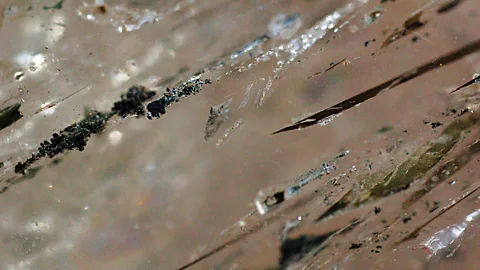
AlamyInclusions are mineral deposits within stones which affect the brightness and clarity. Largely, these deposits can only be detected by eye. In some cases, stonecutters will try to hide these inclusions using their skill and expertise to manipulate the reflective surfaces around them.
“An inclusion can be lasered out,” says Buckby. “The hole left by the laser is so small that it cannot be seen with the naked eye.”
For some stones, inclusions are inevitable. Emeralds will always contain them because the stones are not very hard, but as a result they have less of an effect on their value compared to diamonds.
 Yannis Zafeiriou
Clearly there is a point at which age catches up to us… but I think it also is an opportunity.
