Where loaves of bread are baked with fish

 Ilkka Sirén
Kalakukko is considered quintessentially Finnish, yet there aren’t many Finns who have actually tasted it.
 Ilkka Sirén
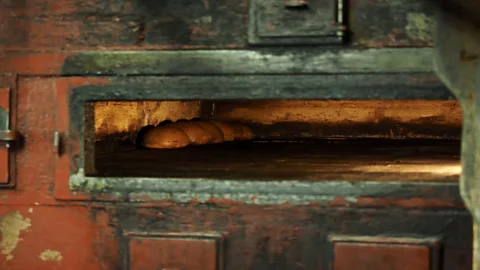
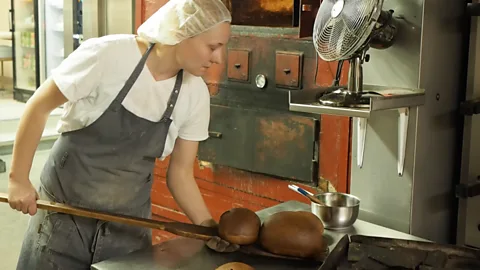
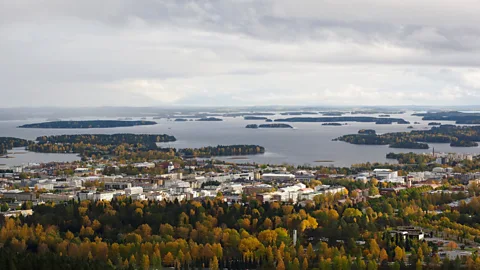
It was 8C outside and the door was wide open, but everyone in the Hanna Partanen bakery was dressed in T-shirts. The red masonry oven at the building’s centre had been radiating heat since 4am, as it has most days for the past 87 years. “It rarely gets cold in here,” said Perttu Partanen, who manages the bakery founded by his great-grandmother, Hanna Partanen, in Kuopio, a city in Finland’s Northern Savonia region.
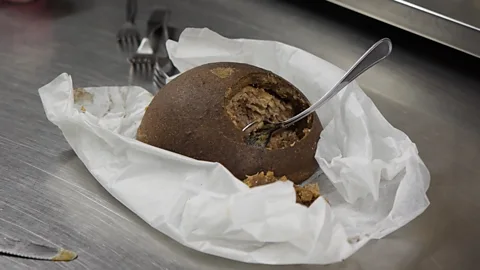
By 6am, the oven was filled with kalakukko, golden-brown mounds of rye bread stuffed with a surprising filling: bacon-wrapped fish.
 Ilkka Sirén
Although the first written mention of kalakukko dates back to the 18th Century, the dish is likely much older. In fact, kalakukko was probably Finland’s first takeaway meal: residents of Rautalampi, a town 70km south-west of Kuopio, used to bake birch sprigs directly into the bread as a handle, so you could literally carry it anywhere.
There are many variations of kalakukko, but the classic version is made with pork and vendace, a fish found in lakes across eastern Finland. As it bakes, the pork and fish amalgamate to form a succulent pâté with a distinct briny flavour.
Kalakukko is considered quintessentially Finnish, yet there aren’t many Finns outside the Northern Savonia region who have actually tasted it.
 Ilkka Sirén
Before establishing the bakery in 1930, Partanen’s great-grandmother made kalakukko at her summer cottage in Lehtoniemi, 6.5km south of Kuopio, which she would deliver to the city market by rowboat. Once she realised just how popular her creations were, she decided to open up a shop in town.
Today, Hanna Partanen is one of the last bakeries in Finland dedicated to making kalakukko.
 Ilkka Sirén
To this day, we use her original recipes,” Partanen said.
 Ilkka Sirén
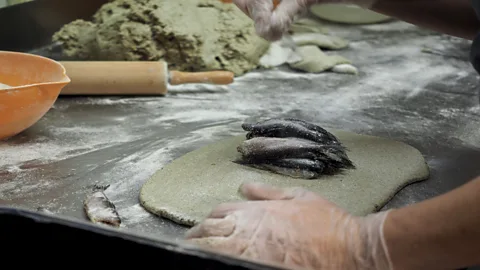
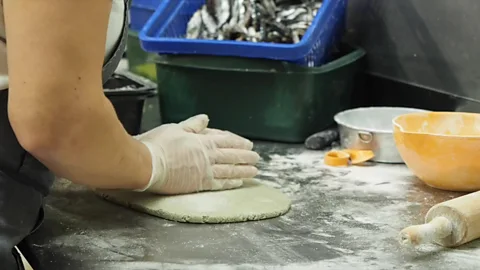
Baking a proper kalakukko is no easy task; the meticulous technique requires months to learn. It all starts with a chunk of rye dough rolled flat. The thickness of the dough is paramount: if it’s too thin, the kalakukko will lose all its moisture while baking; but if it’s too thick it becomes difficult to eat.
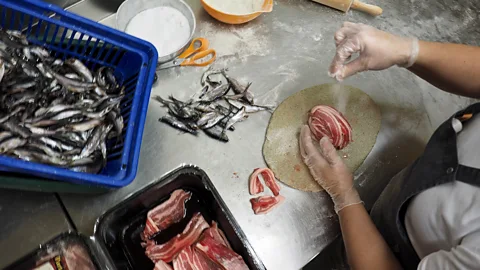
Vendace is the most common filling because of its small bones. Hanna Partanen’s bakers pile whole fish (minus the heads) in the middle of the dough, cover them with fatty strips of pork bacon and sprinkle the mound with a dash of salt. The pork fat keeps the kalakukko juicy inside, and helps to soften the fish bones.
 Ilkka Sirén
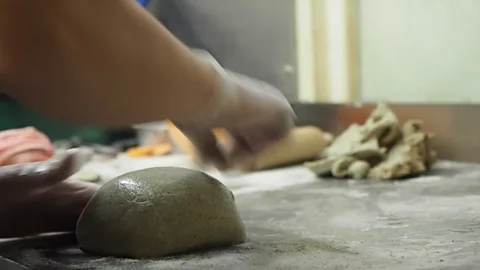
The bakers then wrap the dough around the filling, creating a small bundle that weighs around 1kg. Then, using a knife, they shave the excess dough from the kalakukko while smoothing the surface of the loaf to ensure no moisture escapes during the baking process.
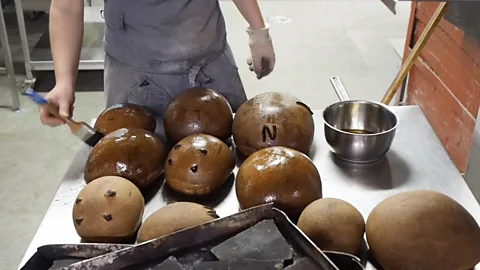
After 20 minutes in the oven, the kalakukko are removed and the bakers spread fresh dough on the bottom to seal any cracks that have formed. The loaves are then placed back in the oven for 10-12 hours at around 100C. Halfway through, the bakers inject the kalakukko with butter using large syringes to ensure they stay moist.
 Ilkka Sirén
Perhaps kalakukko’s rarity is due to the long and laborious preparation, but Partanen is optimistic about the future. “The demand for kalakukko is stable,” he said. “One would think the younger generation is not interested in eating it, but that’s not the case.”
The Hanna Partanen bakery makes an average of 80 kalakukko each day, though it’s been known to produce as many as 150. In addition to the vendace version, the bakery also serves salmon- and perch-stuffed loaves, and a vegetarian variety made with swede.
 Ilkka Sirén
To eat a kalakukko, you cut a circle on top and then use pieces of the rye crust to scoop out the tender filling. While some people prefer to wash it down with beer, “My personal favourite is ice-cold milk,” Partanen said.
