The town that launched a global self-care industry

 Alamy
AlamyLong before wellness became a global industry, a small town in eastern Belgium shaped how Europeans thought about health, leisure and water. In Spa, the original spa is reclaiming its place in the story.
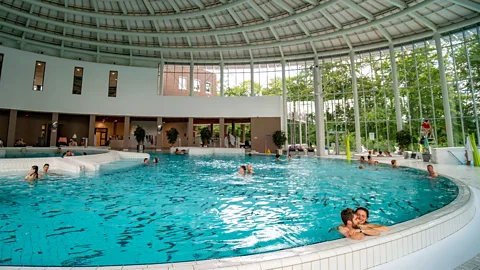
I'm floating on a jet stream of warm thermal water, overlooking bare winter branches silhouetted against the setting Sun. The current draws me gently around the edge of an outdoor pool, nudging me toward its furious, bubbling centre before it propels me indoors, where more pools, jacuzzis, hammams and a dizzying array of treatment rooms unfold in sequence.
I am at Les Thermes de Spa, a contemporary thermal complex perched above a small, elegant town tucked into the forested hills of eastern Belgium. It's a place that might otherwise fly beneath the radar, were it not for one defining fact: the town of Spa gave the world both a word and the foundations of a global wellness industry.
Spa calls itself "the original spa", and its mineral springs were already known in Roman times. They were first recorded by Pliny the Elder, whose writings helped establish Spa's reputation as a place of healing waters. Popular belief tells that the Romans gave Spa its name, derived from the Latin phrase sanitas per aquam ("health through water") but historians agree the name is a later invention.
"Spau, spaha or spaw were old Germanic words used to describe water that bubbles or gushes from the ground," explains local guide Philippe Calonne. "And this is a much more likely origin of the name, which Roman travellers adopted." He explained that they spread it across the empire, lending its name to other places with thermal waters, before it gradually became shorthand for general health and beauty facilities.
 Alamy
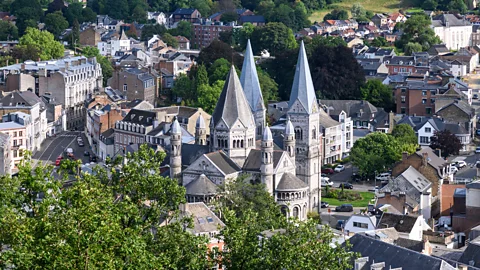
AlamyThe springs that shaped Spa are still visible today. In the town centre, the Pouhon Pierre-le-Grand pavilion – named after Peter the Great, who visited in 1717 – houses one of the sources that first drew visitors here. "The origins of Spa are linked to its very first spring," Calonne tells me. "At the beginning, the site was nothing more than a hole in the ground, but that changed during the Middle Ages, as word spread of Spa's acidic, iron-rich water and its reputed health benefits."
These early visitors did not come to bathe, however. Spa was initially known for "drinking therapy", and public drinking fountains still dot the town, their basins stained a deep, rusty red – visible evidence of the iron content – with some corroded through entirely. The water tastes metallic, sharp and slightly bitter. It's not pleasant, and historically that was the point: the stronger the flavour, the more convincing the cure was believed to be. Peter the Great reportedly stayed for around a month, drank more than 20 cups a day and was said to have been cured of digestive and liver ailments.
The shift from drinking to bathing began in the mid-16th Century. In 1559, a physician from nearby Liège, Gilbert Lymborh, published a treatise on Spa's mineral waters. With it, Spa's reputation grew and wealthy patients began arriving not only to drink the waters but to immerse themselves in them. By the 18th Century, Spa had reinvented itself as one of Europe's most fashionable resorts. Its grand municipal baths were built in 1868, and under Belgium's King Leopold II, who reigned from 1865, the town was deliberately reimagined as the "pearl of the Ardennes".
"Over time, Spa became increasingly well-known and attracted important figures from across the continent," says Calonne. "Aristocrats, artists, intellectuals and political figures arrived to socialise as much as to seek cures."
 SPA! Museum
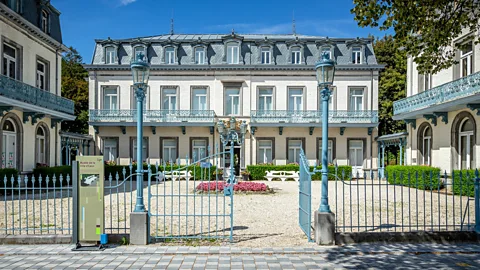
That legacy is traced at the Musée de la Ville d'Eaux, housed in a former royal villa at the edge of the town's park. Inside the Pouhon pavillion, a monumental painting by Antoine Fontaine, Guestbook (1894), offers a sweeping roll call of 92 notable visitors through the centuries, from King Charles II to Descartes, Voltaire and Litz. Later arrivals, including John Lennon, David Bowie, Pablo Picasso and Charles Dickens were too late to be depicted on the canvas, but the point remains: anyone who was anyone made a point of visiting Spa.
More like this:
Over time, however, the idea of "spa" slipped its geographical moorings. What began as a specific practice tied to mineral water and place evolved into a global wellness industry encompassing everything from thermal bathing to beauty treatments, longevity clinics and digital detoxes. As modern, purpose-built resorts proliferated, Spa itself faded from the spotlight, its historic bathhouses and hotels struggling to compete.
That began to change in 2021, when the town was inscribed as part of the transnational Unesco World Heritage Site known as the Great Spa Towns of Europe, a designation recognising not just architecture but living traditions of wellness and social ritual. Today, Spa is quietly re-establishing itself by returning to its roots.
 Thermes de Spa
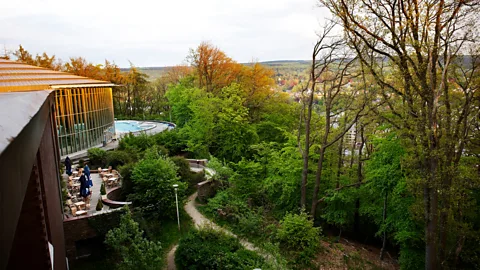
Those roots are perhaps most clearly expressed at Les Thermes itself. Perched above the town, the complex is a bold steel-and-glass structure rising from the wooded hillside. Opened in 2004 to replace the crumbling 19th-Century baths, it was conceived not as a break from the past but as a continuation of Spa's bathing tradition.
"The building may be modern, but what we do here is deeply rooted in Spa's history," says Cristel Pire, a manager at the baths. "Many treatments are direct continuations of those used generations ago."
Reaching Les Thermes is part of the experience. Visitors can take a short funicular ride from the town centre or walk up a wooded path that climbs steadily through the trees. Historically, walking was considered as essential to treatment as bathing or drinking the water, and Spa sits at the gateway to the Hautes Fagnes – a vast sweep of dark forest and wild moorland threaded with hundreds of kilometres of hiking and mountain-biking trails.
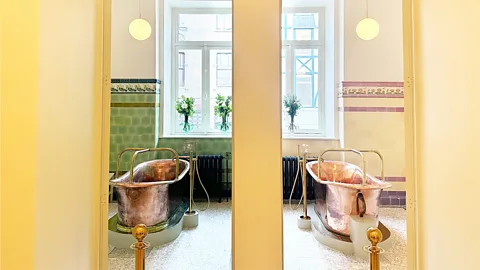
Elsewhere in town, Spa's historic bathhouses are undergoing their own revival. The palatial neo-Baroque Les Bains de Spa, closed in 2003 and lay abandoned for years before reopening in 2025 as a meticulously restored five-star hotel and spa. Though it no longer uses the town's thermal water, its basement spa unfolds around a central pool, with a hammam, saunas and warm, bubbling Roman-style baths. Elsewhere, original copper bathtubs gleam as sculptural reminders of the past.
 Regine Mahaux
Even Spa's modern claim to fame, the nearby Circuit de Spa-Francorchamps, offers reminders of the town's origins. Widely regarded as one of the most beautiful and demanding tracks in Formula 1, its most famous corner is called La Source ("The Spring"), while Eau Rouge ("Red Water") nods to the mineral-rich landscape.
Today, the word "spa" has become shorthand for everything from beauty treatments to wellness retreats. "We don't see ourselves as chasing trends," Pire says. "Our role is to protect what has always been here. The mineral water remains central, and the baths continue to function not just as places of treatment, but as social spaces."
It's a reminder that long before wellness became an industry, it was a practice rooted in place. In Spa, no one has ever forgotten where the word came from.
--
If you liked this story, sign up for The Essential List newsletter – a handpicked selection of features, videos and can't-miss news, delivered to your inbox twice a week.
