Shrovetide football: England's ancient and chaotic ball game

 fantail/Getty Images
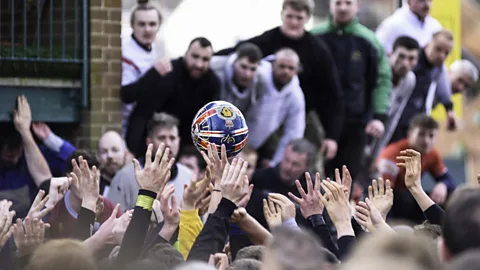
Shrovetide football consumes the town of Ashbourne on Shrove Tuesday and Ash Wednesday, when the normal rules of society are suspended and the town cheerfully turns to anarchy.
Across the British Isles, Shrove Tuesday is celebrated by the cooking of pancakes – a legacy of the time when Christian families would use up their stores of butter and eggs before the lean period of Lent. In the Derbyshire Dales town of Ashbourne in central England, however, Pancake Day is celebrated with a little more gusto.
The whole town is consumed each Shrove Tuesday and Ash Wednesday (this year on 13 and 14 February) by an ancient and extremely chaotic ball game known as Shrovetide football, which sees the population split into two teams who attempt to manoeuvre a large ball through a hundreds-strong scrum of people to reach one of two goals, three miles apart. The "goals" are two stone monuments on the site of former mills, Clifton Mill and Sturston Mill; players score by tapping the ball against them three times.
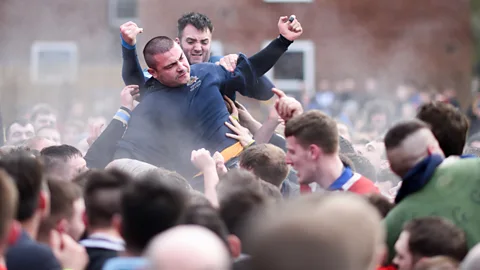
This is achieved by any means necessary – flying fists, kung fu-kicking feet and even chomping teeth are all fair game inside the huge scrum, known as "the hug", which moves at will through town streets, rivers and muddy fields as each team vies for control of the ball. For two days only, the usual rules of society are suspended. This usually genteel market town is swallowed by a deluge of violence, and colleagues, friends and family members become sworn enemies.
And they absolutely love it.
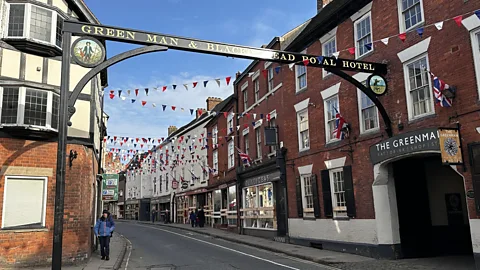
"In the days leading up to Shrovetide, you can see everyone fizzing with excitement," local Amy Fisher told me in the town's Greenman Pub on the first morning of the 2023 celebration. She would be playing herself later that day, she said, showing me a hip flask stowed away in her pocket. "Last time I kept popping in and out of the hug to come back here to the pub," she said. "But this year, I'm in it for the long haul.
Fisher is an Up'ard – that is, somebody from north of Henmore Brook, which runs through the town and is the geographical line along which Shrovetide football's teams are divided. Her friend Pinder Dayal, who works at the pub, is a Down'ard – someone from south of the brook. Despite the apparent animosity between the two teams, this is a sacred Ashbourne tradition and is fiercely protected as such by the locals. "Outsiders are welcome to watch, as long as they don't get in the way," Dayal said. "But as the head of the Shrovetide committee says, this is a local game for local people." Therein may lie a clue as to the purpose of Shrovetide football; while it seems to tear the town apart, it actually strengthens their collective identity.
 Daniel Stables
There aren't many rules to the game, but one that is oft-repeated states that "unnecessary violence is frowned upon" (note: not "forbidden"). The use of motorised vehicles to carry the ball is a no-no, as is entry to cemeteries, churchyards and private gardens. The most striking directive, however, is a gravely simple one (and hopefully one that is no longer relevant today): "Murder and manslaughter are prohibited."
"Tuesday's pretty good-natured, but Wednesday's when it really kicks off – when people have been stamped on a few times," Fisher said. "That's when it gets nasty." She assured me that any hostilities are short-lived, however. "Everyone's great mates again in the pub afterwards," she said. "It's a very wholesome British tradition."
"Wholesome" is a relative term, however. Every year, there are bruised ribs, sprained ankles and broken bones. But Ashbournians, such as local historian Tim Baker, who curates the town's museum and is also the official Shrovetide ball painter, say that's just part of the deal. "This type of game can't be played without injury – everyone plays at their own risk," he told me. "Things can get quite harsh on the day if tempers fray, especially if they've been in the pub a little while before, but it's a friendly rivalry. If you're in the hug and someone's biting your hand, and you don't know who's doing it and you turn round and thump him on the head and it turns out to be your best mate… well, that's just unfortunate."
 fantail/Getty Images
There have been two recorded fatalities in the game's centuries-long history. The first was a young man in the 1860s who fell in a water pit outside Clifton Mill, one of the two "goals", and drowned. The latter casualty was a 20-year veteran of the ball game named David Johnson, who collapsed after the Tuesday's play in 2018.
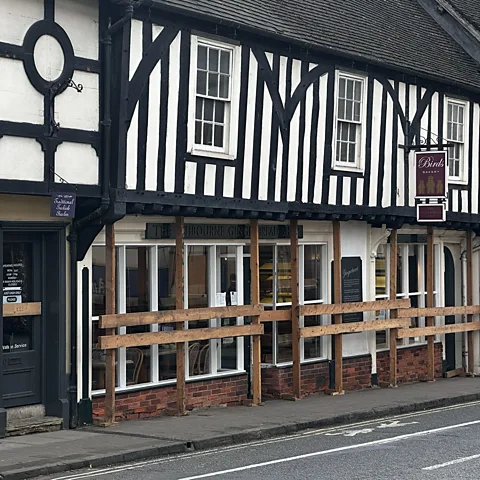
There is collateral damage, too. As I left the pub and walked through town, I saw signs everywhere exhorting people not to park in the town centre lest their vehicles be crushed by a marauding mob of townsfolk. All the shops and cafes had their windows boarded up, even as they remained open for business, exhorting punters to enter through side doors or selling tea and coffee from makeshift wooden stalls. Festive bunting hung on lines above the streets, and Union Jacks were everywhere as if in celebration of a royal jubilee.
The Ashbourne game is one of the last remaining relics of a sport that was once popular all over England. Also known as medieval football, folk football and mob football, it is considered the precursor to modern football and rugby and only survives in its ancient form in a handful of places, including Alnwick in Northumberland and Atherstone in Warwickshire.
The Ashbourne game is by far the largest, with hundreds of players on each side, and is the only one officially known as Royal Shrovetide Football – the town was given permission to use the title after residents gifted a game ball to Princess Mary on her wedding day in 1922. To this day, Baker paints the royal insignia of the Union flag and Tudor Crown on the balls each year. Royals have opened proceedings on a couple of occasions, too, by throwing the ball into the waiting scrum from a plinth in a town-centre carpark – this role was fulfilled by Prince (now King) Charles in 2003, while other celebrities to have been afforded the honour include legendary football manager Brian Clough.
 Daniel Stables
The Ashbourne game's exact origins have been lost to the mists of time, but it is known to have been practiced for centuries. A grisly local legend has it that the original ball was the severed head of an executed prisoner, recalling the Mesoamerican ball game depicted in gory detail in Mayan temple carvings across Mexico. According to Baker, though, that's a little far-fetched. "That may have been the case in places like Alnwick or Warwick, but there was no castle in Ashbourne, so people wouldn't have been executed here," he said.
Nonetheless, he told me, the game used to be an even-more hardcore affair than it is today. "My granddad remembers seeing players running down the road, sparks flying off their hobnail boots," he said. "It was a tougher game; people were tougher – they would come to play straight from work in their gators and flat caps. It was seen as a time for settling old scores. But it's not really like that anymore."
I walked through town towards the carpark where the game was due to begin. The streets were starting to fill with excited spectators who wore their allegiances proudly – upward or downward arrows were plastered on their faces like warpaint. A huge crowd had gathered around the plinth, where a local dignitary belted out an impassioned rendering of "God Save the King" before hurling the ball into the gathered mob. Half the crowd – the spectators – took a step backwards in unison, while the other half – the players – rushed forward, forming the amorphous hug that would be their home for most of the next two days.
As the first fists began to fly, I watched on and got talking to a safety marshal, Dan Thomas (the marshals are there for the safety of the crowd, not to police the game). Did he feel any yearning to get involved, I wondered?
"I played for years but I got injured a few times, so I retired," he said, laughing. "This is the event of the year here, though. Christmas comes and goes, and no one cares about it. They're all looking forward to Shrovetide."
Hidden Britain is a BBC Travel series that uncovers the most wonderful and curious of what Britain has to offer, by exploring quirky customs, feasting on unusual foods and unearthing mysteries from the past and present.
---
Join more than three million BBC Travel fans by liking us on Facebook, or follow us on Twitter and Instagram.
If you liked this story, sign up for The Essential List newsletter – a handpicked selection of features, videos and can't-miss news delivered to your inbox every Friday.
