The Hardknott Pass: Britain's wildest road

 Howard Kingsnorth/Getty Images
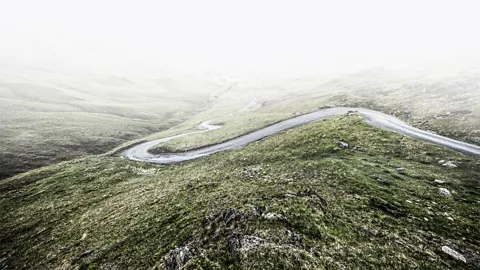
Built by the Romans and considered one of Britain's most "outrageous" roads, it's filled with sharp hairpin turns and is the width of a bridleway.
If I'd steered hard around the hairpin bend, I'd have driven straight into a frightening gradient of crumbling road, rearing up like a tidal wave in front of me. Rainwater poured down the middle of the rough carriageway like a mountain stream. I reached to change gear and realised I was already in first. Just then, a nonchalant sheep strolled out in front of me, causing me to slam on the brakes.
Hardknott Pass in England's north-west Lake District is, technically, the most direct route from the central Lake District to West Cumbria, but it is so steep and difficult that outsiders are often warned to take hour-long detours to avoid braving its twisting, single-track slalom up a mountainside. It was described as one of Britain's "most outrageous roads" by The Guardian, and locals are full of tales of cars suffering brake failures, drivers freezing with the challenge and of skids and misjudgements causing cars to plunge off the narrow carriageway.
This leaves some asking: should this extraordinary 13-mile stretch between the towns of Boot and Ambleside be closed to traffic – or celebrated as a national treasure?
 Steve Fleming/Getty Images
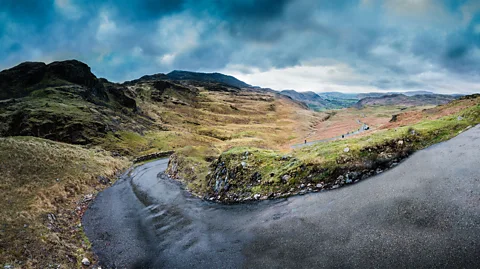
Each year, visitors set off westwards from genteel tearooms in the tourist hub of Ambleside, hoping for a pretty potter through the England's largest national park, the Unesco-inscribed Lake District. Instead, they run straight into the most challenging stretch of road available to British drivers; a sequence of steep switchbacks climbing a bleak mountainside.
Appropriately you'll find this "most outrageous" of roads snaking around England's highest peak (Scafell Pike) and deepest lake (Wastwater) in the mountainous wild west of the Lake District. Many consider Hardknott a hazard. "We put guests off from coming over Hardknott Pass," said local holiday-home owner Greg Poole, matter-of-factly.
The Institute of Advanced Motorists' spokeswoman Heather Butcher said: "Depending on the rider or driver's experience, it could be one to avoid. We don't recommend putting yourself or others in danger… You can read reviews online from various sources confirming that it's a challenging road, a thrill, etcetera, but we would advise all riders and drivers to approach roads like this with caution." And Neil Graham, a communications officer for the Cumbria Police added, "People shouldn't seek out the road to challenge themselves."
And yet, to others, this daunting route is a landmark to be celebrated; a challenge to be attempted.
 Westend61/Getty Images
Owner of nearby Muncaster Castle, Peter Frost-Pennington, has driven Hardknott hundreds of times and calls it "one of the most exciting and incredible roads to drive, cycle or walk in the whole world. It should be on everyone's bucket lists." And while Poole may warn his holiday guests away, he chooses to take the route himself, saying, "I love the drive. It's exciting, challenging, beautiful, sometimes scary but never boring – you won't fall asleep at the wheel for sure."
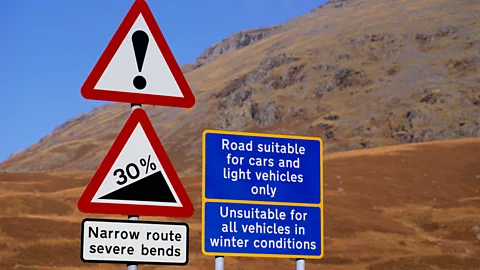
What is this notorious stretch actually like to drive? As Hardknott and its preamble, Wrynose Pass, climb from the gentle lakeside Greenburn Beck, signs warn drivers: "Narrow road. Severe bends". But if you've come this far, there's no alternative route or turning back. You're about to face a sequence of ridiculous hairpins the width of a bridleway, a constantly disintegrating road surface and unguarded drops plummeting hundreds of feet down the mountainside towards rough moorland, rocks and scree.
You may also be interested in:
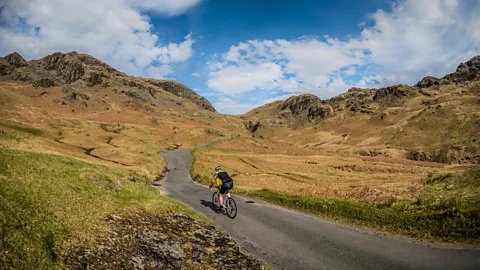
Hardknott's hardest section, towards the top, lasts less than a couple of miles but rises 1,037ft. A few hairpins reach 25% gradient, and the final cliff is a breath-taking 33%. The "Unsuitable for caravans" sign is a humorous understatement.
These gradients are steeper than most alpine routes and exceed the famous extremes of the Tour de France, Giro d'Italia and Europe's other grand cycling tours. The fitness of the few elite cyclists who manage to scale the pass is put into perspective by a 2019 Eurosport documentary called England's Toughest Climb. An "average" cyclist was given a strict six-week expert training regime as preparation for tackling Hardknott. To the programme maker's horror, he still failed to make it up the pass.
 Steve Fleming/Getty Images
My first experience of the Hardknott Pass was as a passenger alongside a super-confident team from the Royal Air Force. We were heading for Scafell Pike as part of the Three Peaks Challenge, in which participants attempt to climb the highest peaks in England, Scotland and Wales in 24 hours. Like many unsuspecting tourists, we were shocked to discover the true nature of the road, and we hit the hairpins amid torrents of water in the dark early hours of a stormy morning. The driving officer struggled to cope and the engine screamed as the wheels repeatedly lost traction.
We made it up, amid a tsunami of special force swear words. The driver stayed in the car to recover while we scaled the peak. Afterwards, he took the longer route back.
My second visit was with an elderly businessman in his proud new Jaguar. I'd warned him about the descent but was overruled. Surely, he stated, his gleaming Jag could cope with a little Cumbrian slope.
Within seconds of cresting the brim of the pass, however, he was tackling a sort of road he had never seen before. His wide, softly sprung luxury saloon was completely inappropriate. Red-faced and gasping, he pulled onto a rocky verge to regain breath. We proceeded to the foot of the hill at single-digit miles per hour.
 Ashley Cooper/Getty Images
Then a few years ago, I set out to tackle the pass in my own car – a humble 20-year-old Volvo.
Yes, at times it felt like I might have toppled over backwards, but if your car is 100%, the weather is fine and you get your revs and gearchanges right, I found it to be completely possible. (My main tip: even when the road seems to rise like a wave in front of you, don't hesitate. A missed gear change can have you rolling back off the carriageway.)
In this age of smart motorways and self-driving cars, for driving-lovers like myself, Hardknott represents a flashback to a time when you had to concentrate on the road as if your life depended on it (it does) and wonder if your car will make it (it might not). Unlike the vast majority of Britain's roads, this short track offers a memorable driving experience every time. It's England's ultimate motoring anachronism.
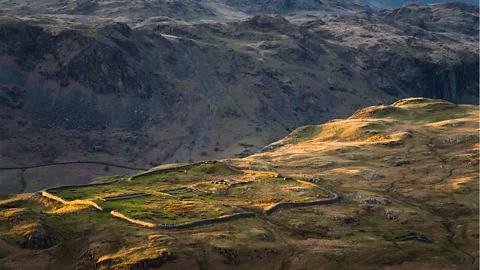
Indeed, the little road has a long, colourful history. The original route was laid by the Romans around 110 AD and led to a dramatic stronghold at the top of the pass known today as Hardknott Fort. The remaining stone walls of the fortress are an English Heritage site with sweeping views across the fells and are all that's left of one of the more remote Roman outposts in Britain. After the Romans left in the 5th Century, the road lingered on as an unpaved horse and mule route until the local hoteliers association paid for improvements to the road in the 1880s, hoping to encourage scenic horse and carriage trips. A few years later, the scheme was abandoned.
 221A/Getty Images
It wasn't until 1913 that the first motor vehicles drove over the pass, from the easier Eskdale side. Later, Hardknott's steep gradient was used to test tanks during World War Two. Their steel tracks chewed up the road so much that it had to be rebuilt.
Today, the road is best tackled on a sunny day – but that's rare in the West Cumbrian fells. An average day features horizontal rain, buffeting side winds and slippery surfaces. On a bad day, the road becomes impassable.
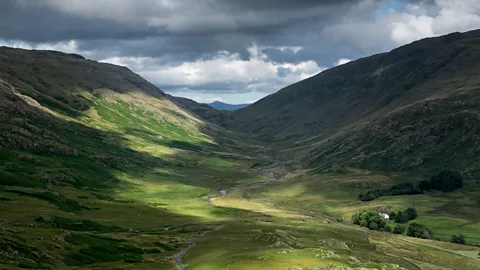
The driver's reward for all that steering and gear changing, however, is access to an untouched mountain landscape of rare, wild beauty. The waterfalls, sheer rock faces and sudden stunning views across the fells must be much as the Romans saw them. Cliffs soar into the clouds on either side while hardy sheep wander confidently across the road. They don't worry about the traffic. After all, cars are the outsiders here.
The Open Road is a celebration of the world's most remarkable highways and byways, and a reminder that some of the greatest travel adventures happen via wheels.
---
If you liked this story, sign up for the weekly bbc.com features newsletter called "The Essential List". A handpicked selection of stories from BBC Future, Culture, Worklife and Travel, delivered to your inbox every Friday.
