Taiwan's acidic underwater hot springs

 Dr Mario Lebrato
Above water, Turtle Island is a popular and idyllic tourist attraction. But it's what's underwater that is fascinating scientists.
The smell hit me first.
The acrid punch of rotten eggs was olfactory evidence that below our boat was a forest of undersea vents tirelessly ejecting sulphurous volcanic gases, like supercharged marine hot springs.
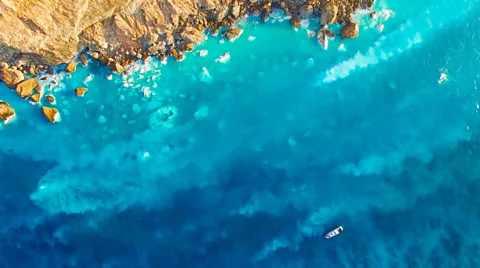
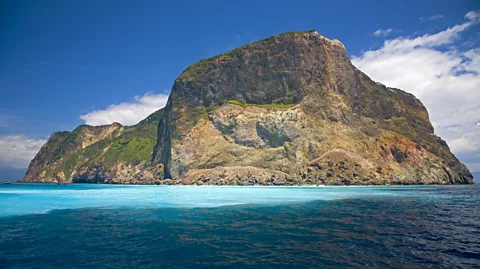
The stench was all the more surprising considering how idyllic our setting was: a forest-covered volcanic island lay in the near distance, while between us and the jagged coastline, a gorgeous spill of turquoise water contrasted sharply with the moody blue of the rest of the ocean.
I was about 12km off Taiwan's north-eastern coast, circumnavigating Turtle Island (Guishan Dao in Chinese), one of Taiwan's only two active volcanos that is about 7,000 years old. That's pretty young in island years. It is a popular tourist attraction, famed for its turtle-shaped silhouette, photogenic cliffs, military tunnels and offshore dolphin watching.
But it's this patch of paler water on the island's eastern side, where the turtle's head tilts upwards out of the sea, that has got both scientists and Instagrammers equally excited.
Nicknamed the Milky Sea, it is both a beauty and a beast. The alluring hue attracts photographers, but under the surface the water is hot and acidic, its pH value one of the lowest naturally occurring in the world's oceans – something not yet fully understood by scientists. Dozens of hydrothermal vents, like small chimneys, called fumaroles, litter the ocean floor, pumping out toxic gases and heavy metals. Turtle Island's vents are like a natural laboratory because not only are they close to shore, they are also shallow, many lying less than 14m below the surface, making them accessible sites for study by marine scientists.
 TopPhotoImages/Getty Images
"The underwater landscape looks like it's from another world," explained Dr Mario Lebrato, who made dozens of dives here as part of a 10-year time series study (2009 to 2018) led by the Institute of Geosciences at the University of Kiel in Germany in collaboration with Taiwanese and Chinese researchers. "There are heavy metals, it is acidic, and you mostly see a lot of bubbles mixed with a lot of noise… and there are continuous temperature changes." Water comes out of the vents at about 100C but cools quickly when it mixes with the surrounding seawater. "It's quite stressful, particularly because the noise from the fumaroles can be deafening," he added. "You feel in danger most of the time."
You may also be interested in:
Such a hostile environment is believed to be similar to the conditions when life first emerged on Earth; and studying the animals that have evolved to survive in the Milky Sea may thus teach us something about the earliest lifeforms 3.5 billion years ago. "We will not necessarily find anything to explain the origins of life, but likely how life evolved in the first few millions of years under such extreme conditions, probably resembling a place like Turtle Island," explained Lebrato. The kinds of things we should be looking for, he added, are what sorts of species are able to survive here, how they are able to do so, and how low diversity is.
So, what lives down here?
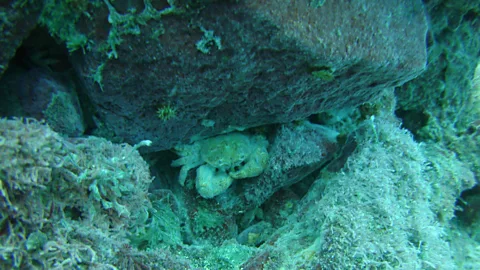
Directly next to the vents, not much. Only a very specialised crab called Xenograpsus testudinatus (a particular type of vent crab) is able to survive, according to Dr Yiming Wang, who joined the study as an expert on food webs. "No other metazoan [multi-cellular animal] life can be found in the immediate vicinity of the [active] vents due to the toxicity of the sulphur fluid plumes," she explained. These crabs have evolved to survive by feeding off animals such as zooplankton and fish that are unfortunate enough to drift close to the vents and perish, as well as detritus and layers of micro-organisms that coat the seabed.
 Dr Mario Lebrato
They may also have "acquired an amazing ability to utilise the sulphur bacteria [bacteria that use sulphur for energy] as a food source," Dr Wang added. Research in this area is so new – this species of crab was only discovered in 2000 – that how these crabs are able to withstand such a toxic environment is still a mystery.
Away from the vents though, it's a different matter entirely. Sea anemones, snails, molluscs and a rainbow of corals flourish in the vicinity. And outside the Milky Sea zone, the waters around Turtle Island are some of Taiwan's richest fishing grounds, teeming with marine life carried by the warm Kuroshio Current that flows northwards to Japan. Testament to this bounty is the prevalence of top predators – schools of dolphins. They are the main attraction of trips to the island, and indeed as my tour left the Milky Sea and coasted east, an enormous pod of spinner dolphins appeared; their grey-streaked bodies twisting, torpedoing and somersaulting around the bow.
There's another more pressing reason to study the animals that live around Turtle Island's hydrothermal vents: they can give us clues as to how marine ecosystems may cope with drastic changes, the kinds predicted to occur from climate change such as ocean acidification, or from major pollution events such as the dumping of mine tailings (crushed rocks and other waste products from mining that can be very toxic). Turtle Island allows us to "study how marine life survives in extreme environments, which is very relevant to understanding the ocean's future," Lebrato said.
In the latter half of their longform study, something happened that would change the whole course of their research. In 2016, Taiwan was rattled by a 5.8 magnitude earthquake, while just weeks later, it was hammered by Nepartak, a Category 5 typhoon. These twin assaults triggered landslides on Turtle Island, with the rubble stoppering many of the vents. After the ocean hot springs were effectively blocked off, the seawater's chemical composition and pH drastically changed.
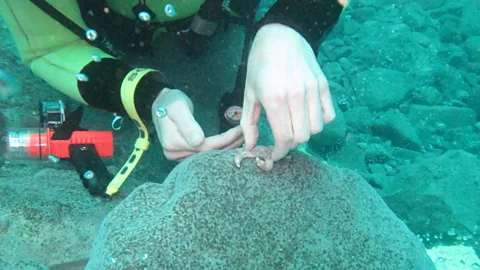
Amazingly, the vent ecosystem coped remarkably well; there was no major species die off, as their 2019 paper explained. "Marine life has a great capacity to adjust to extreme changes," said Lebrato. "Our major finding was that no matter how big the disturbance, life… and the system overall managed to recover after two years to its previous state. This speaks to the resilience of marine systems despite extreme events."
 Dr Mario Lebrato
However, not all species were equally resilient. Crab numbers declined whereas snails and molluscs appeared to be unaffected. Specialist species, like the vent crab that scientists believe may need to supplement their diets with sulphur bacteria for nutrition, are more vulnerable than generalist species that are less fussy about their food sources, explained Wang, now the lead author of a new study on how the typhoon and quake impacted foraging strategies for the vent species. Her research has found that although the vent ecosystem survived the quake-typhoon disaster, the more flexible species ended up coping much better, so there will always be some winners and some losers following catastrophic events.
Most tourists who come here never hear about the fascinating struggle for life going on under the sea. Instead, they delight in the dolphins and take pictures of the surprising blue of the Milky Sea or the caramel-and-grey striped cliffs. Taiwan closed off the island in the 1970s for 23 years during martial law, building tunnels, watch towers and lookout points that remain to this day, and day-trippers (overnight stays are forbidden to protect the island's delicate ecosystem) come to scramble around the military installations, tour the abandoned fishing village and enjoy the forest walks.
As my boat headed back to the mainland, a curtain of rain descended and the outline of Turtle Island began to merge into the mist until it too disappeared along with the secrets of life hidden beneath the waves.
Geological Marvels is a BBC Travel series that uncovers the fascinating stories behind natural phenomena and reveals their broader importance to our planet.
--
If you liked this story, sign up for the weekly bbc.com features newsletter called "The Essential List". A handpicked selection of stories from BBC Future, Culture, Worklife and Travel, delivered to your inbox every Friday.
{"image":{"pid":""}}
