New Zealand's 180-million-year-old forest

 Marian McGuinness
Once part of the ancient supercontinent Gondwana, Curio Bay is home to one of the few accessible petrified forests on the planet and a geological phenomenon of international significance.
Take a globe and spin it to the meridian of longitude 170° East. Run your finger down to the parallels of latitude named by seafarers during the Age of Sail as the "Roaring Forties" because of their wild, westerly winds. There you will find the islands of New Zealand, set adrift like giant jigsaw pieces in the South Pacific Ocean.
There is something deeply seductive about the remote, ragged possibilities of land's edge. I was journeying deep in New Zealand's South Island, along its brink of raw wilderness called the Catlins, where the blustery winds and waters of Antarctica's Southern Ocean perform alchemy on this curve of Kiwi coastline. This 100km stretch is cosseted by rugged landscapes of concert hall-sized sea caves, rock stacks, blowholes, arches and coves. Its dense temperate forests are laced with walks to fairy-tale waterfalls where bellbirds, wood pigeons, fantails and grey warblers make their presence known.
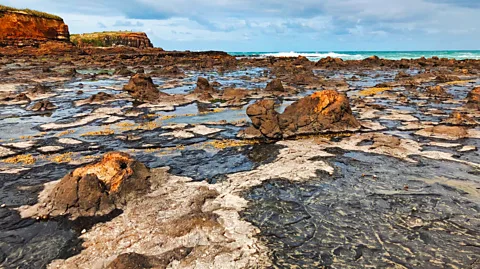
Within this curve of coast lies the clue to the birthplace of New Zealand. This magical landscape is home to the ancient geological phenomenon of Curio Bay, the site of one of the world's finest, most accessible and rarest petrified forests.
Around 180 million years ago during the Jurassic Period, Curio Bay area was part of the eastern margin of the supercontinent Gondwana, connected to Australia and Antarctica while most of future New Zealand lay beneath the waves. Back then, the region was a broad forested coastal floodplain flanked by active volcanoes that continually destroyed the forests with massive sheets of volcanic debris. Covered with silt and mud, starved of oxygen and impregnated with silica from volcanic ash-filled floodwaters, the felled tree trunks eventually solidified and turned to rock through the process of petrification.
 Marian McGuinness
"Liquid full of dissolved silica would have permeated the buried wood, then solidified within the wood cells," explained New Zealand palaeontologist, geologist and palaeobotanist, Dr Mike Pole. "Sometime later, the wood itself would have decayed away, and silica would have solidified in those spaces. The end result is a replacement of the wood, often right down to cell-level detail."
Over the past 10,000 years, the sea has become an archaeologist, scraping away the layers of clay and sandstone to expose this buried forest bit by bit. What makes Curio Bay unique is the forest's horizontal position due to its felling by volcanic ash-filled floodwaters, whereas others – such as Arizona's Petrified Forest and Svalbard's tropical fossil forest – are vertical. It is also one of the few in the world that is accessible. According to the New Zealand Geological Survey, "Known fossil forests of the Jurassic period are very few throughout the world and this is the most varied and remarkable of them all."
You may also be interested in:
• The island made of edible soil
• The Earth's oldest living lifeforms
• A new look at the eighth world wonder
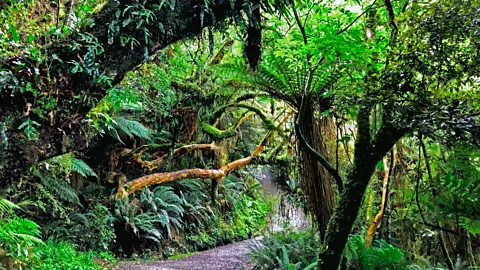
In addition, while most petrified forests are far removed from the modern forests that grow near them, Curio Bay's petrified forest, which is a representation of an ancient Gondwana forest of cycads, gingkos, conifers and ferns, still has its descendants in the present-day forests found here. About 80% of New Zealand's trees, ferns and flowering plants are native having evolved in isolation for millions of years. As well as native beech forests, there are forests of unique Southern Hemisphere conifers, called podocarp, whose species include rimu, totara, matai, kahikatea and miro, whose lineage stretches back to Gondwana.
While completing her geology studies at Victoria University in Wellington, New Zealand, Dr Vanessa Thorn concluded that this fossil forest preserved in its original growth position was rare. To study the fossil forest in its original environment, where it was volcanically buried in a geological instant, gives greater insight into its natural ecosystem, as opposed to a fossil forest ex situ, or out of place, when other factors come into play such as being disturbed by urban activities. When New Zealand was connected to the Antarctic margin of Gondwana, Thorn suggests the forest grew at approximately 75-78°S, "well within the polar circle". The ancestors of the present-day kauri and rimu trees could fluctuate quickly between long, pitch-black winters and perpetually sunny summers of continuous light. "This is a huge difference to the present time," said Thorn. "No trees are known to do this now." This conundrum adds to the uniqueness and scientific importance of the Curio Bay site.
As I journeyed through this elemental landscape, I stood on an anvil-shaped headland that jutted into the sea. Today, due to its geographic isolation and nutrient-rich waters, the Catlins coast provides an extraordinary marine wildlife sanctuary for New Zealand fur seals, southern elephant seals and the native Hookers sea lions. Endemic to this area are the world's rarest and smallest Hector's dolphins and the world's rarest penguin species, the yellow-eyed hoiho.
 Marian McGuinness
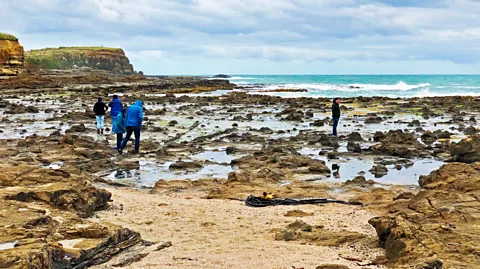
To my north lay the sweep of Porpoise Bay, where Hector's dolphins were catching waves with local surfers. Fanning out to the south was the rock platform of Curio Bay. As an ex-geography teacher and citizen geologist, to be in the presence of a petrified forest was like finding the holy grail. As I looked out to sea, I imagined the water rising and falling, covering the land and retreating, responding to the movement of the tectonic plates beneath as New Zealand was slowly formed. I imagined the volcanoes behind me and the fate of the young forest that was to be violently felled for the last time, and the sea rising to reclaim it.
I was alarmed to see a tsunami warning sign on the headland. It was one more piece of the geological puzzle, as New Zealand sits on the rim of a volcanic, geothermal and seismic zone known as the Ring of Fire that still today results in catastrophic earthquakes and volcanic eruptions, much the same as what would have happened when Curio Bay's fossil forest was formed.
I followed the flax-lined track to the viewing area, joining other fossil enthusiasts on the rock platform overlooking Curio Bay. Buffeted by the onshore breeze, I caught my first glimpse of this geological phenomenon. Spread before me were hundreds of petrified stumps and horizontal trunks. A southern hemisphere Pompeii levelled by the blast and ash of erupting Gondwana volcanoes.
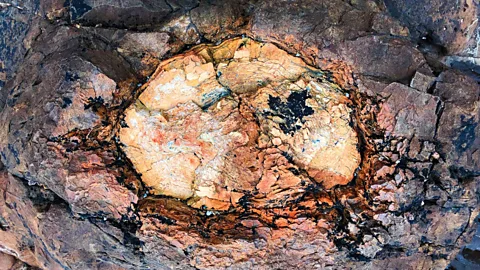
Waves shot up and fanned out over the edge of the platform as I squatted at the stumps that popped up like miniature volcanoes. Within their mini craters, I noticed a distinct change in colour. Unlike the grey sandstone of the rock platform, these craters were mud-orange with circles etched in the stone. I was looking into the past at Jurassic tree rings.
I counted and traced the tree rings and ran my fingers along the trammel lines of prostrate stone trunks, sensing the texture of bark. Some trunks ran like train tracks towards the sea, others veered off, criss-crossing at angles. This ancient forest now lay splayed between marine-jewelled rockpools filled with pockets of sand and barley-coloured Neptune's Necklace (Hormosira banksii), the native seaweed named after the naturalist Sir Joseph Banks who accompanied Captain Cook on his 1763 expedition to the Pacific aboard the HMS Endeavour.
 Marian McGuinness
At the recently opened information centre, Tumu Toka Curioscape, exhibits gave perspective and context to the formation of Curio Bay through interactive touch screens, wall-sized dioramas and an immersive film that reimagined the separation of the continents of Gondwana and the Jurassic era that was to follow. Images of early sea life that were forerunners to today's whales and dolphins swam across one of the screens, while on another, the giant, flightless and now extinct bird, the moa, and the tuatara (the only living survivor of the age of dinosaurs) flitted through the forest of Curio Bay as the volcanic eruption began. There were tactile displays of fossilised wood, some polished so you could see the tree rings, as well as fossilised silver ferns and tree roots ploughed up by local farmers.
I also learned the legends of the Māori tribes who seasonally came to Curio Bay as part of their traditional food gathering. Their middens (camp remains) are still found in the Catlins.
Curio Bay's petrified forest was first protected in 1928 as fossil pilfering and memento hunting was taking place. In the early 1980s, with the involvement of Pole, the area was declared a Scientific Reserve, future proofing it for further research purposes.
"There simply aren't (or very few) other fossil forests around where you have all the stumps, from big, right down to small and tree ferns, plus the logs," said Pole of Curio Bay's importance on a world scale. "In that sense, it's pretty well unique. Plus, the fact that two stone-throws away, there is a remnant of living forest, with (very broadly speaking) relatives of the fossils."
As dusk approached, another of the world's wonders trilled their arrival. Returning from their sea feeding, portly yellow-eyed hoiho flapped, preened salt from their feathers and navigated the fossil forest obstacle course on their way home to their bushy burrows. There were signs to keep clear as well as a plaque celebrating them in poetry: "Straight from the Roaring Forties – South winds lash this bay – Where through its surf the Hoiho go – To and fro each day."
I had come to the Catlins and Curio Bay to behold the sea and sand, the caves and cascades and a forest of stone at the edge of the world. And in being here, I had placed my palms on the birthplace of a country.
Geological Marvels is a BBC Travel series that uncovers the fascinating stories behind natural phenomena and reveals their broader importance to our planet.
--
Join more than three million BBC Travel fans by liking us on Facebook, or follow us on Twitter and Instagram.
If you liked this story, sign up for the weekly bbc.com features newsletter called "The Essential List". A handpicked selection of stories from BBC Future, Culture, Worklife and Travel, delivered to your inbox every Friday.
{"image":{"pid":""}}
