A communal meal on a massive scale

 Marco Secchi/Getty Images
Each July, Venice unites to remember its liberation from the bubonic plague that decimated more than a third of its population between 1575 and 1577.
 robertharding/Alamy
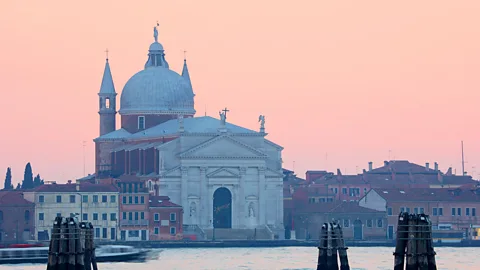
The Festa del Redentore is one of Venice’s most important traditional events, and the small island of Giudecca, located south of Venice’s historic centre, is at the very heart of it.
The bubonic plague swept through the Venetian Republic in 1575, and within two years had killed 50,000 people. In mid-1576, the Doge Alvise Mocenigo I asked for divine help, making a vow to build a new church if the plague ended. The project was entrusted to Andrea Palladio who was the Proto della Serenissima, or the chief architect of the Venetian Republic.
Palladio started planning the church’s construction on land owned by the Clarisses nuns of the Holy Cross on Giudecca island, and in May 1577, the foundation stone of the Chiesa del Santissimo Redentore (Church of the Redeemer) was laid. When Venice was finally declared free of the plague in July 1577, the city celebrated with a procession from San Marco that reached the church via a bridge of boats, giving rise to a tradition that continues to this day.
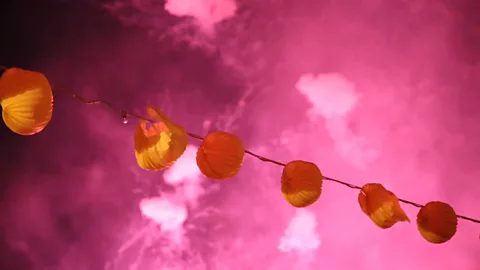
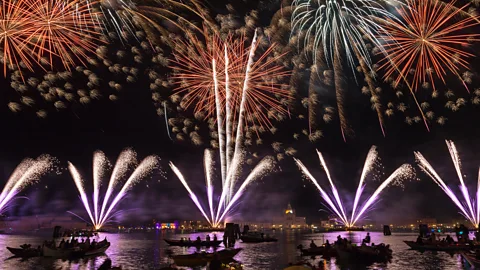
In commemoration of the end of the plague, Venice celebrates the Festa del Redentore (the Holiday of the Redeemer) on the third Sunday in July each year, when the entire island of Giudecca, from its boats to its balconies, is typically festooned with garlands and large balloons of coloured paper, all illuminated at midnight by fireworks.
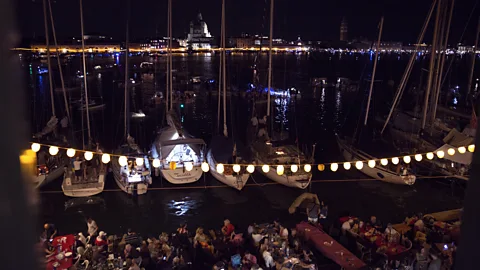
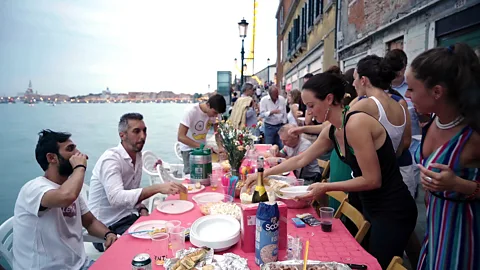
One of the festival’s highlights is on the previous evening, when families in Venice – especially those on the shores facing the Bacino di San Marco – eat on boats or on wooden tables facing the canal in front of their houses, creating an uninterrupted communal meal on a massive scale.
It is an entire carnival concentrated into one summer day,” said Claudia Corò, a local artist.
 Marco Secchi/Getty Images
Giudecca has nearly 5,000 inhabitants – many of them elderly – who are deeply rooted in their island identity. Here, there is still a strong sense of authenticity; protected by water with no permanent bridge to the mainland, the island has been spared much of the city’s increasingly suffocating tourist invasion.
Before the creation of Porto Marghera, the industrial hub on the mainland, in the early 20th Century, Guidecca was Venice’s industrial centre with handicrafts, factories, shipyards and dry-cleaning shops. Now, with the factories closed, the island is a place of small houses and gardens, where many foreigners have second homes. People still stop to ciacola (chat) and play cards, and medieval workshops stand alongside contemporary international ateliers.
Although most of the island’s original families have long moved to the mainland, some genuine Giudecchini remain; Claudia Corò, a local artist, and her family are among them.
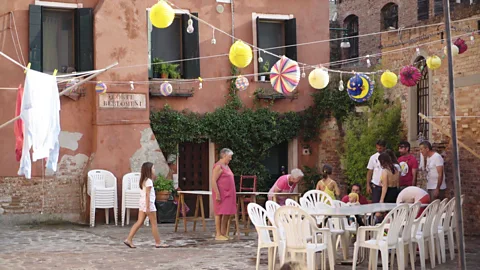
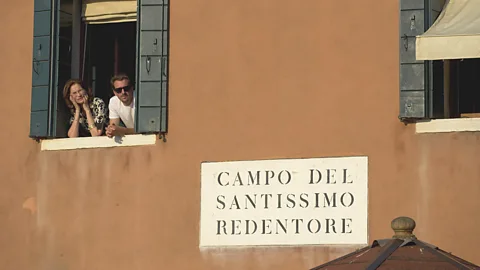
On the Saturday morning before the festival, tables are prepared on the canal sides and in courtyards and squares, and people compete for the best spots, placing signs and sticking tape on embankments to reserve a space. Those fortunate enough to have houses or shops in good locations on the island lean out of their windows to view the scene.
Descending from generations of Guidecca residents, Claudia will spend the Saturday night with friends in her canal-side studio that was her grandmother’s cousin’s bakery until the 1960s. A few metres away, her 80-year-old grandmother celebrates the occasion with the rest of her family in a more customary way, singing Venetian songs and cooking traditional foods like nerveti (chopped calf’s gristle served with onions, olive oil and vinegar), bovoeti (ground snails), pickled sardines and stuffed duck.
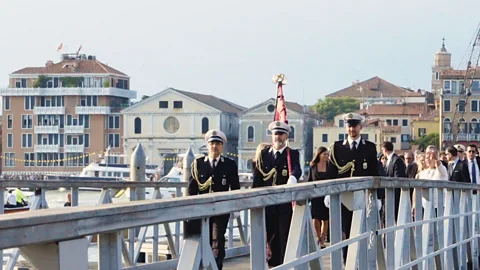
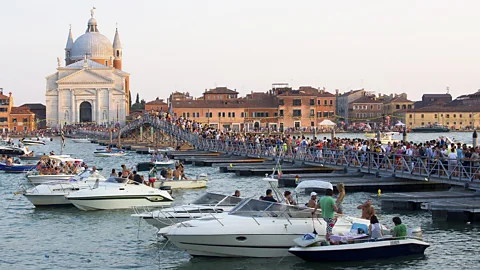
The Festa del Redentore is the only time of the year when Giudecca is actually connected to Venice, thanks to a specially built bridge, more than 300m long, that stretches from the Zattere to the Church of the Redeemer. Constructed from wood and steel and floating on rafts, it commemorates the original bridge of boats that the Doge led the crowds across in the 16th Century.
The festivities start with the opening of the bridge by the Patriarch of Venice, currently Archbishop Francesco Moraglia, at 19:00 on the Saturday evening. Families will cross the temporary bridge on foot throughout the weekend, passing from one shore to the other to attend mass or participate in the charity raffle organised by monks living near the church.
It’s beautiful to have a bridge connecting us to Venice. But two days are enough as the water protects us,” said Maria Corò, Claudia’s grandmother.
 Travelscapes/Alamy
Once the bridge is inaugurated, the party begins. St Mark's Basin fills with up with specially decorated boats; twinkling lights come on; endless rows of yellow balloons illuminate the fondamente (canal walkways) and music starts blaring. People bring food to the tables and everyone begins to eat together.
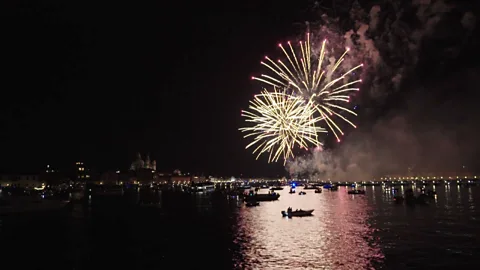
As 23:30 approaches, it’s time to get up and look for a place to watch the spectacular fireworks that light up St Mark’s Basin. The 45-minute display is almost a spiritual experience: once the lights are extinguished and the music stops, the entranced crowds watch the fireworks and their reflections in the canal in near-total silence. Afterwards, the celebrations continue into the night, with singing, dancing and other festivities taking place across Venice until dawn.
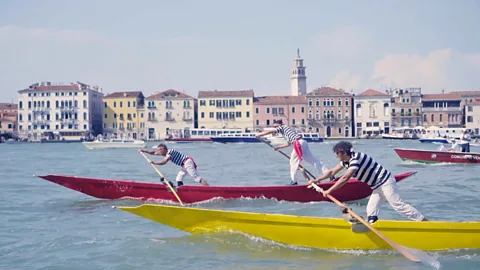
The next day, another beloved tradition takes place: the boat regattas, where multiple teams, all festooned in different colours, race elegant pupparini boats in the lagoon.
“For me, the party is on Sunday, when one watches the regatta from the shore,” said Claudia’s brother Roberto, who has been the adviser to the Giudecca oarsmen for 10 years. “I used to row years ago. A person passionate about the sport follows it. The real party takes place on Sunday, not on Saturday with the fireworks.”
The Festa del Redentore is the city’s last authentic, traditional celebration, according to Claudia’s mother, Liviana. And in a city that is constantly threatened by the overflowing waves of tourism, it’s also a symbol of the resilience of Venetians, who are both proud of their identity and are passionate about preserving the past.
“For me, the Redeemer is one of the most beautiful moments of the whole summer,” Claudia said, joyously.
(Text by Elisabetta Abrami; video by Elisabetta Abrami and Andrea Bancone; sound recording by Andrea Bancone; sound post-production and mix by Carlo Purpura)
Why We Celebrate is a BBC Travel series that revels in how a festival or event is intertwined with a place’s culture.
