The hairy creature scaring away winter

 Martina Žoldoš
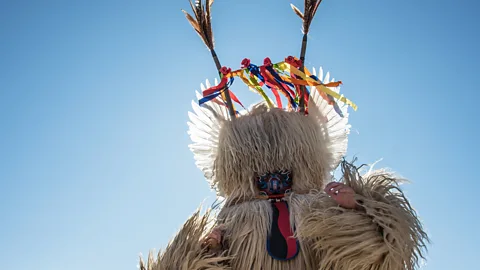
In the days before the annual Shrovetide carnival, a mighty masked figure dances door-to-door through villages in north-east Slovenia to bring abundance and spring to the local people.
 Martina Žoldoš
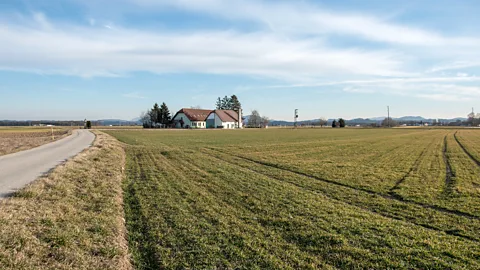
In Slovenia’s fertile north-east, among the endless wheat fields and hilly vineyards, lives a mystical, hairy creature that is beloved by locals. He appears each year during the annual Shrovetide carnival, when locals dress up in masks and costumes and make merry with public dances, street parades and feasts.
According to ancient beliefs, the hairy figure, called kurent, drives out winter and all that is bad by welcoming happiness, abundance, rich harvest and spring to the country. He is the most recognisable of all the carnival characters – jumping high in the air, charging like a wild animal, and noisily ringing large cow bells to announce his arrival and awaken joy among the people – and is an important part of spring folk traditions in the region.
 Martina Žoldoš
The origins of kurent are shrouded in mystery. One hypothesis links him to the Illyrians or the Celts who lived in the region between 1000 and 300 BC. Another theory says that he was brought by the mythical escorts of Cybele, a goddess who was once worshiped in the region. Others still believe that he came with Uskoks, people from south-east Europe who migrated here during Ottoman siege in the late 15th and 16th Centuries.
Whatever kurent’s origins, the annual ritual has become so important to locals in this region that in December 2017, the door-to-door rounds of kurents were inscribed on the Unesco list of Intangible Cultural Heritage.
 Martina Žoldoš
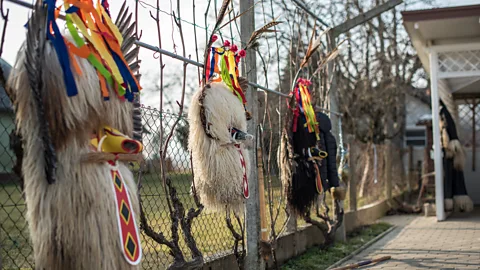
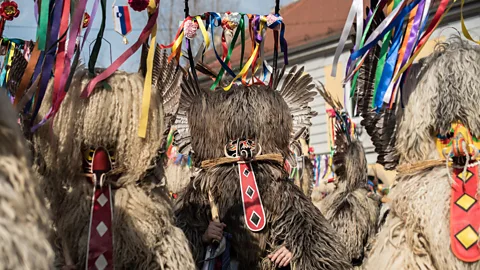
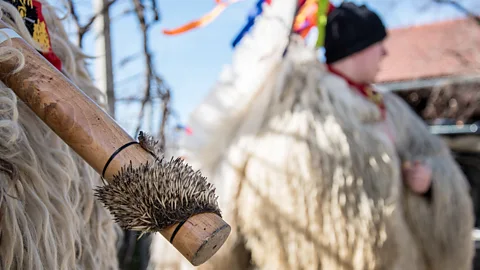
Kurents wear long sheepskin coats; red or green plaited gaiters; black boots; a waist chain with five huge cow bells; and carry a ježevka, a wooden bat covered with real hedgehog skin that serves as a symbolic weapon. Their leather masks have pointed noses, long tongues, white beans as teeth and sorghum moustaches.
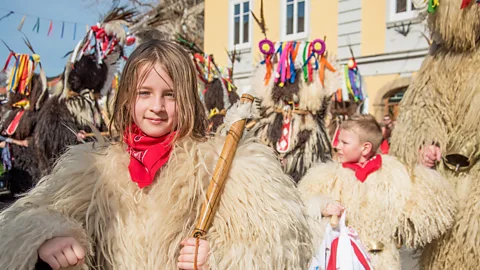
You can tell which region a kurent comes from by his headpiece. Feathered kurents, who come from the Ptujsko polje, Dravsko polje and Slovenske gorice regions, use turkey or goose feathers, and wrap their straw horns in leather and colourful paper straps and flowers. Horned kurents, meanwhile, who originate in the Haloze region, parade genuine cow horns and big, round ears made of leather or fur.
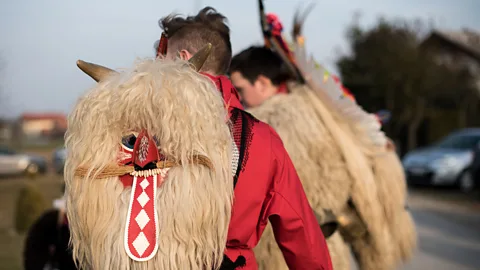 Martina Žoldoš
When you put on the garment, the adrenaline rushes in and there's no limit, the limit is the sky,” said Drago Lesjak, president of a kurent group from Draženci village near Ptuj.
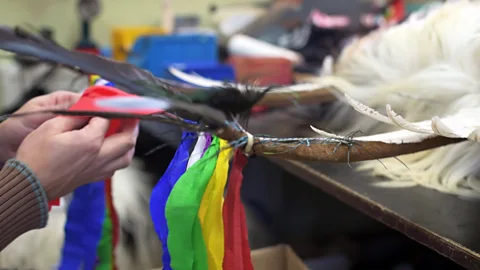 Martina Žoldoš
The original kurent was not made of sheepskin, but of any animal skin scrap that was left from the winter slaughter, such as rabbits and goats – or even from old bags, boots and any other throwaway leather. The men would make the costumes during winter when there was no farm work, gathering any material they could find and sewing the scraps into their own kurentija (kurent costume).
But when urbanisation encroached on the rural area in the 1960s, locals abandoned farming and animal breeding and instead took higher-paying jobs in nearby towns. As they no longer had time or materials to make their kurentija, the intricate craft became practiced by only a few people and passed from one generation to another, mostly within a family.
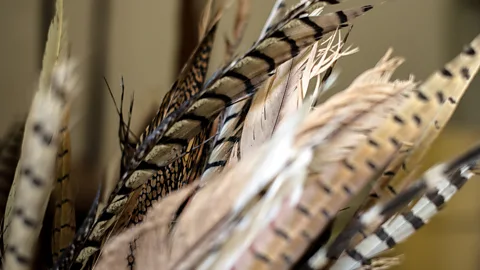 Martina Žoldoš
I kind of fear pre-carnival time, because we constantly work 17 hours a day, including Saturdays and Sundays, so it’s pretty exhausting. Nevertheless, I can’t wait for this special spirit to come. It’s a great pleasure and honour to be a kurentija maker,” said kurentija-maker Marko Klinc.
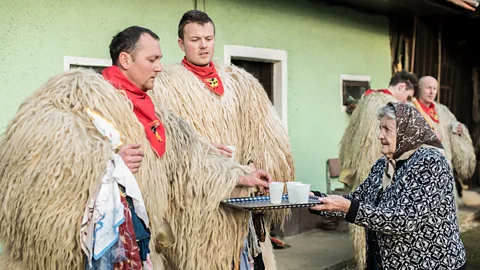 Martina Žoldoš
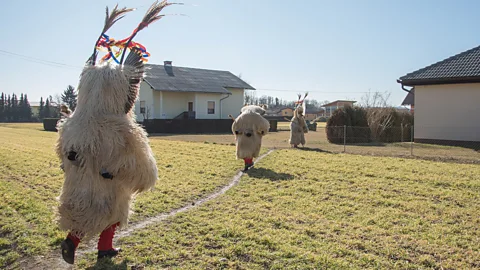
From Candlemas on 2 February to the end of Shrove Tuesday, groups of 15 of more kurents spend each day visiting homes in their village, where they dance in the courtyards to announce a good harvest. Each family happily greets them and offers food and drink, such as wine, juice and home-made biscuits and doughnuts, while young girls may tie a handkerchief to the end of a kurent's ježevka to symbolise their preference for him over the others.
If a host doesn’t welcome the kurents properly, the creatures will roll on the ground, which is said to bring bad luck for entire year. When a kurent takes off his mask to drink and eat, he should never put it on the floor as it will rot the crops and the domestic animals will suffer.
 Martina Žoldoš
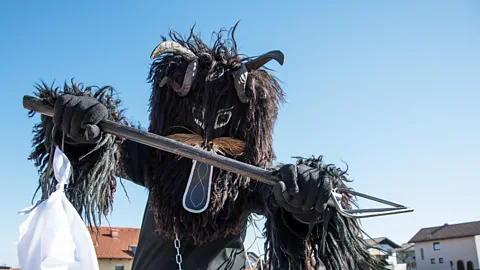
Groups of kurents are always accompanied by one or more devils, another traditional regional mask. Wearing a red or black outfit, a mask with horns, a pointy nose, a long, red tongue and a small trident or pitchfork, the devil’s task is to enable the kurents’ undisturbed functioning and round-going.
That’s why he is always in at the front of the group and the first one to enter the courtyard. Today, the devil functions more as a companion than the enemy; but in the past, he represented the evil that kurents were fighting against.
 Martina Žoldoš
The kurent tradition almost disappeared in the early 20th Century, when the masked figures were prosecuted both by the Church, which disapproved of the carnival revelry, and by the authorities because of the violent encounters between rival groups from different villages. Men who wanted to demonstrate their courage or resolve unsettled disputes used to carry long knives and short rifles under their garments, meaning the clashes frequently ended with death. The sign for a fight was throwing their ježevka into the air.
During World War Two, the use of masks and costumes in public places was prohibited, which meant the end of street parades, Shrovetide feasts and dances. After the war, with the rise of socialism and the diminished influence of the Church in public and political life, kurents and other folk costumes regained a presence in Shrovetide celebrations because they were no longer seen as a disruptive element.
 Martina Žoldoš
In the past, only unmarried men could dress as a kurent. As the tradition gained popularity, more and more people started to put on the masks. Today, both males and females of all ages and marital status wear the elaborate costumes. Lesjak estimates that there are more than 2,000 kurents in Slovenia, and the number is constantly increasing.
“Sometimes people come to us to order the outfit for their one-year-old child, some of the them can’t even walk, so they’re pushed around in their pram dressed as kurents,” said kurentija-maker Marko Klinc.
 Martina Žoldoš
Being a kurent takes money (an outfit costs €1,500 to buy), time and some pain, since the outfit can weigh up to 50kg (and more if it’s made of ram skin, which is much thicker and heavier than the sheepskin). Lesjak said it’s not unusual to end up with bruised shoulders after a day of activities. Many kurents also take several days off work in order to make all the door-to-door rounds.
But for the costume wearers, the effort is worth it. Kurentija isn’t just a costume, it’s part of their identity and something they take very seriously. “It’s not just about dressing [in] the outfit and making a little noise for a week or two,” said Lesjak, recalling how his son, who became a kurent at the age of three, used to practice the movements in their backyard. “You can’t just jump around like a chicken without a head, there’s a proper way how one must bow the head, make a turn and jump into the air.”
 Martina Žoldoš
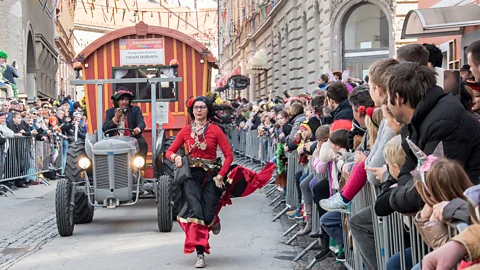
Today, kurents participate in Shrovetide carnivals throughout the country, as well as at social events like birthday celebrations, weddings and sport matches. The biggest gathering of kurents takes place during Ptuj’s Kurentovanje carnival, which is the most famous and popular Shrovetide celebration in Slovenia.
The 11-day-long festivities culminate on Shrove Sunday (the Sunday preceding Lent) when more than 1,000 kurents jump, dance and parade on the streets to finally scare away winter. Shrove Tuesday is the final day of celebrations and street parades, and the last day that kurents can put on their outfit. After that, kurent bells mustn’t make a sound until they’re brought out again the following year.
Why We Celebrateis a BBC Travel series that revels in how a festival or event is intertwined with a place’s culture.
