Tarrant Rushton: Former D-Day airfield to mark 80th anniversary

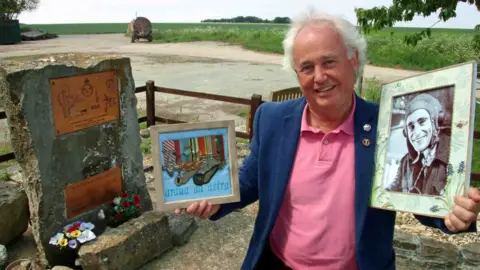 Andrew Wright
Descendants of servicemen with links to a key D-Day airfield in Dorset are inviting the public to an event marking the operation's 80th anniversary.
The first British troops to land in Normandy flew in gliders from Tarrant Rushton late on 5 June 1944.
A newly-formed community group, Friends of Tarrant Rushton Airfield Memorial, has been set up to care for the memorial at the former RAF base.
The group is hosting the commemoration event on Saturday 1 June.
 Andrew Wright Collection
 Andrew Wright Collection
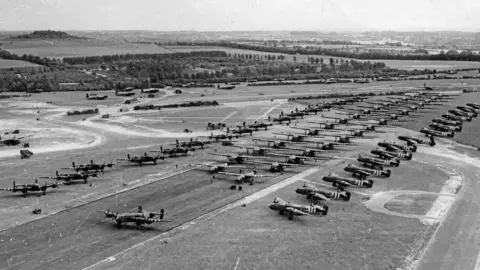
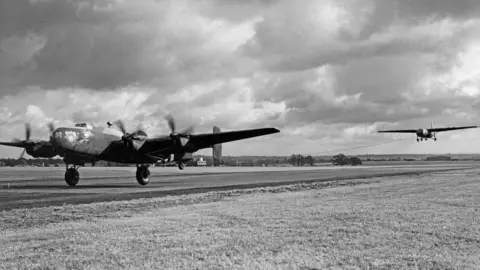
Opening in May 1943, Tarrant Rushton airfield was built to train Halifax bomber and glider pilots for operations in Nazi-occupied Europe.
Anne Gardner, whose father, William Wastell, served in the Glider Pilot Regiment during 1944, is chairwoman of the new community group.
She said "anyone with an affinity with the former airfield" was invited to attend.
"The courage of its Halifax aircrews, glider pilots and airborne troops should be remembered and commemorated," she added.
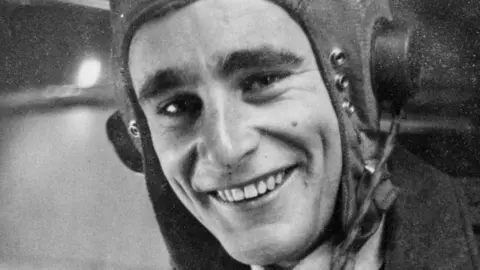 Bob Seymour
Between April 1944 and May 1945, Tarrant Rushton's 298 and 644 Squadrons flew 2,284 missions into occupied territory.
Bob Seymour, secretary of the Friends, said 27 Halifaxes were shot down during this time and more than 160 aircrew died, along with glider pilots, troops and agents dropped behind enemy lines.
His father, Robert Seymour, was a navigator, taking part in two successful D-Day operations from Tarrant Rushton.
The first six gliders to land in Normandy carried troops from the Oxfordshire and Buckinghamshire Light Infantry, who seized the Orne river and Caen canal bridges just 20 minutes into D-Day.
A total of 26 Halifaxes flew in the early hours of 6 June 1944, with another 32 taking off in the early evening, each towing a wooden Horsa glider carrying troops or a Hamilcar glider, which carried tanks.
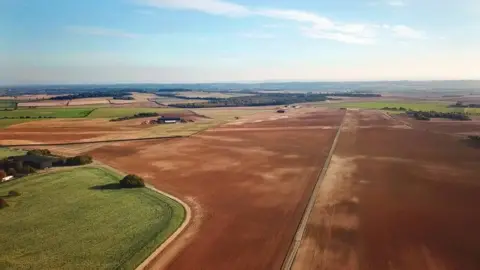
The former airfield has since been returned to farmland. All that remains is a strip of concrete runway, two hangars and a perimeter track - now a public footpath.
The commemoration takes place at 12:30 BST, with gates opening at 10:00.
 Andrew Wright
Follow BBC South on Facebook, X, or Instagram. Send your story ideas to south.newsonline@bbc.co.uk or via WhatsApp on 0808 100 2240.