'Heathrow runway change will make our village unliveable'

 BBC
BBCThe noise is loud and very distinct. It is the sound of jet engines.
Longford could be a village anywhere in the country - that is until you hear the noise. It is in the shadow of Heathrow and is the nearest village to the west London airport.
Now its residents say it is under threat.
Their worries are twofold. Long term, if the third runway goes ahead the village would be destroyed.
But Longford's residents say their village will become uninhabitable even before then if changes are made to the airport's runways.
Something called the Cranford agreement has previously stopped aircraft taking off to the east from the northern runway, over the village of Cranford.
But that deal was scrapped and many in nearby villages fear the added pollution and noise created by take-offs in the future.
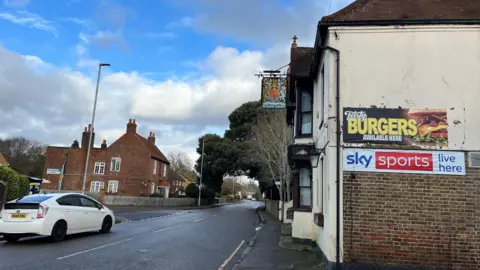
The planes will take off right next to Longford.
Trevor Gordon is one of those who is worried about the introduction of what the airport calls "eastern alternation".
"That will just make this village uninhabitable with the noise and the pollution. How can you live with aircraft 250m away if it happens? It's ridiculous," he says.
"You've not only got the aircraft taking off, history shows us in the summer you could have 13 aircraft in the queue - that's a minimum of 26 engines.
"This place, you won't be able to breathe. And the noise will be horrendous."
He fears for the future of the village.
"The community has been run down for a long time. We used to have three pubs, now we have one.
"They're just not interested, they just want the airport to get bigger and bigger," he says.
 Heathrow Airport
The Cranford agreement was an unwritten undertaking made in 1952 by the UK government to protect residents of the village Cranford, located at the eastern end of Heathrow's northern runway.
It prohibited take‑offs to the east from Heathrow's northern runway to reduce aircraft noise for Cranford residents.
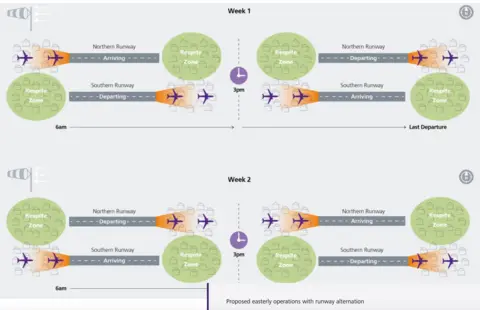
Planes usually take off into the prevailing wind for safety and performance reasons. At Heathrow, 70% of the time that is to the west; the rest of the time they take off to the east.
On westerly take-offs, the airport alternates the runways for half of the day to provide noise relief to communities below the flight path.
However, it currently doesn't alternate runways when conditions mean planes must take off to the east, with the northern runway normally used for landings and the southern for take-offs.
The Cranford agreement was removed in 2009, meaning eastern alternation is now possible, although it hasn't started yet.
However, it is expected to begin soon.
On 16 December 2025, Hillingdon Borough Council granted planning permission for the proposed development of ground infrastructure changes.

Ian Matthews is holding a book called Longford: A village in limbo.
The locals have seen many residents sell up and move out. Along with the three pubs, there used to be a squash club, but that is also no more.
Many of the homes have been bought up by the Arora Hotel Group, which owns a lot of property around Heathrow and are rented out.
"I think it's the uncertainty in people's minds," says Matthews.
"You're not sure what to expect because we are not being given sufficient information about what's being discussed behind closed doors."
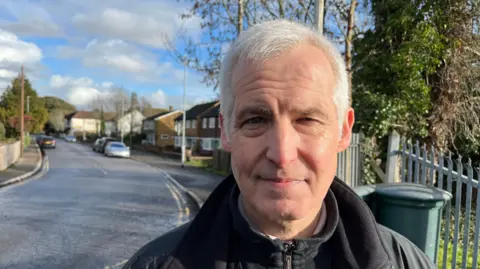
Christian Hughes, chair of Longford Residents Association, says no longer following the Cranford agreement will mean the village of Cranford being "dramatically impacted as it's so close to the end of the runway", but so will Longford "as we are at the side of the runway".
"More so we will be impacted by take offs because [planes] will start here and they will put on full thrust and the fumes and the noise that will be as a result of take-offs will make our village unliveable," he says.
"The ultra fine particles during take off will be up to 14-and-a-half times the WHO recommended hourly limit.
"If it happens we don't think the village will be liveable anymore from pollution, noise and vibration."
He also says changes to the runways will have a wider impact across parts of London.
Planes taking off on the northern runway to the east will change the flightpaths. Some areas, like Windsor, will get fewer aircraft but other areas, like Hounslow, will get more planes overhead.
"There's a wider concern here as well - this isn't just not in my backyard. There's a wider issue about airport expansion," says Hughes.
"The big problem is there isn't an economic case for Heathrow. The big concern is the public do not know how it is going to impact them from a noise perspective and from a pollution perspective."

Heathrow Airport is proposing to construct a noise barrier between 5m (16ft) and 7m (23ft) high to protect local residents.
A spokesperson for airport said: "Easterly alternation is a long-held commitment to provide predictable noise respite to more of our local community and our plans include a noise barrier specifically aimed at helping residents in Longford.
"Once complete, we will be able to alternate our runways throughout the year, ensuring aircraft noise is shared more equally and giving predictable noise respite during easterly operations, just as we do today on westerly operations."
Listen to the best of BBC Radio London on Sounds and follow BBC London on Facebook, X and Instagram. Send your story ideas to hello.bbclondon@bbc.co.uk
