We can portray Wales better on screen, says BBC boss

 Senedd Cymru
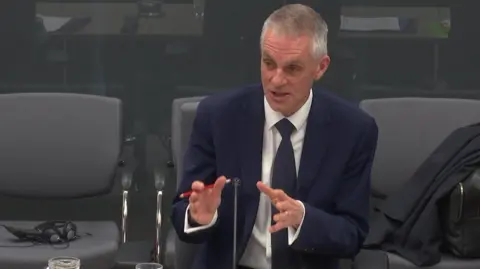
The BBC "can do more" to improve portrayal of Wales in its English-language programming, according to the broadcaster's outgoing director general.
Tim Davie told a Senedd committee that investment in Welsh broadcasting had increased but that he was keen to see funding boosted further in the future.
He was responding to criticism from committee member Alun Davies that there was "a significant failure still" in how informed non-Welsh speakers are about Wales as a result of BBC output.
Interim Director of BBC Wales Garmon Rhys said 2026-2027 would be a "landmark year in terms of the visibility of Wales".
He referenced the fact that the BBC's long-running award-winning medical drama Casualty would soon be set in a fictional Welsh hospital.
BBC interim Director of Nations Rhuanedd Richards told the committee that the broadcaster's spending on programming portraying Wales would be £40m in 2027, compared to less than £2m in 2015.
Whilst acknowledging there had been significant improvements to the BBC's approach to Wales, Labour's Alun Davies told the organisation's executives: "As somebody who speaks Welsh, I watch S4C and I watch BBC Wales...and as a Welsh speaker, I find myself far more informed about events in Wales than I do as an English speaker."
Richards responded that it had been a "priority" for her to look at "how we can leverage more money into content that's about Wales, made in Wales, to the people of Wales".
She added that budgets would increase further in the coming years "to guarantee another level of portrayal spend on programmes about Wales".
Rhys told the committee that BBC Wales was investing in programming on Welsh arts and culture, highlighting documentaries about Welsh artist Gwen John and actor Richard Burton as two examples.
He added: "I do think that when we look ahead to 26-27 it is going to be a landmark year, in terms of the visibility of Wales."
"We've got [crime drama] Death Valley coming back. We've got a drama series called The Rapture. We've got Better Later, co-written and co-starring Ruth Jones and Steve Spears.
"We do have further announcements that will be announced over the coming months and on top of that there is the change of Casualty to be a Welsh portrayal drama for around 20 weeks a year."
"So I genuinely think it is going to be transformative in the way that people in Wales see themselves," Rhys said.
Labour MS Lee Waters asked the BBC bosses how the organisation could justify spending twice as much in Scotland as it does in Wales.
Davie responded that there were "differences in the broadcasting shape, there's difference in the population numbers, there's all kinds of difference".
However, he added that he did want to boost spending in Wales.
"I do take the point, which is we can do more, and we're quite excited about doing more," he said.
Davie announced his resignation as director general in November in the wake of criticism of a Panorama programme which misled viewers by editing a speech by Donald Trump.
He will remain in post whilst a successor is found.
Concluding the session with the BBC, Senedd culture committee chair Delyth Jewell thanked Davie and added that the challenge for the next director general "will be to have Wales as high on the agenda and to build on what you've done".
The committee then took evidence from senior figures at S4C.
Its chair, Delyth Evans, said there had been "huge improvements" since the Welsh language channel faced the worst crisis in its history over claims of a toxic and bullying culture.
Former chief executive Sian Doyle was sacked in November 2023, followed by Delyth Evans' predecessor Rhodri Williams telling UK ministers he did not want a second term in charge.
Doyle filed a personal injury claim against her former employer and Williams at the High Court before reaching an out-of-court settlement with no admission of liability by any party.
Evans, S4C chair since last May, told Thursday's committee hearing it was now in a much better place.
"From a chair's point of view, I feel confident that we're definitely going in the right direction, and there's been huge improvements," she said.
"People tell me that they feel that it's a different organisation now, and it's a place where people feel happy to work and proud to work in.
"But, as a board, we're very alert to the need to be on top of that all the time."
S4C chief executive Geraint Evans, in post since late 2024, added: "We have embedded a new culture code.
"We do have new values, and this has been rolled out with all staff participating in the forming of those values."
But he stressed this was "not a one off event, you can't just look at the culture once".
"It's ongoing, so we do have an external consultant coming in to train all staff and to embed the new culture across the organisation," he said.
It meant "that you can be at your best, you can be challenged as well, but respectfully", he added.
