'Beautiful' rare octopus spotted on popular Welsh beach

 Gareth Davies
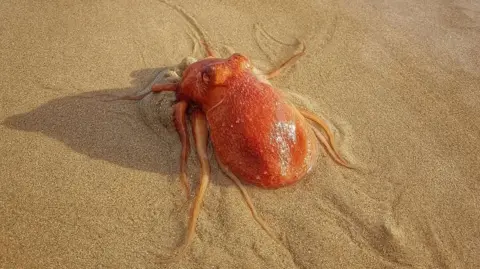
A photographer who was enjoying a walk on a popular Welsh beach says he became "completely absorbed" after spotting an octopus.
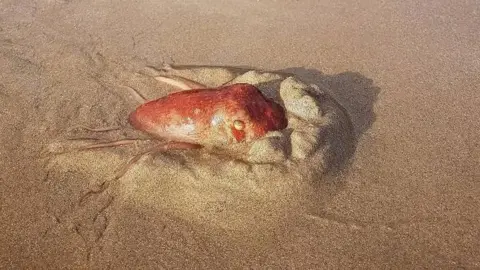
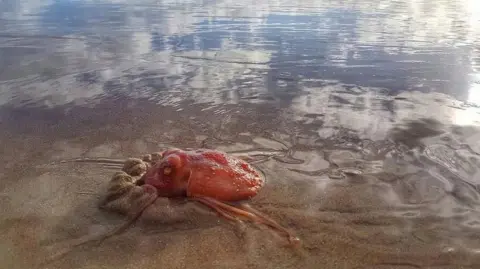
Gareth Davies witnessed the "beautiful" orange cephalopod as it buried itself in the sand in Tenby, Pembrokeshire, and "vanished" in an "effortless display of camouflage".
He said the sighting was unexpected, but that the beauty of a seaside walk is that you never know "what might turn up".
It comes after record numbers were spotted in the UK last year, leading to a wildlife charity declaring 2025 as "the Year of the Blooming Octopus".
This is not the first time an octopus has washed up Welsh shores, after two were seen and rescued, while crawling on a Ceredigion beach in 2022.
On another occasion, an octopus was spotted changing colour in footage captured at Menai Bridge beach on Anglesey.
Gareth, a professional photographer from Pembroke, said the low tide at North Beach in Tenby led to a "sense of anticipation" that was soon rewarded.
"I unexpectedly came across a beautiful common octopus," he said.
"I watched, completely absorbed, as it began to bury itself in the sand, its skin shifting colour and texture in an effortless display of camouflage."
The octopus "soon vanished from sight, as quietly as it had appeared", he added.
 Gareth Davies
There has been a dramatic increase in the number of octopuses seen in UK waters with warmer winters, which are linked to climate change, thought to be responsible for the population spike.
The Wildlife Trusts said the highest number of octopuses had been seen off the south coast of Devon and Cornwall last year since 1950.
Gareth said he saw what he thinks is a common octopus, which despite its name is not very common in UK waters.
He described them as a "highly intelligent" and "active predator" equipped with "specialised glands that produce venom to incapacitate its prey".
The octopus increase does however pose a problem for shellfish species around the UK shores.
The eight-armed creatures eat shellfish such as lobster, crabs and scallops so the Wildlife Trusts has warned that if population numbers remain high, both fishing and eating habits may have to change.
 Gareth Davies