The 'reclusive spinster' artist who shunned conformity and embraced freedom

 Tate
TateGwen John lived her life refusing to bow to what was expected of a woman born in the Victorian era.
Regarded in her time as "a reclusive spinster that never left her house", she was determined to be free to pursue a life of artistic expression.
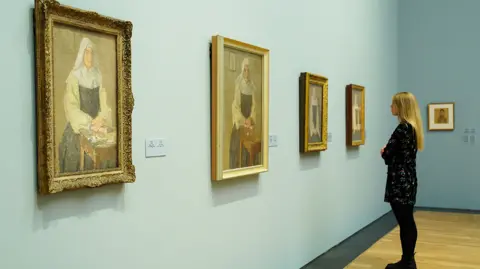
Now a major retrospective of one of Britain's greatest 20th Century artists is opening in Cardiff on the 150th anniversary of her birth, bringing together works from across the UK and the USA for the first time.
A BBC documentary, Keeping the World Away: Finding Gwen John, has also been made to coincide with the exhibition.
National Museum Cardiff acquired a huge amount of John's works in 1976 from her nephew Edwin but until now this collection has never been researched heavily or exhibited, Lucy Wood, the curator of Gwen John: Strange Beauties, said.
John was born in 1876 in Haverfordwest, Pembrokeshire, one of four siblings including her younger brother and fellow artist Augustus.
In their lifetimes he was considered one of the most important artists in Britain and his work at the time hugely overshadowed John's.
But, as Wood notes: "The attitudes towards her have really shifted. So there's the famous quote where Augustus John wrote '50 years from now I will be known as Gwen John's brother'.
"And I think this has probably come about."
 Alistair Heap/PA Media Assignments
French-American author Lauren Elkin, who writes on art and culture, said a mythology pervaded that she was "this reclusive spinster that never left her house and lived at home with her cat making her paintings".
This image may have been reinforced by a book Augustus wrote about her after her death that painted her as "this crazy spinster lady who lived in Paris".
"But the biographers who have written about John... have established that she was incredibly social, incredibly interested in people and the world, was not just sitting at home doing her painting, although obviously her work as a painter was important to her."
Alicia Foster, curator, art historian and novelist, said of John: "Right from being very young she had this idea she would be a great artist and that nothing would stop her."
John's mother Augusta, an accomplished watercolour painter herself, died when John was eight, and the family moved to Tenby.
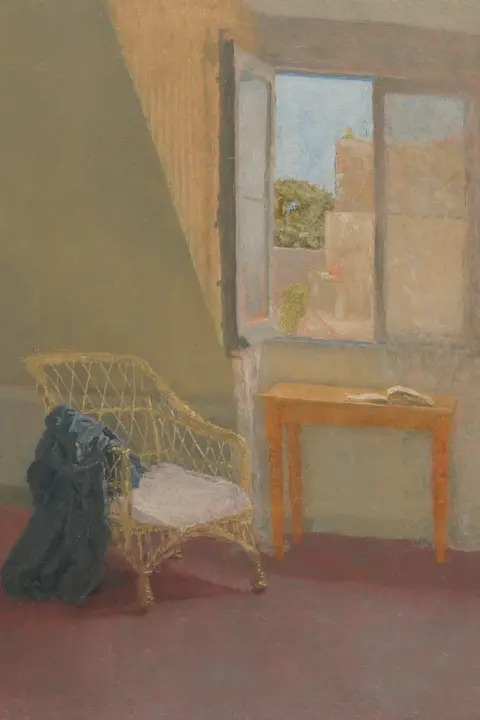
Her mother's paintings hung on the walls of the family home, according to Hannah Saunders, curator of Tenby Museum, and John had a studio in the attic, where she would bring local children to pose for portraits.
"She must have seen her mother's talent as she walked through the house and she knew that she had that potential in her and wanted to go and show the world," said Saunders.
The death of their mother had an enduring influence on all the children's lives
 Tenby Museum and Art Gallery
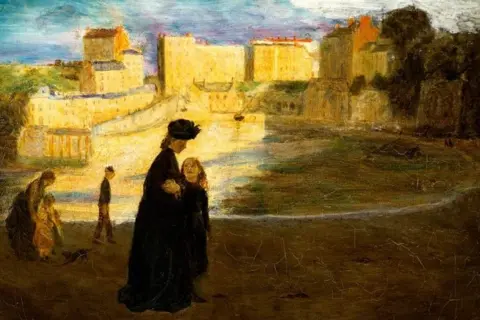
A picture of her hometown hangs in the museum, her only known work of Tenby, believed to have been painted while she was a student in London.
Judith Mackrell, writer and John's biographer, said: "She's painted the beach at twilight so there's already a ghosting of melancholy about it, and there are these two family groups and it's significant that there are no fathers in either group, as if reflecting the utter emotional absence of her own father.
"The two young mothers in the groups, there's something very idealised about them, the very sweet attentiveness that they are paying to their children, as if Gwen was drawing on her own last happy memories of her mother."
Longtime John fan, Nicky Wire of the Manic Street Preachers, said this was the first painting of hers he ever saw.
"It's something of an outlier because it's very much the exterior world and her art didn't really end up like this."
The bassist wrote a song inspired by the complex relationship between John and her younger brother Augustus, The Secret He Had Missed.
Each had a very different outlook on art and its role in life.
Wire said while Augustus "wants to make the world his", his sister wanted to "retreat into something".
Mackrell thinks their mother's death and their subsequent misery motivated all the siblings to leave.
"That was a really driving factor in Gwen's career, that she had a vision of a world that was completely other than this dark, claustrophobic place of her childhood."
 Museum Wales
When Augustus went to the Slade School of Fine Art in London in 1895, at the time one of the only art schools in the UK to allow female students, John made her father's life "intolerable" until she was also allowed to go the following year.
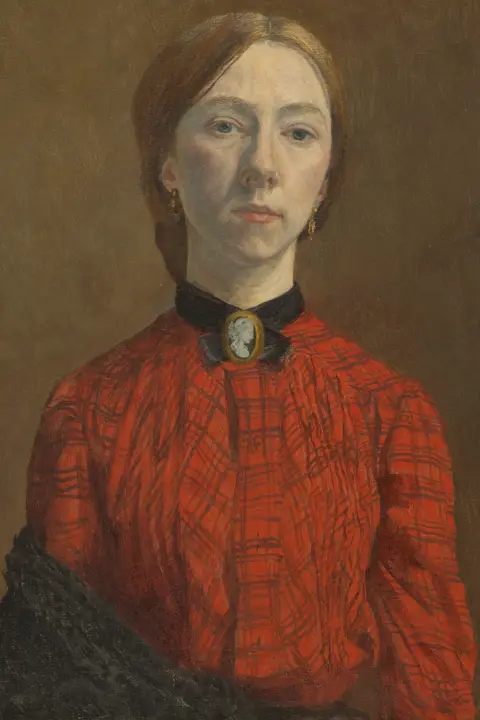
A self-portrait created during that time, which now hangs in the Tate Britain, so impressed her tutor Frederick Brown that he bought it and it hung in his home.
Tate curator Thomas Kennedy said it was recognised "as a masterpiece" even in the early days of her career.
After three years, John went to Paris to study under the American painter James McNeill Whistler for six months before moving back to England.
In 1903, she and her friend Dorelia McNeill, who was also Augustus's mistress, returned to France via Bordeaux with the intention of walking all the way to Rome.
But they only got as far as Toulouse before changing direction and instead went to Paris, which was to remain John's home until very shortly before her death.
Kennedy said the desire to be recognised in her own right may have been a factor.
"Augustus was a great artist in his own right but he completely overshadowed Gwen John and that's perhaps the reason she left Britain and went to France, to be able to flourish on her own."
 Museum Wales
For many years John earned money as an artist's model to support her painting, including working for sculptor August Rodin, with whom she had a passionate decade-long affair, writing him no fewer than 1,000 letters.
This affair with Rodin, who was 35 years her senior, ended before World War One, and she channelled some of her passion to the spiritual, embracing Catholicism and being received into the church.
Although Rodin was an important figure in her sexual life, many of her other major relationships were with women.
Mackrell notes: "Gwen's sexuality is a really fundamental part of her. As far as we can tell her earliest relationships were with women but I think it's significant the one major sexual relationship she had with a man was with Rodin.
"In a way she put him in a separate category from other men."
Outside of her romantic life, her career was developing.
By 1911 she had acquired an American patron, John Quinn, whose financial support until his death in 1924 enabled her to move to the Parisian suburb of Meudon and devote herself entirely to her work, increasingly influenced by her developing faith.
Wood said: "She talks about 'my art and my religion are my whole life'. So I think they were really two sides of the same coin for her.
"She refers to herself as 'God's little artist, a seer of strange beauties, a teller of harmonies, a diligent worker'."
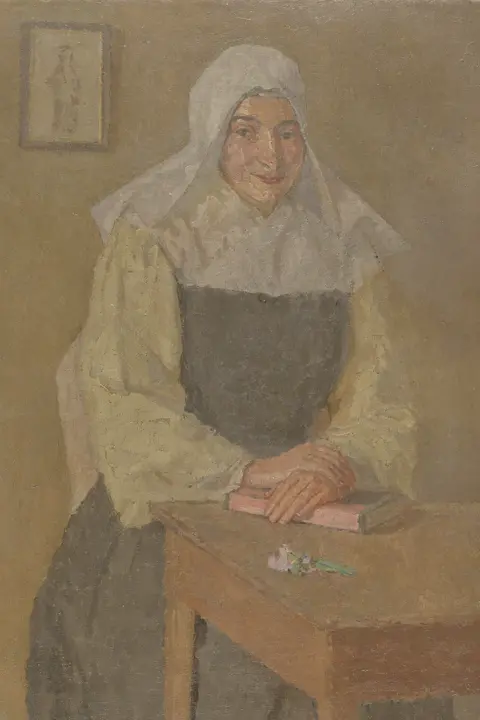
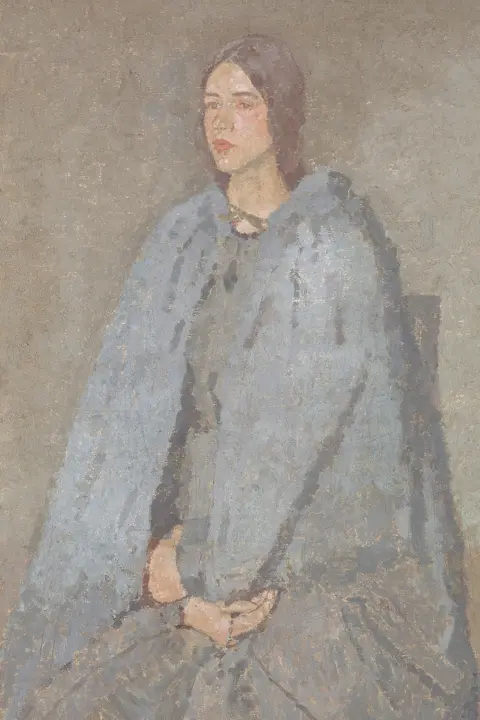
As the exhibition reflects, much of John's work focuses on three-quarter portraits of women, often seated, sometimes reading.
She would create multiple pictures of the same or similar subjects, refining her craft through painstaking repetition on her modest-sized canvases.
John only had one solo exhibition during her lifetime, in 1926. She left Paris just before the outbreak of World War Two but died in Dieppe, apparently on her way back to Britain.
 Yale Centre for British Art
Wood said there was an embrace of John and a reframing of her work in the '70s and '80s, looking at her life and art as "the kind of embodiment of these new forms of emancipation" that women were achieving in the early 20th Century.
"She transitioned from being a feminine artist or an artist of a feminine domain, to a feminist artist."
Elkin added: "She was a person who was very determined to make her life look the way she wanted it to look.
"That meant her art but it also meant living life on her own terms, independent of the trappings of a normal bourgeois existence - the husband, the kids."
Gwen John: Strange Beauties is on at the National Museum Cardiff from 7 February until 28 June 2026.
